


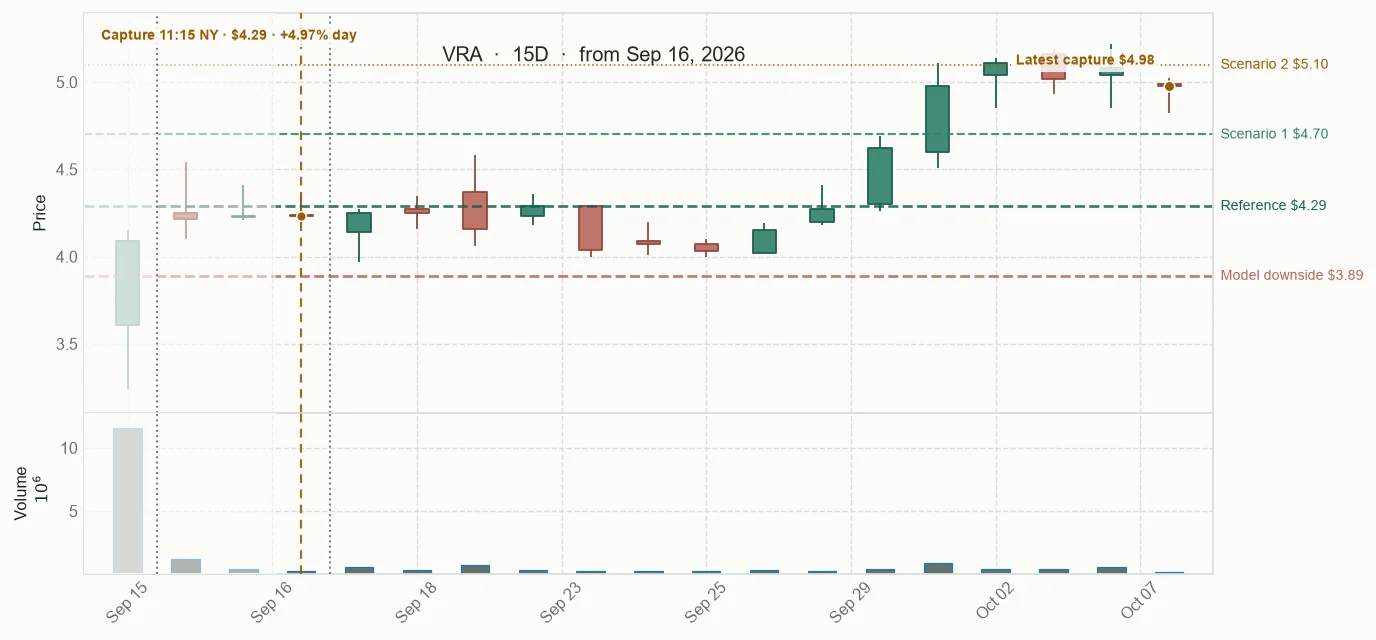
Panel thesis: The provisional Try of the Day remains VRA. Its fiscal Q2 report supplied the strongest supported operating mechanism in the comparison, with revenue of $71.6 million, an exact revenue change of +1.1%, an exact Direct Segment sales change of +8.0%, a return to profitability and reiterated guidance. Participation was exceptional, but the stock later eased from $4.25 to $4.18 and was below the $4.32 VWAP observation. APD and RAYA remain reported candidate stories rather than verified issuer facts because their supplied source and ticker linkage require review.
+4.97% · 4.85x volume · 3.54 > 3.41 > 3.47

Company context
A Fort Wayne, Indiana-based lifestyle brand known for colorful handbags, luggage, travel items, accessories and gifts.
Committee read
This is the committee's read of the evidence, not a probability or score. Resolution support remains VRA's issuer-supported earnings mechanism, exceptional participation and multi-frame breakout. The counter-case is the fading path below VWAP and APD's more liquid but unverified reported contract story. The unresolved share reflects the next-session structure, durability without tariff support, unresolved APD/RAYA attribution and unavailable ML and volatility evidence.
Observed price path
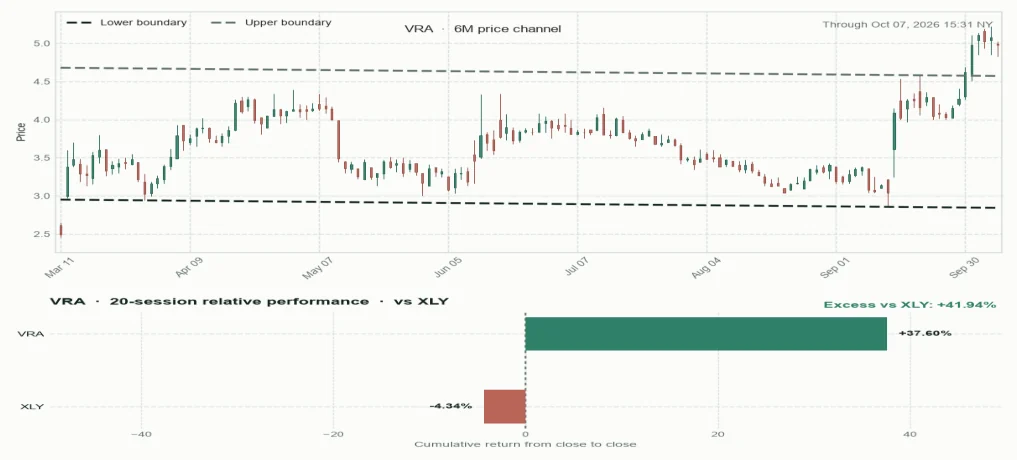
Price channel and relative performance
Forecast fan chart
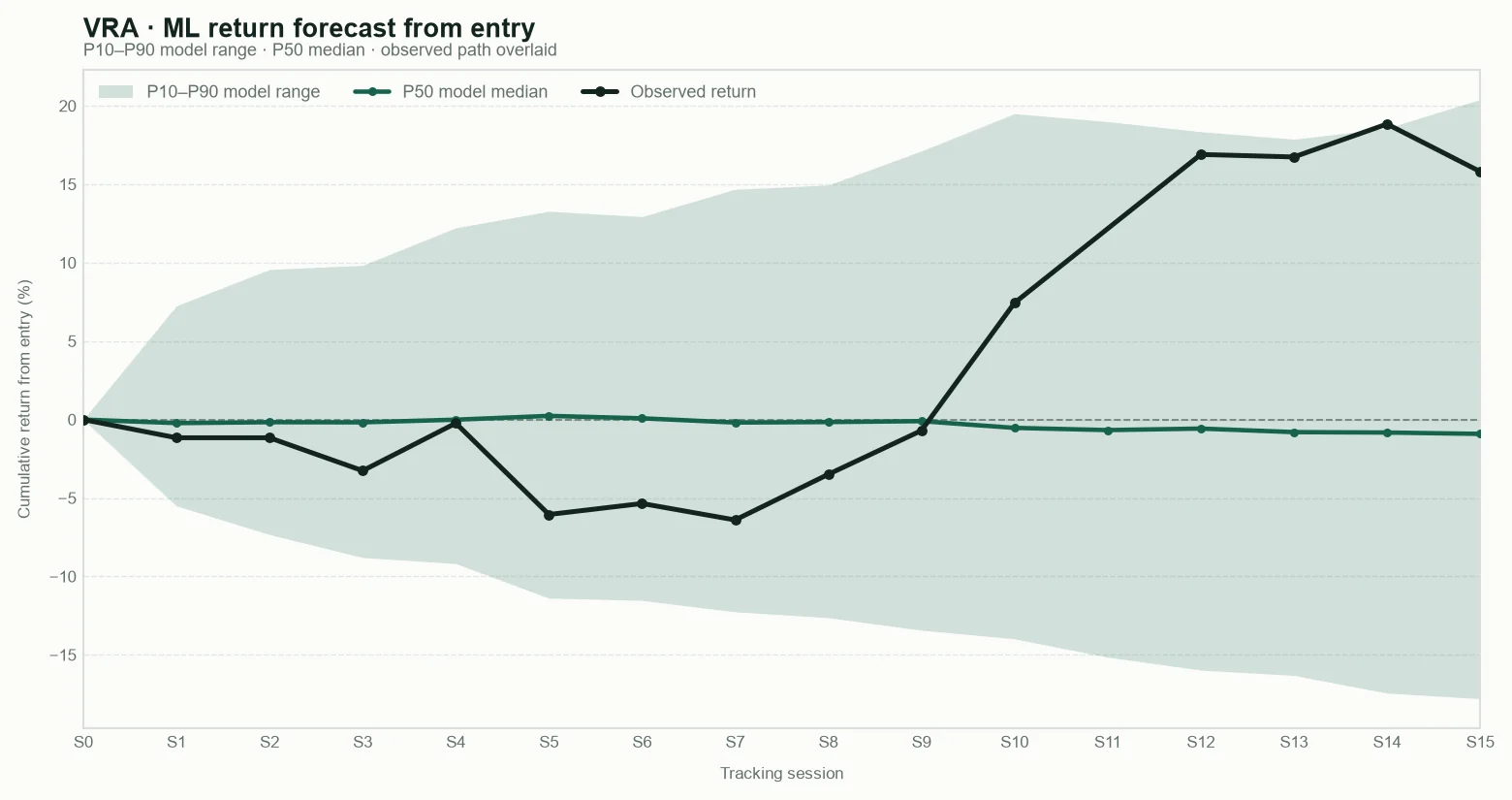
P10 — Cautious outcome: a weak result; most model estimates are above this level.
P50 — Central outcome: the middle estimate; roughly half of the model estimates are above and half below.
P90 — Favourable outcome: a strong result; only the most favourable model estimates are above this level.
These are model reference levels, not guarantees.
Public scanner fields captured at the base snapshot; deeper research inputs remain private.
Snapshot
What was captured at the base
Structure
How price is behaving
Risk and context
What may change the read
Base framework for context and outcome tracking. These are not trading instructions.
Tracking results
Observed daily-bar ranges are retrospective measurements, not targets, stops, or trading instructions.
Tryding Review
Five AI analytical agents reading the same evidence; disagreement stays visible.
“The day began with a firm but incomplete market picture. The S&P 500, Nasdaq 100 and Russell 2000 were positive, and the 10-year yield was lower by 3.7 basis points. VIX was unavailable, so we cannot describe the volatility regime with the same confidence. None of that selects a company.”
The selection therefore stays provisional Try of the Day for VRA. Its post-earnings tape still faded from $4.25 to $4.18 and remained below the $4.32 VWAP, and the candidate-horizon model produced no usable outputs. Those limits are disclosed. The Auditor's material concern has been corrected in the alternative wording without adding a candidate, changing the sealed identity or reopening selection.
“The wider tension was monetary and geopolitical. The sealed context had persistent inflation, a pending Federal Reserve decision, war-related energy costs and builder sentiment at 32. A company case therefore needs a mechanism that can remain visible after the day's macro event passes.”
Agreed. The correction removes an overstatement, not the comparison. APD remains the strongest conditional counter-case if its story and ticker linkage are later verified; RAYA remains a highly participated but representation-risky report. VRA still has the better supported operating mechanism.
Broader Market Context
The day was firm in major equity benchmarks but incomplete as a risk read: inflation and hike-day framing persisted alongside geopolitical fuel costs and weak builder sentiment, while VIX and end-of-day breadth coverage were unavailable. The Coffee records how that setting bears on VRA without changing the sealed provisional decision.
At the sealed snapshot, the S&P 500, Nasdaq 100 and Russell 2000 had positive supplied changes, the 10-year yield was slightly lower, the dollar was steady and commodities were mixed. Intraday breadth was constructive, but its end-of-day layer and VIX were unavailable. Core PCE remaining above 2% for 65 months and the Fed being framed as a hike-day event keep policy sensitivity central. Against that backdrop, VRA's issuer-reported operating improvement remains a durability question: its tape cooled from $4.25 to $4.18 below the $4.32 VWAP, and no candidate-horizon ML output was retained. This is context and coverage discipline, not a second selection.
Sources consulted: biancoresearch · charliebilello · SEC EDGAR · charliebilello · LizAnnSonders · KobeissiLetter
Coffee conversation
“The sealed 16:54 snapshot was firm but incomplete: the S&P 500, Nasdaq 100 and Russell 2000 supplied changes of +0.32%, +0.79% and +0.48%. The 10-year yield stood at 4.959% with a supplied move of −3.70 basis points. A basis point is one hundredth of a percentage point, so that is modest easing, not a regime break. VRA's tape then cooled from $4.25 to $4.18 below its $4.32 VWAP. VWAP is the volume-weighted average traded price; trading below it means the average session buyer is not yet supporting price. No candidate-horizon ML output was retained, so no probability or adverse-tail estimate is treated as certainty.”
“Market breadth means how widely gains are shared across a tracked universe. The sealed intraday proxy was fully covered and constructive, but the end-of-day breadth layer and VIX were unavailable. That makes the risk-on reading a bounded context signal, not protection against a stock-specific reversal.”
“Two macro facts resist a simple risk-on story: Core PCE has remained above 2% for 65 months, and the Fed decision was framed as a hike day. VRA's issuer filing records exact changes of 1.1% in fiscal-quarter revenue and 8.0% in Direct Segment sales. The macro backdrop is therefore a test of operating durability, not a cause or a vote for the publication.”
“The geopolitical and demand mix is uneven. The sealed cut carries an estimate of $107 billion in additional U.S. gasoline and diesel spending from the Iran war, while September builder sentiment was reported at a level of 32. For a consumer brand, that argues for watching resilience in demand and margins rather than assuming every firm index move represents broad consumer strength.”
“Tokenized stock-market capitalization reached a reported $2.9 billion in August, which is a market-structure observation, not a valuation signal for VRA. Gold and WTI carried supplied changes of +1.32% and −3.06%, so the cross-asset picture was mixed. The Coffee records those forces and their coverage limits; it does not vote, rescore or reopen the sealed case.”
Timeline
VRA's 15-session tracking closes at +15.81% from the $4.30 entry, with a best favorable excursion of +21.40% and a worst adverse excursion of -7.67%. After early weakness, price reclaimed the $4.32 event-day average by session 9; the session-15 regular-market capture was $4.98. A separate post-market quote showed $5.15 (+3.41%; timestamped 22:14 Canary). The fiscal Q2 filing supported the original operating case, but no later issuer evidence established that returned profitability and Direct Segment growth would persist without tariff support. The final volume read was 0.41 times average; final momentum, trend and 52-week-position readings were unavailable. Tracking is closed.
VRA's tracked gain rose 9.46 points to +16.90%, the latest capture stayed above VWAP and its 20-session lead over Consumer Cyclical widened to 58.79 points; the price case has strengthened since the last note. Volume remains below average, structure is unconfirmed and the advance is extended, while the near-even model range offers little directional confirmation. The filing-backed Q2 improvement still needs evidence of durability without tariff support.
VRA’s tracked gain rose 5.35 percentage points to 7.44%; by 3:58 p.m., shares at $4.60 stood above the $4.32 earnings-day reference and the session’s volume-weighted average price, while volume had recovered from 7% of average at 10 a.m. to 0.97 times average. The 49.57-point 20-session lead over Consumer Cyclical strengthens the price case, but an extended move without confirmed structure still cannot show that Q2 profitability and Direct Segment growth persist without tariff support.
VRA's tracked return improved 4.42 points to +0.93% as shares rose 5.78% to $4.39, above both the $4.32 event reference and $4.30 session VWAP; its 20-session lead over Consumer Cyclical widened to 35.56 points. The prior price failure has repaired, but volume is only 0.18 times average and structure remains unconfirmed. The active model sits just below even with a near-flat median and wide range, so it neither explains the jump nor settles earnings durability.
VRA's tracked loss widened 5.06 points to 5.29% after a 1.86% decline that finished 0.47% below VWAP at the bottom of its range on only 0.04x average volume. The issuer-reported earnings improvement and 20-session Consumer Cyclical-relative lead remain visible, but the thin, weak tape leaves post-earnings stability and profitability durability unresolved; the near-even model range adds no repair.
VRA's tracked loss improved 4.07 points to -1.16% as the latest capture rose 5.72% on 1.63x average volume, but no structure is confirmed. The issuer-backed earnings case still has strong relative support—VRA is up 35.78% over 20 sessions versus Consumer Cyclical at -6.07%—while RSI at 69.04, a 2.72-ATR extension and the post-close fade keep stabilization conditional.
VRA's first tracked session leaves the return at -4.40% even as volume reached 7.35 times average; price finished near the bottom of its range and 3.98% below VWAP. The issuer-backed earnings improvement remains the strongest part of the thesis, but the post-earnings test is already under pressure: exceptional participation has not yet produced a stable structure.
Panel thesis: VRA offers the most defensible prospective S0-S15 path because its high-participation move is tied to an issuer-supported operating inflection: fiscal Q2 revenue increased 1.1% to $71.6 million, Direct Segment sales increased 8.0%, profitability returned and guidance was reiterated. The thesis remains conditional on the post-earnings structure stabilizing and on the improvement proving broader than tariff-related margin support. Invalidation boundary: The thesis is falsified if VRA persistently fails to reclaim the $4.32 event-day VWAP while its ordered trajectory continues to deteriorate, and subsequent issuer evidence shows that profitability was mainly temporary or that Direct Segment growth did not persist.
Panel comparison
Selected candidate versus the alternatives retained from the panel comparison.
Latest display-only snapshot · Oct 7, 2026 · 18:17 NASDAQ
Since base -5.20% · Today +1.24% · Since prior -20.20% · Relative volume 4.85 · RSI 70.47 · EMA 3.54 > 3.41 > 3.47 · VWAP below · 52-week high 94.56% · As of Sep 16, 2026 · 17:13 NASDAQ
Since base -0.82% · Since prior 0.00% · Relative volume 0.23 · RSI 28.59 · EMA 293.97 > 297.98 > 297.51 · VWAP below · 52-week high 91.90% · As of Sep 16, 2026 · 17:19 NASDAQ
Since base -2.97% · Today +2.35% · Since prior -15.26% · Relative volume 1.54 · RSI 66.21 · EMA 5.18 > 4.93 > 4.44 · VWAP below · 52-week high 58.16% · As of Sep 16, 2026 · 17:10 NASDAQ
Since base -1.00% · Today +5.89% · Since prior 0.00% · Relative volume 1.38 · RSI 65.24 · EMA 2.31 > 1.94 > 1.43 · VWAP above · 52-week high 70.49% · As of Sep 16, 2026 · 17:18 NASDAQ
Since base -8.18% · Today -5.01% · Since prior 0.00% · Relative volume 6.16 · RSI 48.17 · EMA 2.15 > 2.24 > 2.38 · VWAP above · 52-week high 1.24% · As of Sep 16, 2026 · 17:18 NASDAQ
Company dossier
History, curiosities & sources

Selected facts and links behind the public profile.
Company description
Vera Bradley, Inc., together with its subsidiaries, designs and manufactures women's handbags, luggage and travel items, fashion and home accessories, and gifts in the United States. It operates through two segments, Vera Bradley Direct and Vera Bradley Indirect. The company offers bag products, such as backpacks, totes, crossbodies, lunch bags, satchels, clutches, and baby bags; accessories, including ID holders, lanyards, wallets, wristlets, eyewear, various technology accessories, and bag charms. It also provides travel products comprising rolling luggage, cosmetics, travel and packing accessories, and travel bags, which include duffel and weekend bags; home products, such as textiles, throw blankets, beach towels, bedding, mugs, and tumblers; sleepwear, outerwear, slippers, and socks under the Vera Bradley brand; and stationery, licensing, freight, merchandising, and gift card breakage services. The company sells its Vera Bradley branded products through its full-line and outlet stores in the United States; e-commerce sites, such as verabradley.com, outlet.verabradley.com, and international.verabradley.com; direct to consumer marketplaces; and its annual outlet sale in Fort Wayne, Indiana, as well as through specialty retail locations, department stores, national accounts, third-party inventory liquidators, and through licensing agreements. Vera Bradley, Inc. was incorporated in 1982 and is headquartered in Roanoke, Indiana.
History
- Barbara Bradley Baekgaard and Patricia R. Miller founded the company in 1982 after noticing a lack of colorful, distinctive travel accessories while traveling.
- The founders launched with a handbag, sports bag and duffel bag, naming the company after Baekgaard's mother.
- The Vera Bradley Foundation for Breast Cancer began in 1993; the company says it has raised more than $40 million for breast-cancer research.
Curiosities
- The founders developed early sketches and fabric ideas on a basement ping-pong table.
- The annual outlet sale began in a parking-lot tent before moving to the Allen County War Memorial Coliseum Exposition Center.
- The brand's founding idea was to make practical travel goods more expressive through color and distinctive patterns.