



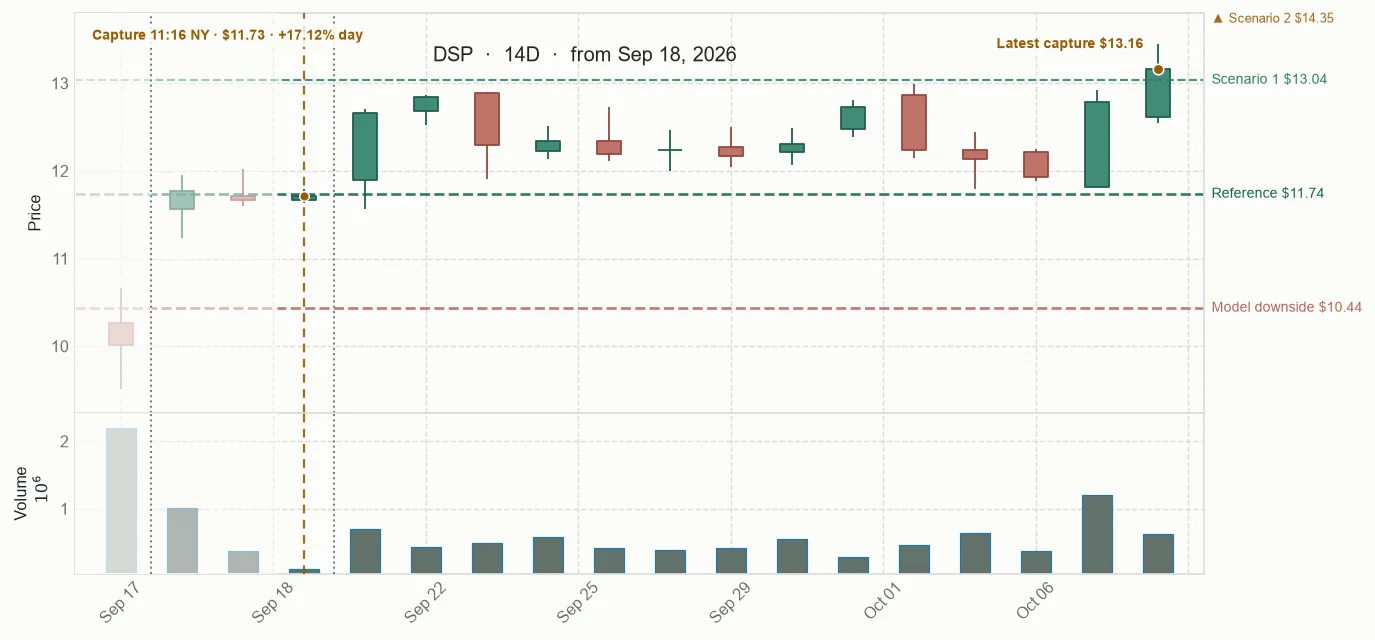
Panel thesis: The Desk provisionally selects DSP because the sealed primary filing documents the withdrawal of a planned 8.5 million-share secondary offering, while the stock recorded a +17.17% change on 4.71x average volume and held above 11.66 VWAP. Prepared SEC context for the quarter ended 2026-03-31 records $88.538 million revenue, a +25.333371082358937% revenue year-over-year change, -$455,000 net income and $2.925 million operating cash flow. The thesis remains conditional on continued VWAP retention and the absence of renewed dilution.
+17.17% · 4.71x volume · 12.12 > 12.44 > 12.36

Company context
Viant provides cloud-based programmatic advertising technology for omnichannel campaigns.
Committee read
This is the committee's read of the evidence, not a probability or score. Support – primary supply-relief mechanism, persistent above-VWAP tape and operating context; Counter-case – small-cap volatility, negative latest-quarter net income and adverse-path exposure; Unresolved – whether supply relief becomes durable operating follow-through.
Observed price path
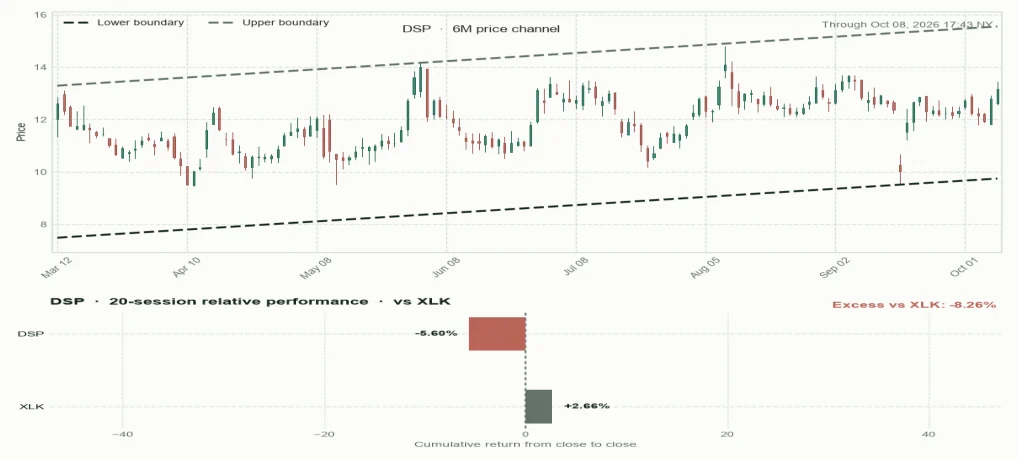
Price channel and relative performance
Forecast fan chart
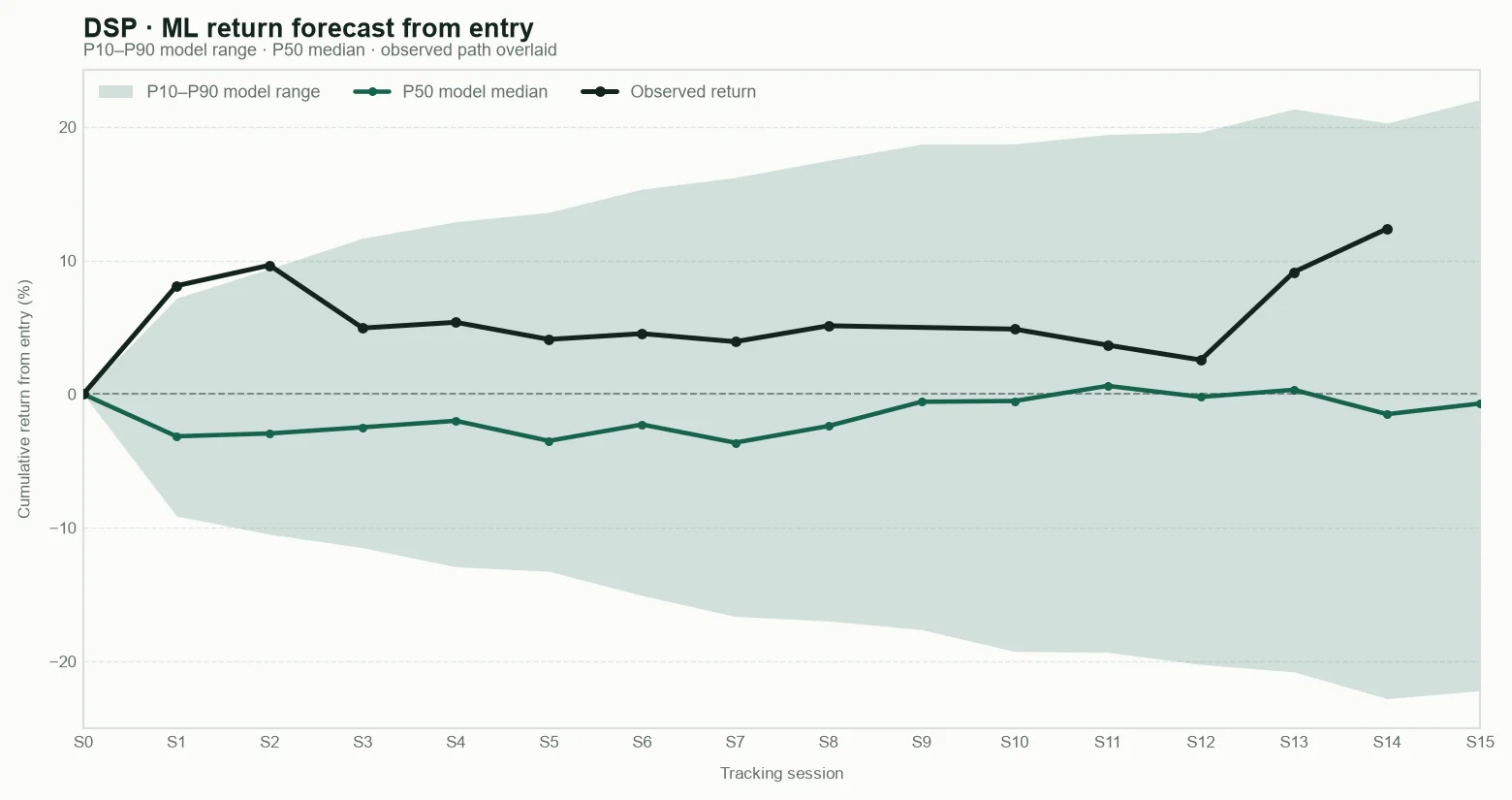
P10 — Cautious outcome: a weak result; most model estimates are above this level.
P50 — Central outcome: the middle estimate; roughly half of the model estimates are above and half below.
P90 — Favourable outcome: a strong result; only the most favourable model estimates are above this level.
These are model reference levels, not guarantees.
Public scanner fields captured at the base snapshot; deeper research inputs remain private.
Snapshot
What was captured at the base
Structure
How price is behaving
Risk and context
What may change the read
Base framework for context and outcome tracking. These are not trading instructions.
Tracking results
Observed daily-bar ranges are retrospective measurements, not targets, stops, or trading instructions.
Tryding Review
Five AI analytical agents reading the same evidence; disagreement stays visible.
“The day is selective rather than broadly supportive. The large-cap indices are nearly flat to slightly lower, the Russell 2000 is under pressure, the ten-year yield is higher near 5%, and the fresh participation read leans weak. That means the market is not handing us a general continuation tailwind.”
The comparative decision is therefore DSP. It is not the safest-looking symbol and it does not have model certainty. It has the most defensible prospective path because the mechanism is specific, the market response remains persistent, and the technical position leaves more room for a test through S15 than the most extended alternatives.
“The public cut points in the same direction. Reuters has equity outflows at a nine-month high on inflation fears, oil is lower as Saudi supply fears ease, and the Federal Reserve says August industrial production was flat with manufacturing down 0.3%. A company-specific mechanism has to earn its place today.”
I accept DSP as the provisional Try of the Day. The next check is straightforward: hold 11.66 VWAP, avoid a renewed offering signal and show that the operating case can persist. If that fails, the thesis fails with it.
Broader Market Context
The day’s broad context was mixed and selective: large benchmarks were nearly steady, small caps were under pressure, the 10-year Treasury yield approached 5%, oil eased, and August industrial production was flat while manufacturing output fell. The public implication is narrower leadership and a higher need for company-specific confirmation. This Coffee adds context only and does not reopen or rescore the sealed DSP decision.
The wider market did not offer a single clean direction. The supplied snapshot showed nearly unchanged large-cap benchmarks alongside weaker small-cap performance, while the validated intraday breadth signal leaned negative. That combination means participation was selective: some names could move on their own evidence, but the broader tape was not providing uniform support. Rates and activity pulled in different directions. The 10-year Treasury yield was near 5.00%, with a supplied move of +5.10 basis points. The Federal Reserve reported unchanged August industrial production and a 0.3% decline in manufacturing output. Oil prices eased as supply-disruption fears receded, but inflation and funding sensitivity remained relevant. For the sealed DSP case, this context makes the existing conditional checks more important than any broad-market narrative: market context can frame the path, but it cannot certify persistence or operating improvement.
Sources consulted: Reuters via Yahoo Finance · Reuters via Yahoo Finance
Coffee conversation
“The day’s broad message is selective participation, not a clean risk-on or risk-off move. In the sealed snapshot, the S&P 500 and Nasdaq 100 were nearly flat while the Russell 2000 was under pressure. That matters because a strong single-name move needs its own mechanism rather than a broad-market excuse.”
“The other pressure point is the 10-year yield near 5.00%. A yield is the market’s required return on a Treasury; when it rises, borrowing and discount rates generally rise too. The supplied snapshot showed +5.10 basis points, so the practical consequence is tighter valuation room, even though it is not proof that every equity must fall.”
“The Federal Reserve release gives the macro backdrop a hard anchor: August industrial production was unchanged, and manufacturing output decreased 0.3%. “Unchanged” describes the comparison with the prior period; it does not mean industry is permanently healthy or weak. The consequence is a flat current pulse with a softer manufacturing component.”
“Energy is pulling in a different direction. The sealed market cut recorded WTI at $96.02 and down 1.24%; Reuters reported that oil was set for a weekly fall as supply-disruption fears eased. Lower oil can relieve headline inflation pressure, but the market is still balancing that against yields near 5%.”
“That split is why the tape feels selective. The VIX was at 15.44 and lower on the day. VIX is an implied-volatility gauge, so its level describes expected movement while its daily change describes movement from the prior reference. It does not certify calm trading in small caps.”
“Exactly. The intraday breadth proxy—how many names are rising versus falling—also leaned negative. That is participation evidence, not a candidate score. When fewer names carry the tape, idiosyncratic moves can look stronger than the market’s underlying sponsorship.”
“I’d add the policy channel. Reuters reported global equity fund outflows at a nine-month high on inflation fears. That does not predict tomorrow’s close, but it helps explain why capital can be more selective and why a company-specific filing has to prove more than headline appeal.”
“Small correction: a source confirming an event is not the same as proving its economic effect. The Federal Reserve release is primary for the output numbers; the inference about selectivity is ours. Keeping those layers separate stops context from becoming causal proof.”
“And the cross-asset signals are mixed, not uniformly hostile: oil eased and the dollar was nearly steady, but rates stayed elevated. Mixed inputs raise the value of explicit falsifiers because the environment will not resolve a company thesis for us.”
“The same applies to DSP. Its sealed trajectory can be read as an idiosyncratic response to its filing, but the broad tape cannot validate persistence. A move above VWAP means price traded above the session’s volume-weighted average; it says where trading occurred, not why the business will improve.”
“That is the useful public reading of this day: broad benchmarks steady, small caps less comfortable, and leadership narrow. The selected case therefore sits inside a market that rewards specific evidence but offers little ambient confirmation.”
“The macro data also put the word “growth” on a leash. Flat industrial production and weaker manufacturing output do not negate an individual company mechanism, but they do make any leap from a supply event to durable operating acceleration too large without fresh company evidence.”
“For readers, the discipline is simple: quote levels as levels and changes as changes. The 5.00% Treasury level, the +5.10 basis-point move and the 15.44 VIX level answer different questions. That precision keeps the narrative from making a stronger claim than the data.”
“For the already sealed DSP case, the practical public checks remain narrow: hold the stated VWAP reference and watch for renewed dilution. Those are observable conditions, not promises about the next fifteen sessions.”
“Good. The day’s context leaves room for a conditional thesis, but not for certainty. The broader conversation should end with the reader knowing what the market is doing, what it is not doing and which next observation would change the story.”
Timeline
For DSP, the tracked gain rose 4.49 points to 13.71%, while shares added 1.96% and held above VWAP near the session high. But volume was just 0.09 times its three-month average, and DSP still trailed Technology by 5.89 points over twenty sessions. The recovery is real; it does not yet show that the withdrawn offering has produced lasting supply relief.
DSP's tracked gain rose 6.06 points to +9.22% as shares jumped 7.11%, held 2.81% above the session average and reached the upper part of the range on 1.31 times average volume. The response is materially stronger, but DSP still trails Technology by 7.33 points over twenty sessions and has no confirmed structure; the withdrawn offering remains a plausible supply-relief mechanism, not proof that the market has absorbed its risk.
DSP's tracked gain fell 4.70 points to 4.95% after a 4.13% decline that put price 1.52% below VWAP near the bottom of the range on 0.21x average volume. The withdrawn-offering filing still supplies a specific mechanism, but Technology-relative weakness, no confirmed structure and a model whose same-direction read falls toward 34% by S15 leave the supply-relief thesis unresolved rather than confirmed.
The tracked gain rose 1.88 points to 8.11% as DSP reached 12.66, held 3.35% above VWAP and traded at 2.14 times average volume, strengthening the tape after the weak-volume prior note. The filing-based supply-relief thesis is still narrower than a durable repricing: DSP trails Technology by 4.61 points over twenty sessions, structure is unconfirmed, and the model leaves a wide S15 range, so continued VWAP retention without renewed dilution remains unresolved.
DSP improved 3.33 points to a 4.78% tracked gain as price reached 12.01, holding 0.42% above VWAP, but volume was only 0.33 times average, participation decelerated and the stock trails Technology by 8.39 points over twenty sessions. The offering-withdrawal mechanism remains live; a model direction read that falls from roughly 46% to 33% and a broad remaining range qualify the early hold, so durable supply relief is still unproven.
DSP's tracked return fell 3.59 points from +5.04% to +1.45%, even as the latest capture remained up 18.56% at 11.88, above 11.72 VWAP on 9.12x average volume and near the top of its range. That keeps the filing-based supply-relief mechanism alive, but the giveback and a 7.82-point 20-session deficit versus Technology narrow the claim to an unresolved test of durable absorption and renewed dilution risk.
DSP begins its public track at +5.04% after the filing-led supply-relief thesis met a strong first observation: the latest capture is up 20.46% at 12.07, above 11.72 VWAP on 6.84x average volume. That supports the mechanism but not durability; the panel keeps the thesis conditional on VWAP retention and no renewed dilution.
Panel thesis: From S0 through S15, DSP offers the most defensible prospective path because a primary-filed withdrawal of the planned secondary offering provides a concrete supply-relief mechanism, while the tape remains persistent, above VWAP and strongly participated. The thesis depends on continued VWAP retention, no renewed dilution signal and operating evidence that remains supportive. Invalidation boundary: A refiled offering, new dilution signal or failure to hold 11.66 VWAP would falsify the selected supply-relief thesis.
Panel comparison
Selected candidate versus the alternatives retained from the panel comparison.
Latest display-only snapshot · Oct 8, 2026 · 17:53 NASDAQ
Since base +12.10% · Today +2.97% · Since prior -1.13% · Relative volume 1.66 · RSI 64.51 · EMA 12.5 > 12.46 > 12.41 · VWAP above +1.05% · 52-week high 88.90% · As of Oct 8, 2026 · 16:01 NASDAQ
Since base +0.37% · Today +0.18% · Since prior 0.00% · Relative volume 1.1 · RSI 86.13 · EMA 35.49 > 33.2 > 30.53 · VWAP below · 52-week high 98.53% · As of Sep 18, 2026 · 17:09 NASDAQ
Since base -1.89% · Today -1.77% · Since prior 0.00% · Relative volume 1.2 · RSI 18.39 · EMA 57.41 > 62.94 > 67.64 · VWAP above · 52-week high 61.64% · As of Sep 18, 2026 · 17:07 NASDAQ
Since base +8.44% · Today -2.40% · Since prior 0.00% · Relative volume 1.25 · RSI 70.3 · EMA 1.74 > 1.64 > 1.53 · VWAP above · 52-week high 29.93% · As of Sep 18, 2026 · 17:19 NASDAQ
Since base +6.13% · Today +4.77% · Since prior 0.00% · Relative volume 0.99 · RSI 41.18 · EMA 16.75 > 16.89 > 16.17 · VWAP above · 52-week high 86.44% · As of Sep 18, 2026 · 17:01 NASDAQ
Since base +20.15% · Today +3.23% · Since prior 0.00% · Relative volume 1.23 · RSI 58.44 · EMA 7.39 > 6.67 > 5.23 · VWAP below · 52-week high 91.49% · As of Sep 18, 2026 · 17:20 NASDAQ
Since base -0.57% · Today +5.19% · Since prior 0.00% · Relative volume 5.61 · RSI 70.31 · EMA 19.78 > 19.22 > 18.43 · VWAP below · 52-week high 98.03% · As of Sep 18, 2026 · 16:41 NASDAQ
Since base +0.20% · Today +6.12% · Since prior 0.00% · Relative volume 1.46 · RSI 76.71 · EMA 8.45 > 8.05 > 7.89 · VWAP above · 52-week high 88.22% · As of Sep 18, 2026 · 17:04 NASDAQ
Since base -0.97% · Today +2.17% · Since prior 0.00% · Relative volume 2.34 · RSI 73.33 · EMA 4.99 > 4.22 > 3.55 · VWAP above · 52-week high 51.33% · As of Sep 18, 2026 · 17:19 NASDAQ
Since base +1.59% · Today +0.01% · Since prior 0.00% · Relative volume 0.24 · RSI 51.47 · EMA 340.98 > 343.4 > 345.02 · VWAP above · 52-week high 87.91% · As of Sep 18, 2026 · 16:47 NASDAQ
Company dossier
History, curiosities & sources

Selected facts and links behind the public profile.
Company description
Viant Technology Inc. operates a cloud-based demand-side platform that helps marketers and agencies plan, buy and measure advertising across connected TV, streaming audio, mobile, desktop, gaming and digital out-of-home channels.
History
- Viant was founded in 1999 by Tim, Chris and Russ Vanderhook.
- The company acquired Myspace in 2011.
- Viant acquired Adelphic, a demand-side platform, in 2017.
- A 2019 transaction returned Viant to independent ownership.
- Viant completed its initial public offering in February 2021 under the ticker DSP.
Curiosities
- Co-founders Tim and Chris Vanderhook also co-founded Xumo, which Comcast acquired in 2020.
- The company reported 57 issued patents, 21 pending patent applications and 300 issued trademarks as of December 31, 2024.
- At the end of 2024, Viant had approximately 376 employees across 10 offices.
- Its platform spans connected TV, linear TV, audio, mobile, desktop, gaming and digital out-of-home advertising.