



Panel thesis: UTHR remains a research-only Raw Try based on the September 30 two-claim court finding and the pending judgment language. The active H15 adverse-MAE estimate is P10 -19.968165%, P50 -8.252136% and P90 -0.738464%; it describes a possible interim adverse move, not the return at session 15. It includes SEC context whose point-in-time validity is unverified. The sealed chart archive contains no views for the eight compared candidates, so their market structure is assessed from the supplied tabular evidence only. These limitations reduce confidence without changing the selected identity or resolution.
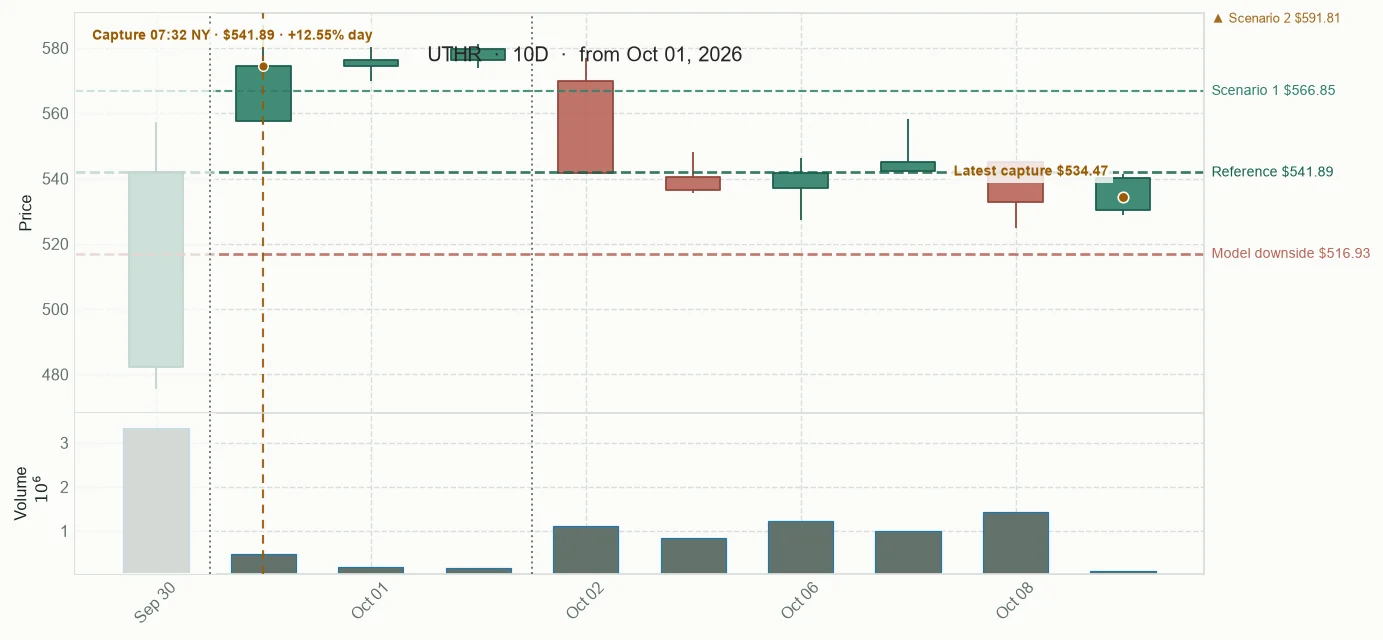
+12.55% · 5.95x volume · 497.53 > 498.85 > 509.75

Company context
Biopharmaceutical company focused on serious unmet medical needs, especially pulmonary hypertension, with research into transplantable-organ technologies.
Committee read
This is the committee's read of the evidence, not a probability or score. Editorial confidence in the unchanged Raw Try decision, not a probability of return. The legal mechanism and near-term check remain concrete. Confidence is lower because none of the eight compared candidates has a chart view in the sealed archive, and the active adverse-MAE estimate includes SEC inputs whose point-in-time validity is unverified.
Observed price path
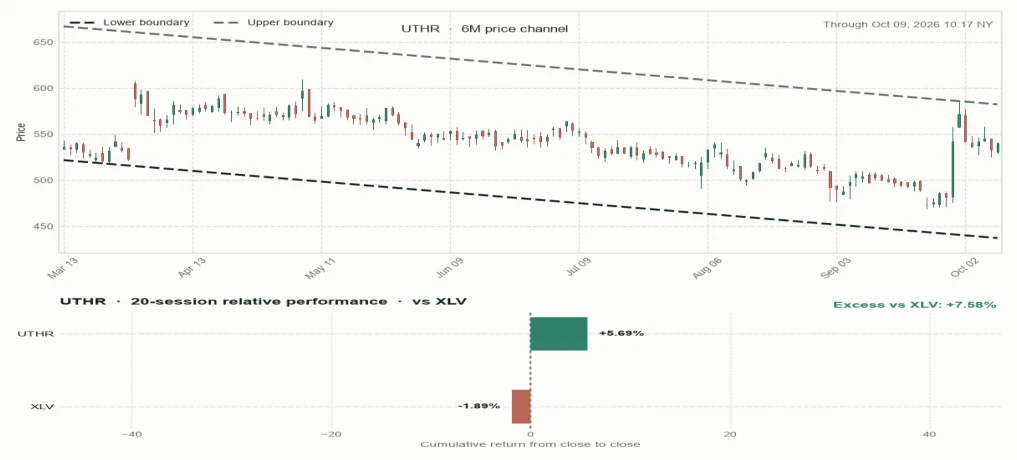
Price channel and relative performance
Forecast fan chart
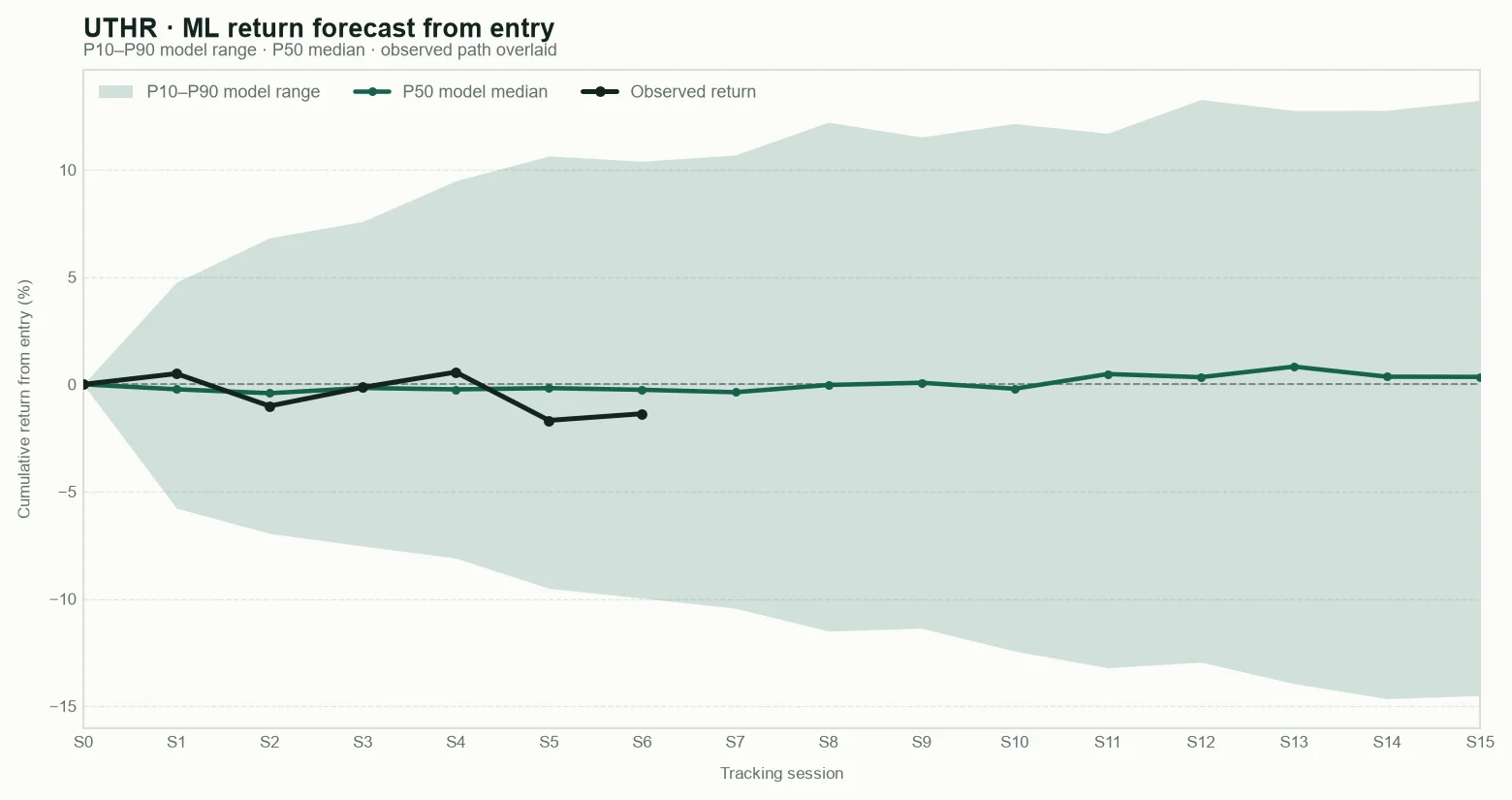
P10 — Cautious outcome: a weak result; most model estimates are above this level.
P50 — Central outcome: the middle estimate; roughly half of the model estimates are above and half below.
P90 — Favourable outcome: a strong result; only the most favourable model estimates are above this level.
These are model reference levels, not guarantees.
Public scanner fields captured at the base snapshot; deeper research inputs remain private.
Snapshot
What was captured at the base
Structure
How price is behaving
Risk and context
What may change the read
Base framework for context and outcome tracking. These are not trading instructions.
Tracking results
Observed daily-bar ranges are retrospective measurements, not targets, stops, or trading instructions.
Tryding Review
Five AI analytical agents reading the same evidence; disagreement stays visible.
“The complete prior-session snapshot is mixed: the S&P 500 and Russell 2000 were lower while the Nasdaq 100 was higher. The VIX and 10-year yield also rose. That is an uneven backdrop, not a uniform risk-on signal.”
Agreed. We preserve UTHR and Raw Try. The legal thesis remains concrete enough for research, but the absent candidate charts and the SEC-input limitation make the unresolved risk more visible.
“The separate end-of-day breadth cut leaned negative: more names declined than advanced. Breadth is simply how widely stocks joined a move; here it suggests weaker participation. It is not an intraday reading, and it says nothing about an individual company.”
I also need to complete the model-risk description. The active H15 adverse-MAE estimates are P10 -19.968165%, P50 -8.252136% and P90 -0.738464%. Adverse MAE is the largest interim fall from entry; lower is worse. This is not a forecast of the session-15 closing return.
Broader Market Context
The dated market snapshot was mixed: the Nasdaq 100 was firmer while the S&P 500 and Russell 2000 were lower, and volatility rose modestly. A separate end-of-day breadth reading leaned negative, but its intraday proxy was unavailable. Inflation and bond headlines, oil and Iran coverage, and cross-asset moves describe different instruments and capture windows; together they frame an uneven backdrop without explaining any individual company outcome.
The shared market snapshot was captured at 2026-09-30 23:11 UTC and marked complete across seven rows. The S&P 500 was down 0.25% and the Russell 2000 down 0.39%, while the Nasdaq 100 was up 0.23%. The VIX, a gauge of expected near-term S&P 500 volatility, stood at 16.34, up 1.87%. The 10-year Treasury yield was 5.293%, with an exact captured change of +3.80 basis points; the dollar index was 101.574, up 0.12%. Gold and WTI were at $4,185.80 and $90.30, with captured changes of -0.02% and -0.13% respectively. A separate end-of-day breadth artifact, captured about seven minutes earlier, showed weaker participation across its covered universe. Breadth measures how widely gains or declines are shared among stocks. Its intraday proxy was unavailable, so the reading cannot establish conditions later in the session. The public news cut, captured on October 1, described third-quarter swings involving AI, bonds and crude; earlier reports covered mild U.S. inflation, bond yields and oil-market tension around U.S.-Iran talks. Those reports and the snapshot refer to different times and, in places, different instruments. They establish a choppy, mixed context, not a single causal market story or an explanation for the selected company’s legal and commercial uncertainties.
Sources consulted: Reuters · Investor's Business Daily · The Wall Street Journal · Investor's Business Daily · Reuters · Reuters
Coffee conversation
“The captured index picture is split: the S&P 500 and Russell 2000 were lower, while the Nasdaq 100 was higher. That already argues for a selective session, not one broad market direction.”
“Agreed, and the broader quarter had AI, bond and crude swings in the same frame. A strong technology index can sit beside pressure elsewhere; the index headline alone does not tell us how widely stocks participated.”
“That is where breadth helps. It means whether gains or declines are spread across many stocks, rather than concentrated in a few large names. The separate end-of-day reading leaned negative, so the Nasdaq’s firmness did not mean broad participation was strong.”
“The inflation coverage also needs care. One report described mild inflation and falling bond yields, while another questioned whether the core inflation improvement was durable. Those are interpretations of the policy backdrop, not a settled rate path.”
“And the later snapshot shows the U.S. 10-year yield higher by 3.80 basis points, at 5.293%. That can coexist with an earlier bond-yield headline: the capture times and the instruments described are not identical.”
“Just to keep the numbers clear: 5.293% is the yield level at capture; +3.80 basis points is the reported change. A basis point is one hundredth of a percentage point. The move was modest, but a higher borrowing rate can still affect how investors value future cash flows.”
“That is a fair implication, as long as we keep it at the market-wide level. Rates can change the discount investors apply to future benefits; they cannot explain a particular company’s news by themselves.”
“Oil coverage had a similar timing issue. Reuters reported prices rising by about a dollar a barrel amid stalled U.S.-Iran talks and tight fuel markets. That is a documented headline and possible supply concern, not proof that the later commodity snapshot moved for that reason.”
“Exactly. The market capture lists WTI at $90.30 with a -0.13% change, but that is a different observation window from the earlier report. We should not turn the two into a single uninterrupted oil trend.”
“The dollar evidence is modest too: the captured dollar index was up 0.12%, while Reuters described it as flat against peers after softer inflation data. Small changes and different windows can produce different descriptions without either being a broad directional signal.”
“So I would resist calling the backdrop simply risk-on or risk-off. The Nasdaq was positive, smaller-company shares were weaker, and the VIX rose 1.87% to 16.34. Those measures point in different directions.”
“The separate breadth reading adds a useful qualification: more of the covered market was declining than advancing. I accept the caution, though, because that is an end-of-day measure and not a live read of the later review window.”
“Right; the intraday breadth proxy was unavailable. We cannot assume the end-of-day participation pattern persisted, and it cannot be used to explain a particular premarket price response.”
“That distinction matters for this publication. Broader rates can shape how investors value long-lived commercial benefits, but they cannot tell us what a court’s remedy will do or whether an appeal changes the practical outcome.”
“Then the useful context is the unevenness itself: policy signals, index performance, participation and commodity headlines did not line up into one clean story. It frames the day’s uncertainty without resolving the company-specific questions.”
Timeline
Panel thesis: The September 30 infringement finding on two claims involving UTHR’s inhaled treprostinil use for PH-ILD may reduce competitive risk. The practical effect depends on the court’s remedy and any appeal, so the legal outcome is a research thesis rather than a confirmed full-horizon market path. Invalidation boundary: A final order that leaves the challenged use commercially unaffected, or an appellate stay or reversal that removes the practical effect of the two-claim finding, would falsify the proposed reduction in competitive risk.
Panel comparison
Selected candidate versus the alternatives retained from the panel comparison.
Latest display-only snapshot · Oct 9, 2026 · 10:49 NASDAQ
Since base -1.15% · Today +0.54% · Since prior +0.54% · Relative volume 0.06 · RSI 60.86 · EMA 531.33 > 519.85 > 517.67 · VWAP above +0.32% · 52-week high 87.90% · As of Oct 9, 2026 · 10:06 NASDAQ
Since base 0.00% · Today +10.27% · Since prior 0.00% · Relative volume 13.74 · RSI 74.06 · EMA 36.64 > 36.45 > 36.29 · VWAP below · 52-week high 97.64% · As of Oct 1, 2026 · 07:32 NASDAQ
Since base -0.30% · Today -0.30% · Since prior 0.00% · Relative volume 2.05 · RSI 49.97 · EMA 10.22 > 10.28 > 10.07 · VWAP above · 52-week high 53.11% · As of Oct 1, 2026 · 07:44 NASDAQ
Since base -0.02% · Today -0.02% · Since prior 0.00% · Relative volume 2.98 · RSI 67.31 · EMA 8.4 > 8.1 > 7.58 · VWAP above · 52-week high 97.64% · As of Oct 1, 2026 · 05:12 NASDAQ
Since base 0.00% · Today +11.09% · Since prior 0.00% · Relative volume 4.24 · RSI 80.04 · EMA 0.87 > 0.81 > 0.8 · VWAP below · 52-week high 34.52% · As of Oct 1, 2026 · 07:44 NASDAQ
Since base +1.75% · Today +1.75% · Since prior 0.00% · Relative volume 1.7 · RSI 77.29 · EMA 130.86 > 121.93 > 116.28 · VWAP above · 52-week high 93.16% · As of Oct 1, 2026 · 07:44 NASDAQ
Since base 0.00% · Today +1.17% · Since prior 0.00% · Relative volume 1.64 · RSI 61.29 · EMA 76.04 > 74.93 > 78.21 · VWAP above · 52-week high 63.62% · As of Oct 1, 2026 · 07:36 NASDAQ
Since base +1.22% · Today +1.22% · Since prior 0.00% · Relative volume 1.4 · RSI 67.62 · EMA 26.21 > 26.21 > 27.88 · VWAP below · 52-week high 70.43% · As of Oct 1, 2026 · 07:00 NASDAQ
Company dossier
History, curiosities & sources

Selected facts and links behind the public profile.
Company description
United Therapeutics is a biopharmaceutical company based in Silver Spring, Maryland, with principal offices also in Durham, North Carolina. It develops and commercializes medicines for serious diseases, with a major focus on pulmonary arterial hypertension. Its marketed products include inhaled, oral and injectable therapies for pulmonary hypertension and Unituxin for high-risk neuroblastoma. The company also researches technologies intended to expand access to transplantable organs; those programs remain distinct from its marketed medicines.
History
- Founded on June 26, 1996, as Lung Rx, Inc., by Martine Rothblatt.
- Renamed United Therapeutics Corporation in December 1997.
- Completed its initial public offering on June 17, 1999.
- Adopted the public-benefit-corporation form in 2021.
Curiosities
- United Therapeutics says it was the first publicly traded biotechnology or pharmaceutical company to become a public benefit corporation.
- The company’s 2026 proxy described a 2025 initial UKidney transplant in the EXPAND study as part of what it called the world’s first human clinical trial of a xeno-organ product.