



Panel thesis: The provisional selection rests on reported earnings and higher FY2027 guidance, prior relative strength and a strong session response above the session’s volume-weighted average price. The active model gives LW higher positive-return estimates at the three, eight and fifteen-session horizons, and ranks it first versus APOG second among only four candidates with model results. Those estimates are context, not certainty: each historical adverse-MAE comparison uses eight cases, and APOG’s SEC-aware estimate relies on a September 1 prepared snapshot whose point-in-time validity is unestablished. This counterevidence moderates confidence without changing the selection.
+18.31% · 3.96x volume · 37.35 > 37.53 > 38.49

Company context
Apogee supplies architectural glass and aluminum building systems, façade services, and coated materials for display and preservation.
Committee read
This is the committee's read of the evidence, not a probability or score. Moderated from the initial 72/18/10 allocation after adding the active APOG–LW model comparison. These are editorial confidence allocations, not outcome probabilities or votes. The prior four-to-one panel position and selected candidate remain unchanged.
Observed price path
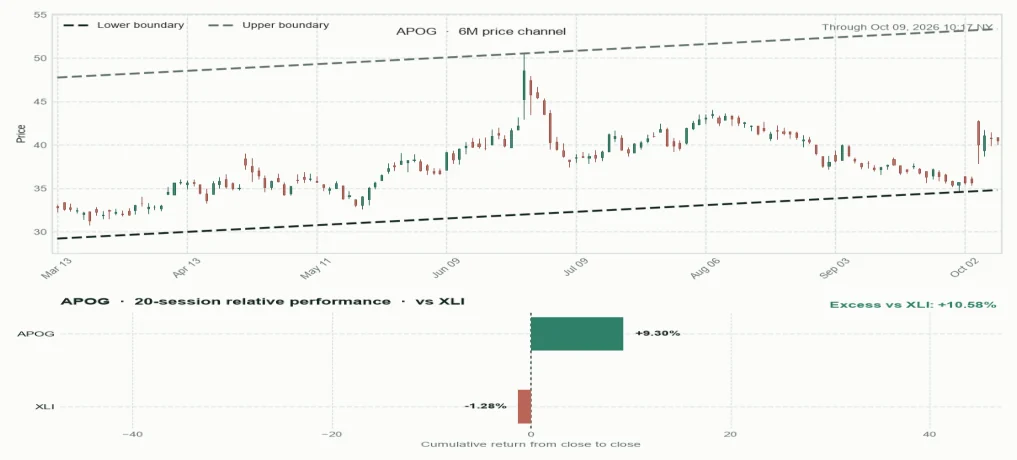
Price channel and relative performance
Forecast fan chart
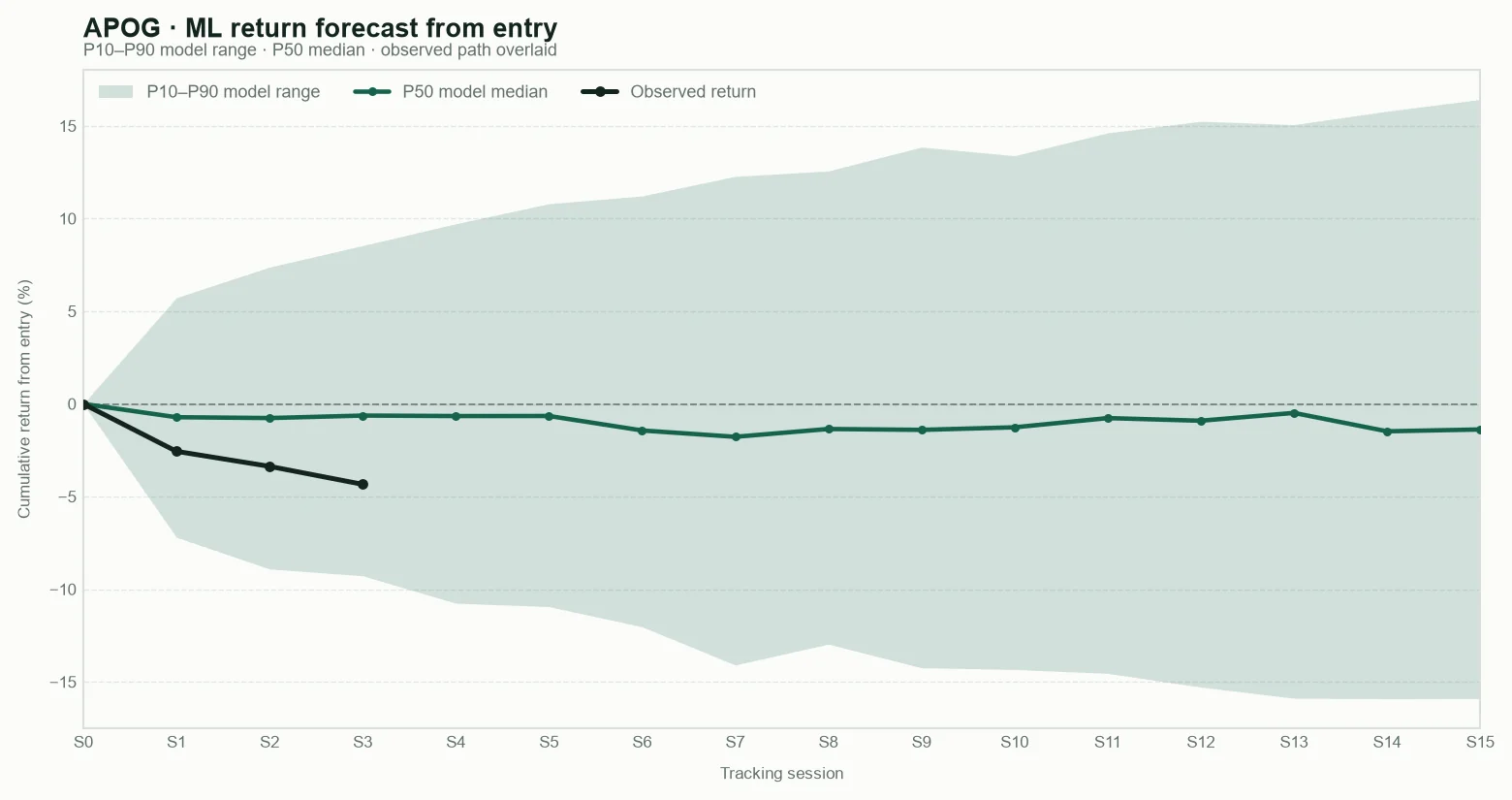
P10 — Cautious outcome: a weak result; most model estimates are above this level.
P50 — Central outcome: the middle estimate; roughly half of the model estimates are above and half below.
P90 — Favourable outcome: a strong result; only the most favourable model estimates are above this level.
These are model reference levels, not guarantees.
Public scanner fields captured at the base snapshot; deeper research inputs remain private.
Snapshot
What was captured at the base
Structure
How price is behaving
Risk and context
What may change the read
Base framework for context and outcome tracking. These are not trading instructions.
Tracking results
Observed daily-bar ranges are retrospective measurements, not targets, stops, or trading instructions.
Tryding Review
Five AI analytical agents reading the same evidence; disagreement stays visible.
“The shared session was broadly constructive but uneven: the large benchmarks rose, the Russell 2000 slipped, and volatility was contained. An earlier fresh-quote breadth reading leaned positive, but the later EOD breadth layer is unavailable. I’ll keep that as market context, not candidate evidence.”
Correction recorded: the provisional Try of the Day remains APOG, and the prior majority-with-dissent status remains unchanged. The public rationale now names LW’s model advantage, the four-candidate rank scope, the eight-case adverse-MAE samples and APOG’s dated SEC input. Confidence is reduced; this correction does not conduct a new selection.
“The candidates do not all have the same kind of story. APOG and LW have reported earnings and guidance changes; SRFM has a reported software contract; MRVL has multi-year targets. The distinction is whether the event can support a testable path, not how dramatic its headline sounds.”
The model evidence favors LW on several measures; we should say so plainly. It does not erase APOG’s reported guidance change, its stronger prior relative performance or its above-VWAP session response. The model comparison qualifies the case instead of deciding it.
Broader Market Context
The later market snapshot showed firm large-cap benchmarks alongside a weaker Russell 2000, while end-of-day breadth was unavailable. Day news paired a prolonged expansion with falling real hourly earnings; a tanker-supply warning and community-bank oversight discussion added separate risk and policy angles. Lower yields and dollar readings coexisted with mixed commodities, leaving the session without one simple macro explanation.
The supplied market snapshot was captured at 2026-10-06T16:54:48.629355Z and marked complete across seven rows. The S&P 500 stood at 7,828.25, with a reported change of +0.70%; the Nasdaq 100 stood at 31,282.652, with +0.66%; and the Russell 2000 stood at 2,840.4856, with −0.23%. The VIX level was 14.98, with a −3.48% change. The U.S. 10-year yield level was 5.277%, with a −3.40 basis-point change; DXY stood at 101.879, with −0.28%. Gold and WTI levels were $4,188.00 and $89.40, with reported changes of +0.75% and −0.03%, respectively. These are levels and changes at the snapshot time, not causal explanations. An earlier intraday breadth proxy leaned positive, but the end-of-day breadth layer was unavailable, so that earlier reading cannot establish participation through the later snapshot. The day-context feed reported both a fifth consecutive monthly fall in real hourly earnings and U.S. expansion reaching 78 consecutive months. Those claims can coexist: continued expansion does not establish that inflation-adjusted pay is keeping pace. The Financial Times reported a tanker-shortage warning and a possible $200-a-barrel oil scenario; this is a risk warning, not the snapshot’s observed oil price. Federal Reserve Governor Bowman’s remarks concerned community-bank regulation and supervision, not a change in the federal-funds path. Apogee’s FY2026 filing describes its architectural segments as exposed to cyclical North American non-residential construction conditions and factors including interest rates and commodity prices. That establishes relevant business exposure, but it does not attribute any company-specific market move to the day’s macro readings.
Sources consulted: The Kobeissi Letter · The Kobeissi Letter · Financial Times · Federal Reserve Board
Coffee conversation
“The day’s news cut puts two forces beside each other: it reports a fifth straight monthly fall in real hourly earnings while U.S. expansion has reached 78 months. Separately, the tanker-shortage warning raises a severe oil-price scenario.”
“Real hourly earnings means wages adjusted for inflation. A fifth monthly decline points to weaker purchasing power, but it does not by itself show that total spending is falling or establish demand at any one company.”
“The later snapshot was uneven across benchmarks: the S&P 500 stood at 7,828.25, up 0.70%, and the Nasdaq 100 at 31,282.652, up 0.66%; the Russell 2000 stood at 2,840.4856, down 0.23%.”
“Those figures pair each index’s level—where it stood—with its exact reported change. The snapshot was captured at 16:54 UTC and marked complete across seven rows; its end-of-day breadth field was unavailable.”
“Does the missing breadth field mean the advance was narrow?”
“Not by itself. Breadth means how many stocks are rising versus falling. An earlier intraday proxy leaned positive, but the end-of-day layer was unavailable, so we cannot say whether that participation reading held later.”
“The Financial Times reports a tanker-shortage warning and a possible $200-a-barrel oil scenario; that is a contingency, not the observed price. In the later snapshot, WTI stood at $89.40 with a −0.03% change, while gold stood at $4,188 with +0.75%.”
“That separates the warning from the market reading. Could the lower Treasury yield be treated as an offset to the oil risk?”
“The 10-year yield level was 5.277%, with a change of −3.40 basis points. A basis point is one hundredth of a percentage point; that daily move is not enough to quantify an offset to a hypothetical oil shock.”
“The VIX, a market-implied volatility gauge, stood at 14.98 and had a −3.48% change. The snapshot classified volatility as contained, but that reading cannot rule out a supply disruption.”
“Bowman’s remarks were about modernizing community-bank regulation and supervision. That is a structural oversight discussion, not a signal about the federal-funds path or an explanation for the Treasury yield reading.”
“Expansion and falling real earnings are not contradictory: economic activity can keep growing while inflation-adjusted pay weakens. That leaves purchasing power as an open question rather than a conclusion about demand.”
“Apogee’s annual filing says its architectural businesses are exposed to the cyclical North American non-residential construction market and factors such as interest rates and commodity prices. That explains why this context matters, but does not connect today’s macro readings to a specific share-price move.”
“So the day combines firm major indexes, a weaker small-cap benchmark, an earlier positive breadth proxy without an end-of-day check, and cross-currents in wages, rates, policy, and commodities. That context frames issuer evidence; it does not resolve it.”
Timeline
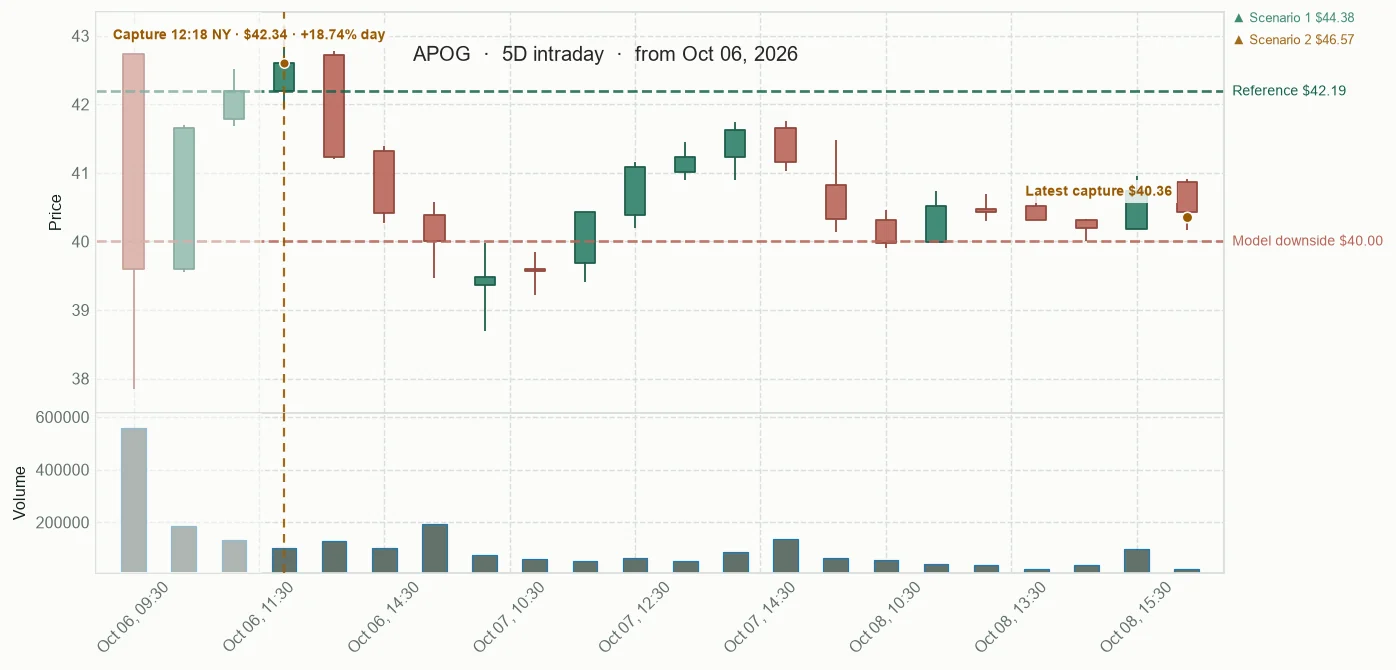
APOG tracked loss widened 1.99 points to 4.55% from the prior public note, while shares slipped 0.39% on 0.14 times average volume and hovered 0.12% above the $40.90 VWAP. Over twenty sessions, APOG still led Industrials by 10.38 points, but that relative gain has not offset the episode loss. The prepared record includes an October 6 filing pointer without verified terms; the model shows 47% same-direction persistence and a +0.99% session-15 median, leaving the guidance thesis unresolved.
APOG recovered 5.47 points in tracked return to -1.21% as shares rose 3.73%, held 3.01% above VWAP and sat near the top of the range on 1.55 times average volume. That is firmer than the prior capture, but the episode remains below its starting return and the prepared handoff still lacks the October 6 filing terms, so the raised-guidance thesis remains unverified.
APOG was up 14.02% on the session in the latest pre-close capture, yet its tracked return from the initial review remained down 4.55%. Price sat 0.39% below VWAP as intraday participation eased; the 5.47x volume and positive 20-session relative returns keep the case alive, but do not prove acceptance of the reported outlook. The cited October 6 filing contents are not in the prepared record, and the live model has no usable session-zero estimate, so the guidance and follow-through claims remain unresolved.
Panel thesis: The reported Q2 beat and raised FY2027 guidance may support follow-through if the market accepts the revised outlook. APOG’s prior relative strength and captured above-VWAP structure support the selection. The active model comparison favors LW on several measures and materially tempers confidence; its historical samples and prepared SEC inputs limit how much weight those estimates can carry. Invalidation boundary: The October 6 filing materially contradicts or qualifies the reported guidance raise, or follow-up observations fail to hold or reclaim the event-session VWAP area while relative performance deteriorates.
Panel comparison
Selected candidate versus the alternatives retained from the panel comparison.
Latest display-only snapshot · Oct 9, 2026 · 10:49 NASDAQ
Since base -4.25% · Today -0.92% · Since prior -0.92% · Relative volume 0.04 · RSI 65.38 · EMA 38.75 > 38.17 > 38.71 · VWAP below -0.16% · 52-week high 79.40% · As of Oct 9, 2026 · 10:06 NASDAQ
Since base -3.92% · Today -0.33% · Since prior 0.00% · Relative volume 1.85 · RSI 56.43 · EMA 45.01 > 46.14 > 47.91 · VWAP above · 52-week high 74.41% · As of Oct 6, 2026 · 16:16 NASDAQ
Since base -3.47% · Today -1.93% · Since prior 0.00% · Relative volume 2.48 · RSI 73.89 · EMA 270.75 > 269.38 > 269.31 · VWAP above · 52-week high 73.66% · As of Oct 6, 2026 · 17:20 NASDAQ
Since base -1.47% · Today -0.30% · Since prior 0.00% · Relative volume 2.34 · RSI 77.61 · EMA 144.9 > 143.09 > 144.82 · VWAP above · 52-week high 73.38% · As of Oct 6, 2026 · 17:19 NASDAQ
Since base -4.28% · Today -0.96% · Since prior 0.00% · Relative volume 1.62 · RSI 72.25 · EMA 1.0 > 0.9 > 0.82 · VWAP above · 52-week high 17.02% · As of Oct 6, 2026 · 17:19 NASDAQ
Since base +1.88% · Today -0.02% · Since prior 0.00% · Relative volume 1.54 · RSI 82.19 · EMA 266.88 > 253.99 > 238.48 · VWAP below · 52-week high 85.49% · As of Oct 6, 2026 · 17:20 NASDAQ
Since base -10.31% · Today +2.03% · Since prior 0.00% · Relative volume 8.34 · RSI 45.13 · EMA 1.65 > 1.67 > 1.66 · VWAP below · 52-week high 75.78% · As of Oct 6, 2026 · 17:17 NASDAQ
Since base -2.07% · Today -3.40% · Since prior 0.00% · Relative volume 2.12 · RSI 66.62 · EMA 1.16 > 1.1 > 1.05 · VWAP above · 52-week high 90.34% · As of Oct 6, 2026 · 17:02 NASDAQ
Since base +0.25% · Today +0.07% · Since prior 0.00% · Relative volume 1.26 · RSI 80.06 · EMA 3.82 > 3.62 > 3.52 · VWAP above · 52-week high 98.25% · As of Oct 6, 2026 · 16:59 NASDAQ
Since base +0.28% · Today +0.18% · Since prior 0.00% · Relative volume 4.91 · RSI 58.77 · EMA 38.16 > 36.19 > 33.22 · VWAP above · 52-week high 94.11% · As of Oct 6, 2026 · 17:19 NASDAQ
Company dossier
History, curiosities & sources

Selected facts and links behind the public profile.
Company description
Apogee is a U.S.-based provider of building enclosure products and services and high-performance glass and coated materials. Its four reportable segments cover aluminum building systems, architectural glass, façade project management and installation, and coated materials used in applications such as museums, displays, and industrial flooring.
History
- Founded on July 12, 1949, as Harmon Glass Company, it began with a single Minneapolis shop replacing windshields for used-car dealers.
- In 1955, the company began offering contract glass installation for buildings.
- Apogee Enterprises was formed in 1968 as the company expanded into multiple business lines; it became publicly traded in 1971.
Curiosities
- In a July 2024 anniversary release, Apogee reported 4,400 employees across 15 principal facilities in the United States, Canada, and Brazil.
- The company says its architectural products are used in settings ranging from skyscrapers to medical clinics and schools.
- Its Tru Vue brand provides high-performance glass and acrylic products used in custom picture framing and museums.
- Its FY2026 Form 10-K identifies four reportable segments: Architectural Metals, Architectural Services, Architectural Glass, and Performance Surfaces.