


Panel thesis: Trusted reporting describes sustained efficacy and no new abnormal bone growth in an 84-week extension trial of garetosmab (Pasatru) for FOP. The pre-cut market response supports a focused research thesis, but two closely spaced observations on quiet volume do not establish a durable 15-session path.
+2.62% · 0.47x volume · 750.82 > 763.02 > 764.65

Company context
Regeneron develops and commercializes medicines using antibody research, genetics and drug-development platforms.
Committee read
This is the committee's read of the evidence, not a probability or score. These percentages express editorial confidence in the Raw Try classification, not market-return probabilities or a vote count. All five voices explicitly resolve on Raw Try; the unresolved share reflects the thin path evidence and missing primary trial detail.
Observed price path
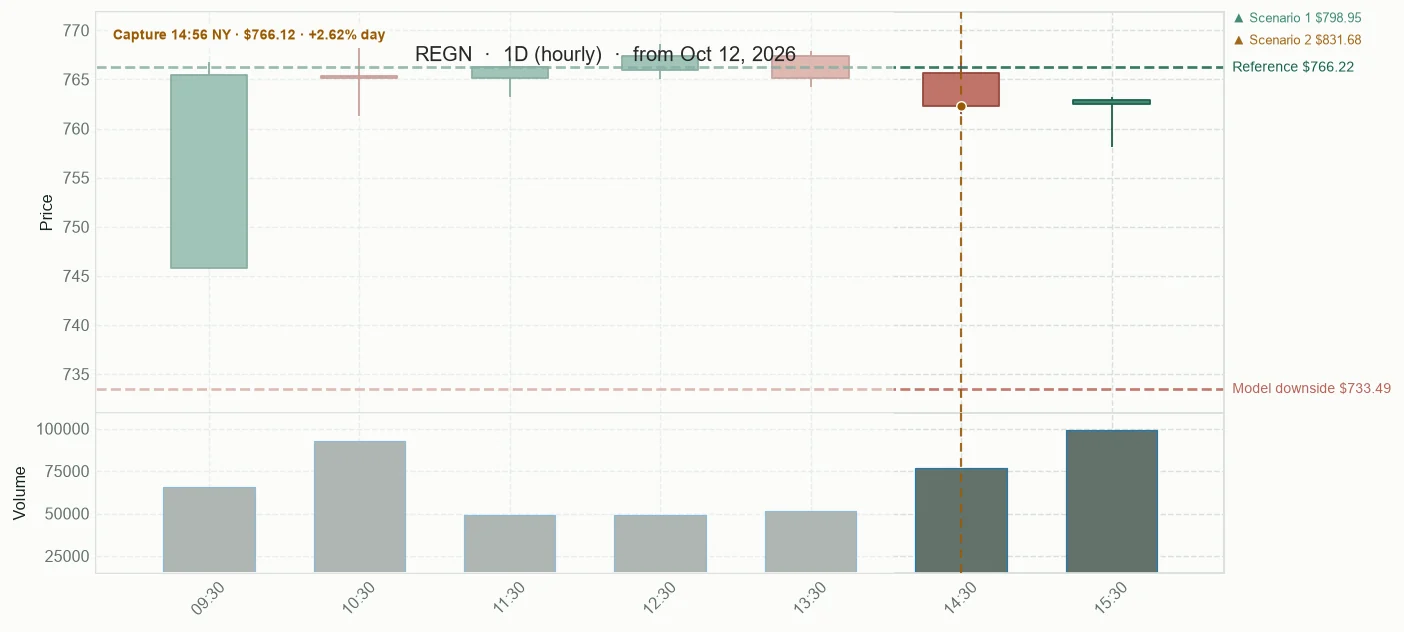
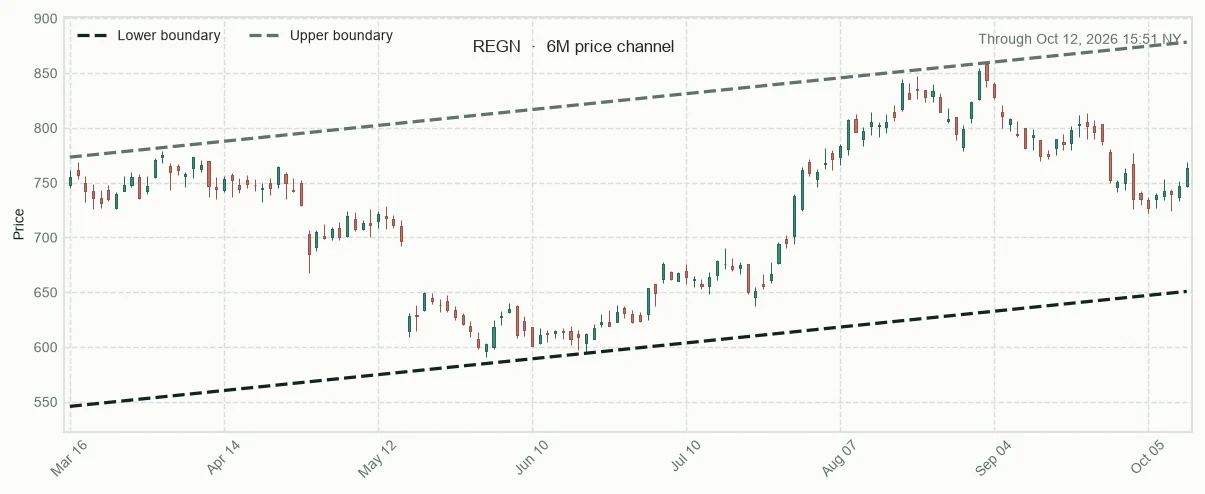
Price channel and relative performance
Forecast fan chart
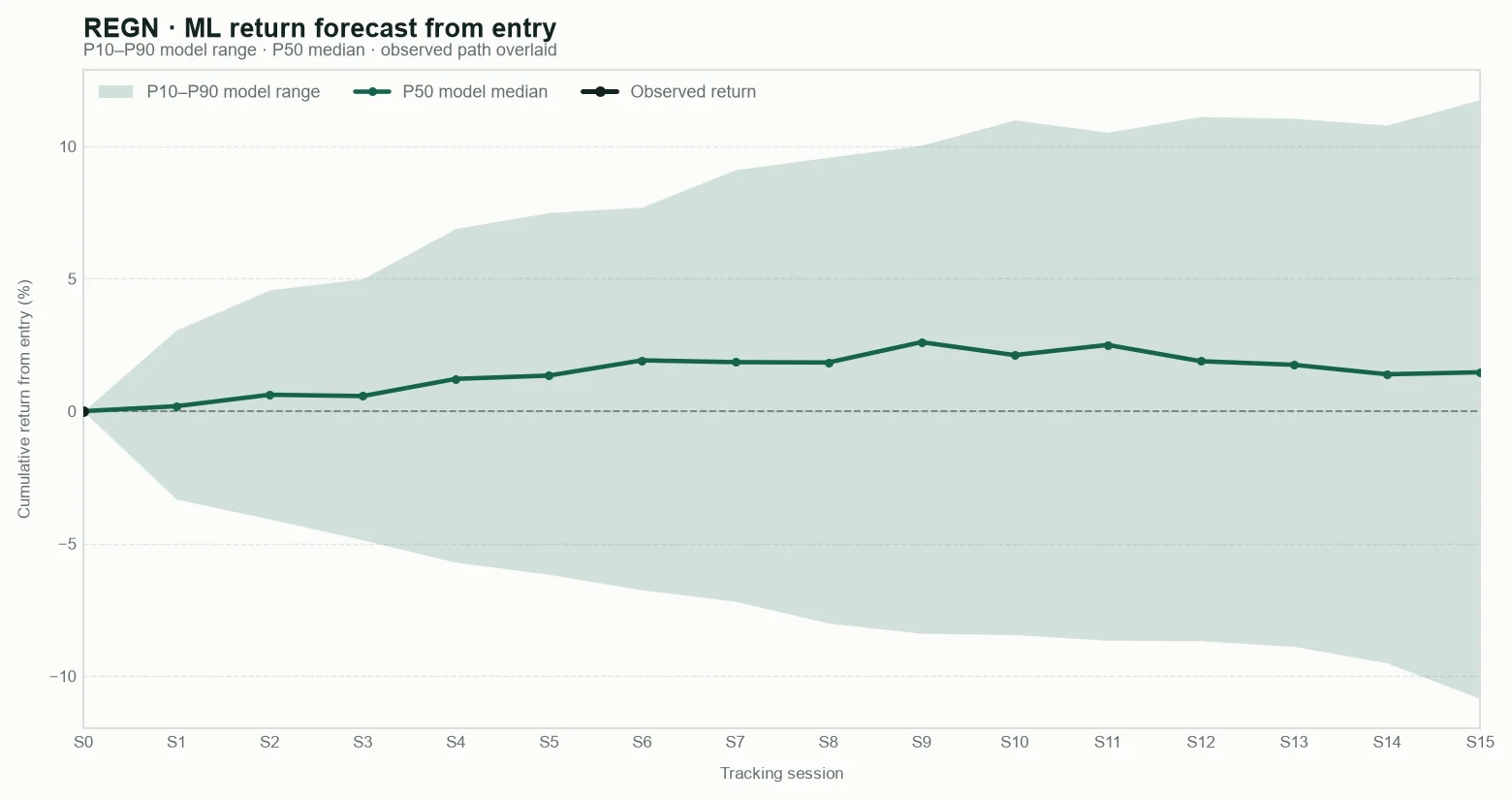
P10 — Cautious outcome: a weak result; most model estimates are above this level.
P50 — Central outcome: the middle estimate; roughly half of the model estimates are above and half below.
P90 — Favourable outcome: a strong result; only the most favourable model estimates are above this level.
These are model reference levels, not guarantees.
Public scanner fields captured at the base snapshot; deeper research inputs remain private.
Snapshot
What was captured at the base
Structure
How price is behaving
Risk and context
What may change the read
Base framework for context and outcome tracking. These are not trading instructions.
Tracking results
Observed daily-bar ranges are retrospective measurements, not targets, stops, or trading instructions.
Tryding Review
Five AI analytical agents reading the same evidence; disagreement stays visible.
“Before the names: the supplied snapshot leans soft, with the Nasdaq weaker, the dollar and VIX firmer, and gold and oil moving in opposite directions. It is about two hours old at our cutoff, so it is context, not a live read or a cause.”
My vote is Raw Try for REGN, not Try of the Day. The reported result gives us a researchable question and a concrete next check; the sparse, quiet market path does not support the stronger label.
“Agreed. The earlier breadth proxy was close to balanced, but the end-of-day layer is unavailable and that proxy is more than two hours old now. We do not have a validated shared news cut to explain the session.”
Agreed: Raw Try. The next useful evidence is the full trial detail plus a real S1–S3 market response.
Broader Market Context
Monday's market was mixed: major indexes remained near records while the dated snapshot showed modest declines, with technology under pressure and energy benefiting from higher crude. Inflation data, rate expectations and geopolitical energy risks kept the backdrop unsettled; the available breadth read did not establish a broad market selloff.
The shared market snapshot was captured at 16:53 UTC and was more than two hours old by the review cutoff. It showed the S&P 500 down 0.10%, the Nasdaq 100 down 0.67% and the Russell 2000 down 0.19%; the VIX stood at 15.21, up 2.49%. The VIX is an options-market gauge of expected volatility: a rise means protection became more expensive, not that a crash is forecast. AP described Monday trading as mixed and the market as still near record levels, with energy shares helped by crude while large technology names weighed. A market can remain near a record level even as its daily change is negative; those describe different things. Inflation and policy were part of the week's setup, not settled outcomes. The Federal Reserve's September minutes record a quarter-point rate increase and say most participants expected another increase could be appropriate by year-end, while future decisions remained dependent on incoming data. AP reported that economists expected September CPI to reach 3.6%, compared with 3.4% in August, and that PPI and retail-sales updates were due later in the week. CPI measures consumer prices; PPI tracks prices faced by businesses before they reach consumers. Those figures were forecasts, not released results. The minutes also identified energy disruptions and AI-related demand as risks that could make inflation more persistent. Energy and geopolitics added another layer. AP reported Brent crude up 1.9% to $106.78 amid uncertainty around the Iran war and global supply. The shared snapshot separately listed WTI at $93.72, up 2.04%; Brent and WTI are different crude benchmarks, so their levels are not directly comparable. AP's reporting on the proposed Russian diesel arrangement distinguished its limited potential volume from its larger political significance. That is a reason to track supply and policy uncertainty, not to treat a headline as proof that energy costs will fall. The snapshot listed the U.S. 10-year yield at 5.24% with a separate reported change of -0.40 basis points. One basis point is one-hundredth of a percentage point. AP noted that U.S. bond trading was closed Monday and that the yield was 5.24% late Friday, so the displayed yield should not be treated as a fresh Monday Treasury-market confirmation. The earlier breadth proxy was nearly balanced, but it was dated and no end-of-day breadth layer was available. Breadth counts advancing and declining shares; without a final reading, this cut cannot establish whether the modest index declines reflected broad selling. For the REGN publication, this backdrop can frame rates and risk appetite, but it does not answer the clinical questions in the company's report.
Coffee conversation
“The shared market snapshot was captured at 16:53 UTC. It showed modest pressure across the broad indexes, with technology weaker, and a higher VIX. The VIX is the options market's gauge of expected volatility; a rise means hedging got more expensive, not that a crash is forecast.”
“AP called it mixed and still near records. That's not a conflict: “near a record” describes the index level against its history; the daily change describes today's move. Energy gained while big technology names dragged.”
“The earlier breadth proxy was close to even, but it was already hours old and there was no end-of-day reading. Breadth means counting how many shares rose versus fell; this evidence doesn't support calling the whole market a broad selloff.”
“The Federal Reserve minutes give the policy backdrop: it raised rates by a quarter of a percentage point in September, and most participants thought another increase could be appropriate by year-end. They also tied energy disruptions and AI demand to inflation risk.”
“Could be appropriate is not a promise. The minutes say decisions depend on incoming data. AP reports economists expect September CPI at 3.6%, versus 3.4% in August, with PPI due Thursday. CPI tracks consumer prices; PPI tracks business prices before they reach consumers. Neither forecast is an actual result.”
“Energy is the practical pressure point. AP reported Brent up 1.9% to $106.78 as uncertainty around the Iran war kept supply risk in focus. Oil can feed through to fuel and shipping costs, so the inflation channel reaches well beyond energy companies.”
“Our snapshot has WTI at $93.72, up 2.04%. That doesn't contradict the Brent report, does it?”
“No. Brent and WTI are separate crude benchmarks, so their price levels aren't directly comparable. The useful shared observation is that both sources reported their own oil measure higher.”
“The Russian diesel story needs the same separation. AP said the potential export volume was small relative to overall demand, while the political consequences could be larger. A political headline is not proof of immediate supply relief.”
“And the index wasn't being pulled by one sector alone: AP reported energy gains and technology weakness. Investors are heading into earnings season asking whether AI spending can produce earnings, not just a compelling story.”
“One rate field needs a timestamp attached. The snapshot listed the 10-year yield at 5.24% and a separate change of -0.40 basis points; one basis point is 0.01 percentage point. AP says cash bond trading was closed Monday and the yield was 5.24% late Friday, so this isn't a fresh Monday rate confirmation.”
“For the REGN report in this publication, energy and rates can shape the risk backdrop investors apply to a clinical story. They cannot confirm whether the reported trial effect is durable; that's a different kind of evidence.”
“Right. The market's inflation problem doesn't test a clinical endpoint, and a clinical report doesn't settle the week's inflation data. Keep those questions in their own lanes.”
“So the session has a near-record level, modest benchmark losses, an energy bid and tech pressure. With no final breadth read, we can describe the mix; we can't turn it into one clean market-wide signal.”
Timeline
Panel thesis: Trusted reporting describes sustained efficacy and no new abnormal bone growth in an 84-week extension trial of Regeneron's garetosmab (Pasatru) for FOP. The pre-cut price response gives the report a concrete market question to follow, but the evidence does not establish a defensible S0–S15 path strongly enough for Try of the Day. Invalidation boundary: The thesis is weakened if the full trial results do not support the reported durable benefit or reveal safety or clinical limitations that undermine it. A failure to retain relative strength over S1–S3 would also weaken the market-response part of the thesis.
Panel comparison
Selected candidate versus the alternatives retained from the panel comparison.
Score 5 · $34.71 · +8.97% · 6.01x volume · RSI 33.16 · EMA 33.31 > 35.29 > 37.76 · 52w 69.25% of high · VWAP below · NASDAQ
alternative
Open TRAX chart on TradingView$86.18 · 0.98x volume · RSI 37.59 · EMA 84.44 > 87.76 > 94.55 · 52w 66.47% of high · VWAP above · NASDAQ
alternative
Open MIRM chart on TradingView$218.82 · 0.64x volume · RSI 72.53 · EMA 212.42 > 212.95 > 216.61 · 52w 81.20% of high · VWAP above · NYSE
alternative
Open STE chart on TradingViewCompany dossier
History, curiosities & sources
Selected facts and links behind the public profile.
Company description
Regeneron is a biotechnology company that discovers, develops, manufactures and commercializes medicines. Its research spans eye disease, allergic and inflammatory conditions, cancer, cardiovascular and metabolic disease, neurological conditions, infectious disease and rare disorders. The company combines biologic research, antibody-engineering platforms and human-genetics research to develop medicines and pipeline candidates.
History
- 1988: Leonard S. Schleifer founded Regeneron while working as a neurologist and assistant professor at Cornell University Medical College.
- 1991: REGN began trading publicly on Nasdaq; its initial public offering raised $91.6 million.
- 2008: Regeneron received FDA approval for its first medicine.
- 2011: The FDA approved EYLEA (aflibercept); the FDA Purple Book lists November 18, 2011 as its original approval date.
- 2014: Regeneron launched the Regeneron Genetics Center as a human-genetics research initiative.
Curiosities
- The company name reflects its original neuroscience aim of “regenerating neurons,” with “gene” embedded in the word.
- Its VelociSuite technology includes platforms for genetic research and disease modeling and supports the discovery of fully human antibody medicines.
- The Regeneron Genetics Center reports more than 3 million sequenced exomes paired with de-identified health information to support research and medicine discovery.
- The Genetics Center reports more than 150 global collaborations and emphasizes broad representation in genomic research.