


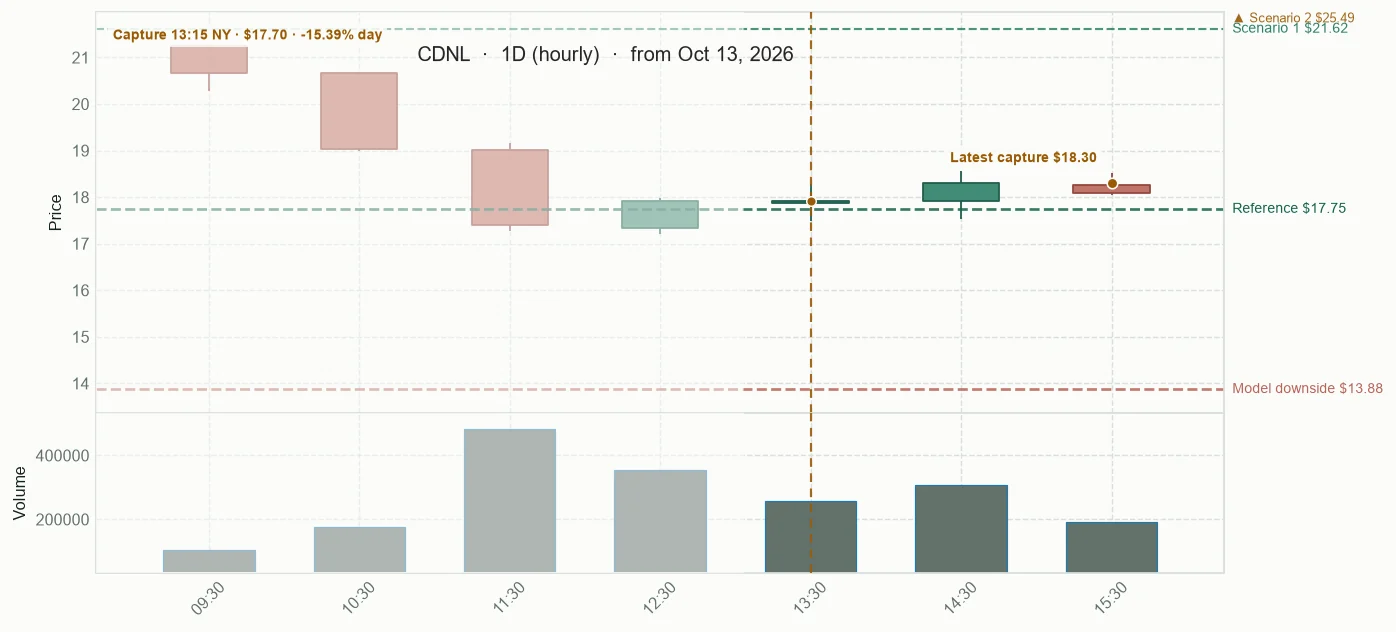
Panel thesis: The reported Hughes Brothers acquisition gives CDNL a specific question to investigate. Its captured daily change was -15.39%, and the intraday observation was below VWAP, the session's average price weighted by trading volume. The packet does not establish financing, closing terms, expected contribution, or integration costs, so this is a research thesis rather than a claim of recovery.
-15.39% · 1.47x volume · 23.94 > 27.99 > 37.05

Company context
A Southeastern U.S. civil infrastructure and site-development platform that works from preconstruction and utilities through grading, drilling, and paving.
Committee read
This is the committee's read of the evidence, not a probability or score. Editorial confidence in Raw Try, not a return probability or model output. The acquisition provides a concrete research question; the weak tape and missing deal terms keep confidence bounded. The committee status records the explicit dissent.
Observed price path
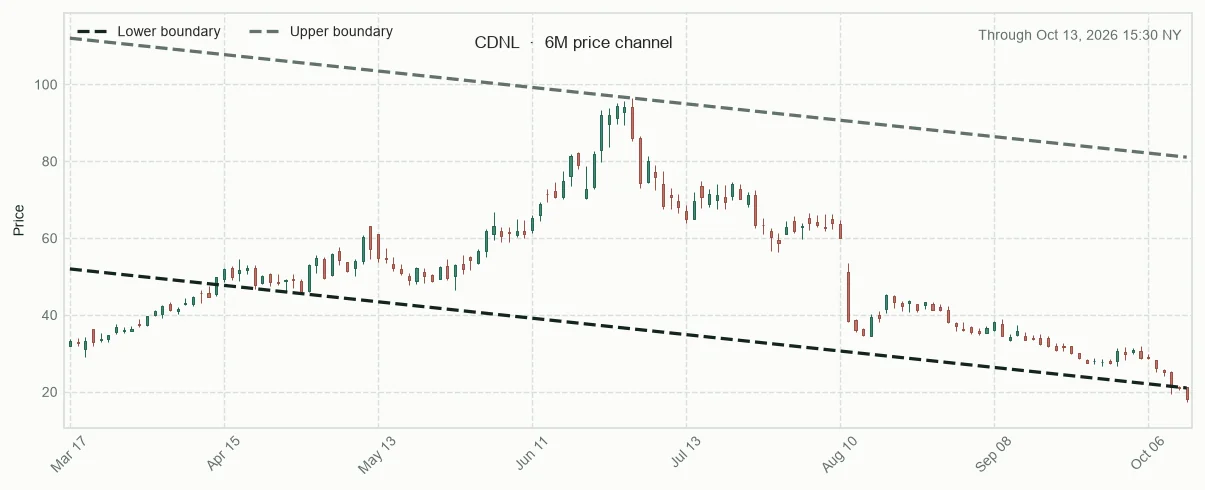
Price channel and relative performance
Forecast fan chart
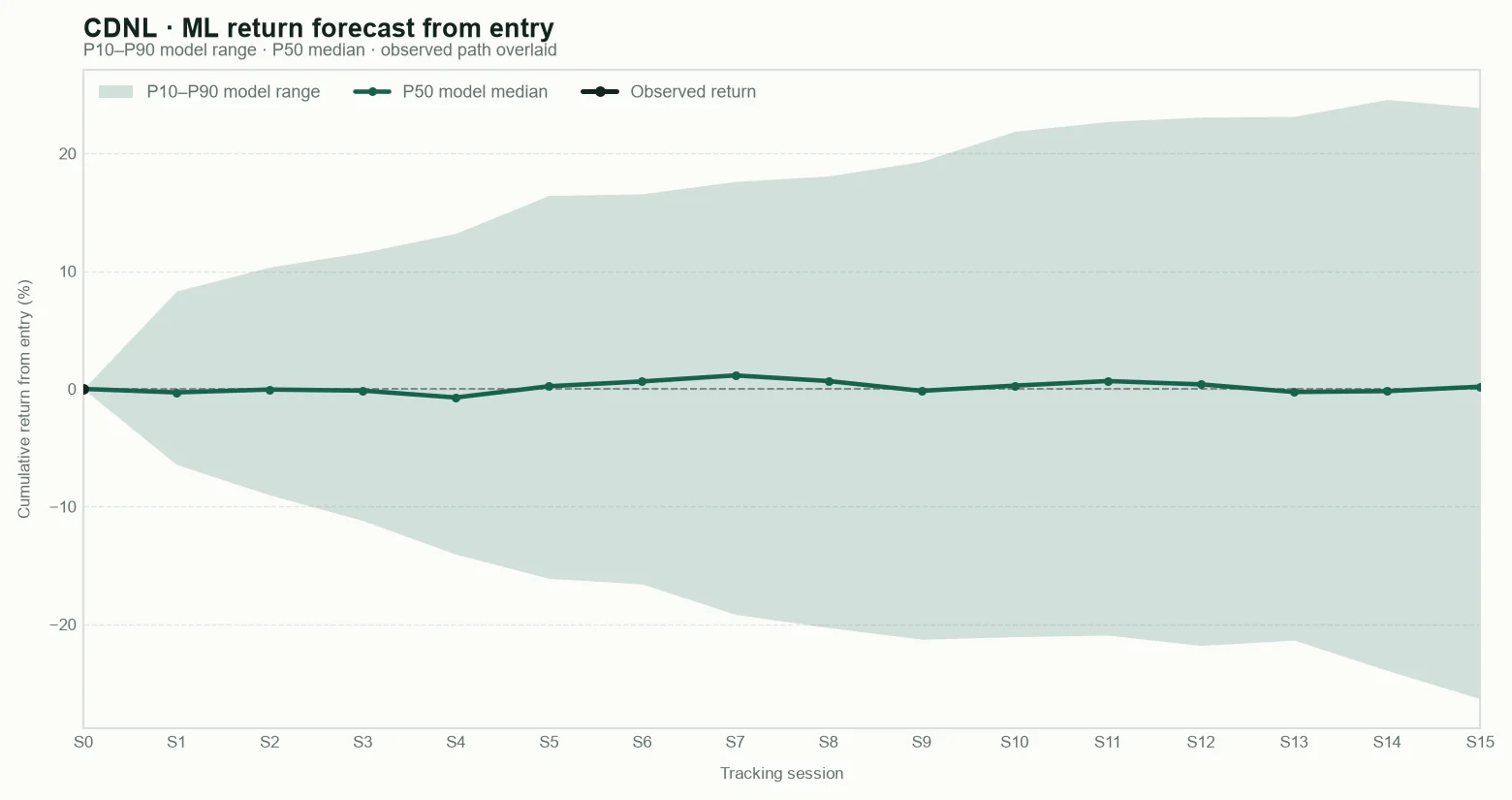
P10 — Cautious outcome: a weak result; most model estimates are above this level.
P50 — Central outcome: the middle estimate; roughly half of the model estimates are above and half below.
P90 — Favourable outcome: a strong result; only the most favourable model estimates are above this level.
These are model reference levels, not guarantees.
Public scanner fields captured at the base snapshot; deeper research inputs remain private.
Snapshot
What was captured at the base
Structure
How price is behaving
Risk and context
What may change the read
Base framework for context and outcome tracking. These are not trading instructions.
Tracking results
Observed daily-bar ranges are retrospective measurements, not targets, stops, or trading instructions.
Tryding Review
Five AI analytical agents reading the same evidence; disagreement stays visible.
“The broad market is subdued, with more pressure in Nasdaq and small caps. The energy and housing headlines add uncertainty, but they do not explain any one company. I am judging the supplied cases on their own evidence and their possible path through the next fifteen sessions.”
The majority retains Raw Try because the deal gives a concrete next check and falsifier. The public comparison is now limited to the selected case and those four alternatives.
“Agreed. Hormuz and oil-demand headlines are loud today, and the AI-finance story is competing for attention. That is context, not a free catalyst for any ticker in this packet.”
The reported $357.5 million deal gives us specific checks: funding, conditions, contribution, and integration costs. The captured decline and relative weakness keep it below Try of the Day.
Broader Market Context
The day’s context pulled in different directions: a softer early oil and dollar read met renewed shipping and refinery risks, while Gulf output recovery and a sharply lower oil-demand growth forecast complicated the supply story. The supplied later market snapshot showed pressure across U.S. benchmarks, especially smaller companies, even as rates and the dollar eased.
The day opened with a market interpretation that geopolitical escalation might remain contained: Reuters reported oil and the dollar easing as traders focused on the Federal Reserve’s rate path. Later reporting raised the shipping risk around Hormuz. AP relayed an assessment that Iran appeared to be targeting ship-to-ship oil transfers, and the supplied news cut carried reports of attacks on vessels. OPEC’s ministers separately described shipping and insurance costs as a growing burden, while the IEA reported sustained attacks on Russian refineries and fuel-export restrictions. The energy picture was therefore not a single supply headline. There were counterweights. The supplied context reported a rebound in Gulf production and Saudi output of about 8.4 million barrels per day in September; that Saudi figure is a reported production level, not a change. OPEC’s 2026 global oil-demand-growth forecast was trimmed to 0.2 million barrels per day. That is a forecast for growth, not a claim that current demand fell by that amount. Recovering production, constrained transport, refinery disruption, and weaker expected demand can coexist. The supplied 16:54 UTC market snapshot showed the major U.S. benchmarks lower, with the Russell 2000 lagging, while the VIX rose and Treasury yields and the dollar eased. The complete intraday breadth proxy leaned negative, particularly among smaller companies. These are descriptions of the session, not proof that any one headline caused the moves. Housing reports in the supplied context pointed to a difficult transaction environment, while a separate market-structure item put the S&P 500 earnings yield below the 10-year Treasury yield. Those observations add demand and valuation questions without resolving them. CNBC’s report that Anthropic would disclose new revenue numbers and Reuters’ report of LSEG talks to buy Octus also put the distinction between announced plans, negotiations, and realized economics in view. For the already selected CDNL case, this wider setting can frame questions about demand, financing, and durable contribution; it cannot establish company-specific outcomes. The formal Raw Try selection remains sealed.
Sources consulted: FT Energy · International Energy Agency · FT Energy · Javier Blas · OPEC Secretariat · Charlie Bilello · Charlie Bilello · The Kobeissi Letter · CNBC · Reuters Business
Coffee conversation
“At 16:54 UTC, the supplied snapshot had the S&P 500 down 0.04%, the Nasdaq-100 down 0.39%, and the Russell 2000 down 0.92%; the VIX was up 3.91%. Treasury yields and the dollar eased. Pressure, yes; one clean market story, no.”
“Earlier, Reuters described oil and the dollar slipping as traders leaned toward contained Middle East tension and watched the Fed’s rate path. That was the market’s read at that point, not a guarantee about what ships would face later.”
“And then the shipping reports arrived. AP, citing the Institute for the Study of War, said Iran appeared to be targeting ship-to-ship oil transfers; the sealed news cut also reported a severe run of attacks in Hormuz. “Contained” was an assumption, not a safety certificate.”
“There are separate bottlenecks here. OPEC described high shipping and insurance costs; the IEA described attacks on Russian refining and fuel-export restrictions. Crude production, safe transport, and usable refined fuel are different parts of the chain.”
“But the supply side was not uniformly shrinking. The supplied reports said Gulf production was rebounding, and Saudi production was reported at about 8.4 million barrels per day in September. That is a monthly level, not a measured increase for the day.”
“Then put the demand forecast beside it: OPEC trimmed its 2026 global oil-demand-growth forecast to 0.2 million barrels per day. That is the forecast for growth, not a 0.2 million-barrel decline in current demand.”
“On the stock tape, the complete breadth proxy leaned negative, especially among smaller companies, and the Russell lagged. That supports the picture of uneven pressure. It tells us nothing by itself about an individual stock.”
“The VIX rose 3.91% in that same snapshot. It is an options-based gauge of expected near-term market volatility, not a count of losses or proof of panic. Yields easing at the same time makes this a mixed cross-asset read.”
“The housing items deserve a place in the risk picture too: sellers reportedly outnumber buyers by the widest gap since 2013, and September purchase cancellations set a record for that month. That points to transaction friction, not a full forecast for the economy.”
“For Cardinal, residential work is one end market among several; the company also describes commercial, industrial, municipal, and state projects. The housing headlines make one exposure worth watching, not the whole demand story.”
“One valuation comparison in the supplied context: the S&P 500 earnings yield sat 1.5 percentage points below the 10-year Treasury yield. That is a relationship between two yields, not a daily percentage move.”
“Earnings yield—quick clarification: that is not the cash dividend an investor receives, is it?”
“Right. It compares companies’ earnings with their share prices. Sitting below a Treasury yield can be a valuation hurdle for stocks; it does not tell us what caused today’s market move.”
“The business headlines have the same stage problem. CNBC said Anthropic was due to disclose revenue numbers; Reuters reported LSEG was in talks to buy Octus for about $3.5 billion. A planned disclosure and reported talks are not realized results or a completed deal.”
“That is why the broad backdrop can frame the CDNL question but cannot answer it. Demand conditions, financing, and integration costs matter; the day’s index and commodity moves do not establish whether an acquisition will produce durable value.”
Timeline
Cardinal’s release clarifies the Hughes Brothers deal: a $357.5 million purchase funded with at least 40% in stock, $156 million of new debt plus cash, and up to $97.5 million in earnout tied to 2026 adjusted EBITDA. Closing is targeted for Q4, subject to approvals; the company estimates post-close net leverage near 1.4 times. CDNL is down 12.17% today on 2.25 times average volume, near the lower third of its range, while the tracked return remains +3.1% from the initial reference. The terms are clearer, but today’s reaction shows no market acceptance.
Panel thesis: Whether Cardinal Infrastructure Group's reported Hughes Brothers acquisition can add a credible growth path without financing and integration costs undermining the case. The supplied price response does not establish a rebound or justify Try of the Day. Invalidation boundary: The thesis weakens if disclosed terms show unavailable or materially dilutive funding without a credible contribution, or if closing conditions fail. Continued relative weakness after terms are clarified would also count against the prospective case.
Panel comparison
Selected candidate versus the alternatives retained from the panel comparison.
Latest display-only snapshot · Oct 13, 2026 · 15:51 NASDAQ
Since base +3.49% · Today -12.17% · Since prior +4.58% · Relative volume 2.25 · RSI 23.88 · EMA 24.07 > 28.05 > 36.42 · VWAP above +0.36% · 52-week high 19.10% · As of Oct 13, 2026 · 15:24 NASDAQ
Since base -3.24% · Today +15.07% · Since prior -4.59% · Relative volume 2.98 · RSI 31.94 · EMA 3.84 > 4.26 > 4.95 · VWAP above · 52-week high 12.30% · As of Oct 13, 2026 · 15:50 NASDAQ
Since base +1.70% · Today -1.37% · Since prior +0.60% · Relative volume 0.52 · RSI 59.02 · EMA 43.27 > 41.82 > 40.48 · VWAP above · 52-week high 66.99% · As of Oct 13, 2026 · 15:50 NASDAQ
Since base +1.22% · Today -2.54% · Since prior -0.16% · Relative volume 0.62 · RSI 33.5 · EMA 2.58 > 2.63 > 2.61 · VWAP below · 52-week high 50.62% · As of Oct 13, 2026 · 15:50 NASDAQ
Since base +1.40% · Today +0.46% · Since prior +0.82% · Relative volume 0.35 · RSI 39.38 · EMA 14.25 > 15.29 > 16.78 · VWAP below · 52-week high 57.14% · As of Oct 13, 2026 · 15:50 NASDAQ
Company dossier
History, curiosities & sources
Selected facts and links behind the public profile.
Company description
Cardinal Infrastructure Group, Inc. is a Raleigh-based civil infrastructure and site-development platform serving residential, commercial, industrial, municipal, and state projects across the Southeast. Through its operating companies, it provides services from preconstruction and site clearing through erosion control, grading, utility installation, drilling and blasting, and paving, using in-house teams and equipment.
History
- 2013: Jeremy Spivey and his father, Robert Spivey, founded Cardinal Civil Contracting as a wet-utility provider.
- 2019: Aviator Paving was established to bring paving and finished road surfaces into the group’s site-development work.
- 2023: Cardinal Civil entered the Charlotte market through the acquisition of Monroe Roadways and brought retaining-wall construction in-house.
- December 2025: Cardinal Infrastructure Group went public on Nasdaq under the ticker CDNL as the parent of Cardinal Civil Contracting, Aviator Paving, and Civil Drilling & Blasting.
Curiosities
- In 2018, Cardinal Civil added CCTV, vacuum, and flush-truck services to support its utility work in-house.
- Its Civil Drilling & Blasting business handles drilling, blasting, excavation, and crushing to clear rock from project sites.
- In 2026, Aviator Paving developed the group’s first asphalt plant to control material quality, pricing, and delivery.
- At year-end 2025, continuing equity holders retained a 61% economic interest in the operating company while the public parent served as its managing member.