





Panel thesis: Verastem’s initial VS-7375 response data create a specific clinical question worth following. The reported rates are early evidence, and the stock’s move had faded by the last observation before the review cutoff. The panel selects Raw Try, not Try of the Day.
+15.50% · 9.88x volume · 8.1 > 7.94 > 7.51

Company context
Verastem Oncology develops and commercializes medicines for RAS/MAPK pathway-driven cancers, with programs targeting RAF/MEK, FAK, and KRAS G12D signaling.
Committee read
This is the committee's read of the evidence, not a probability or score. These are committee confidence allocations, not return probabilities. The traceable VSTM event and concrete next checks support Raw Try; its fading tape and incomplete clinical detail support the counter-case and leave meaningful uncertainty.
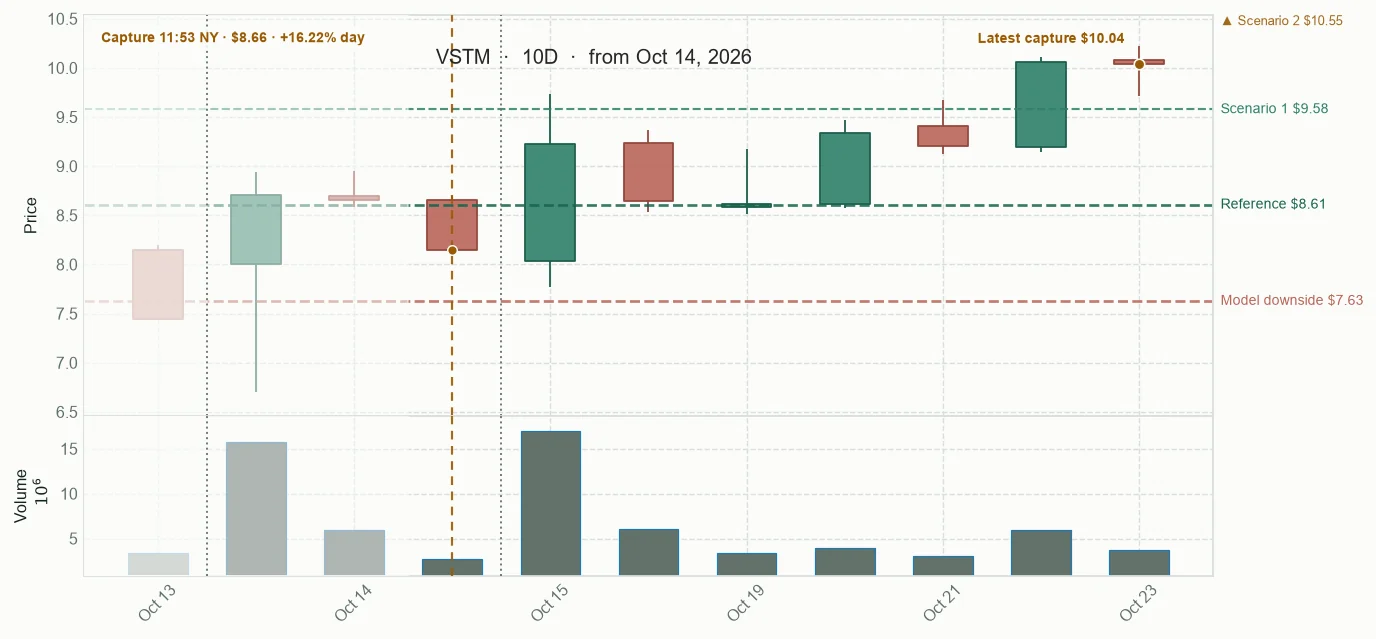
Observed price path
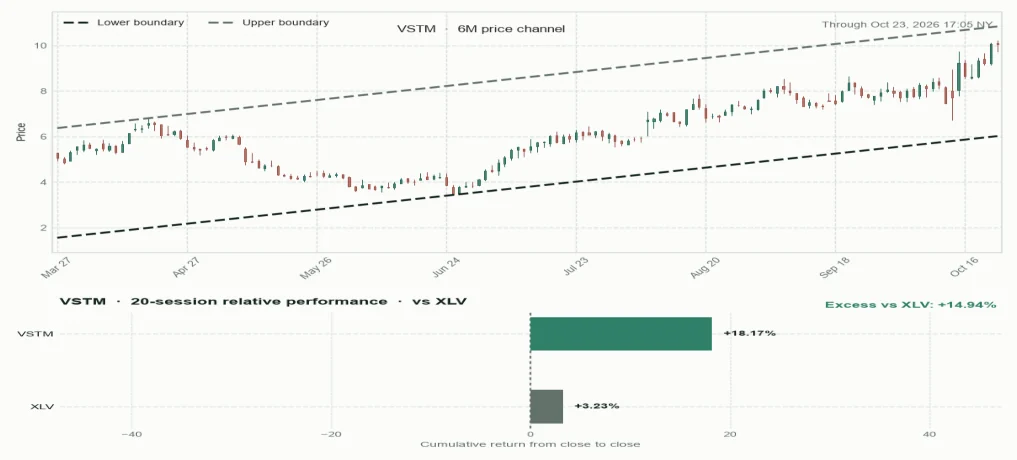
Price channel and relative performance
Forecast fan chart
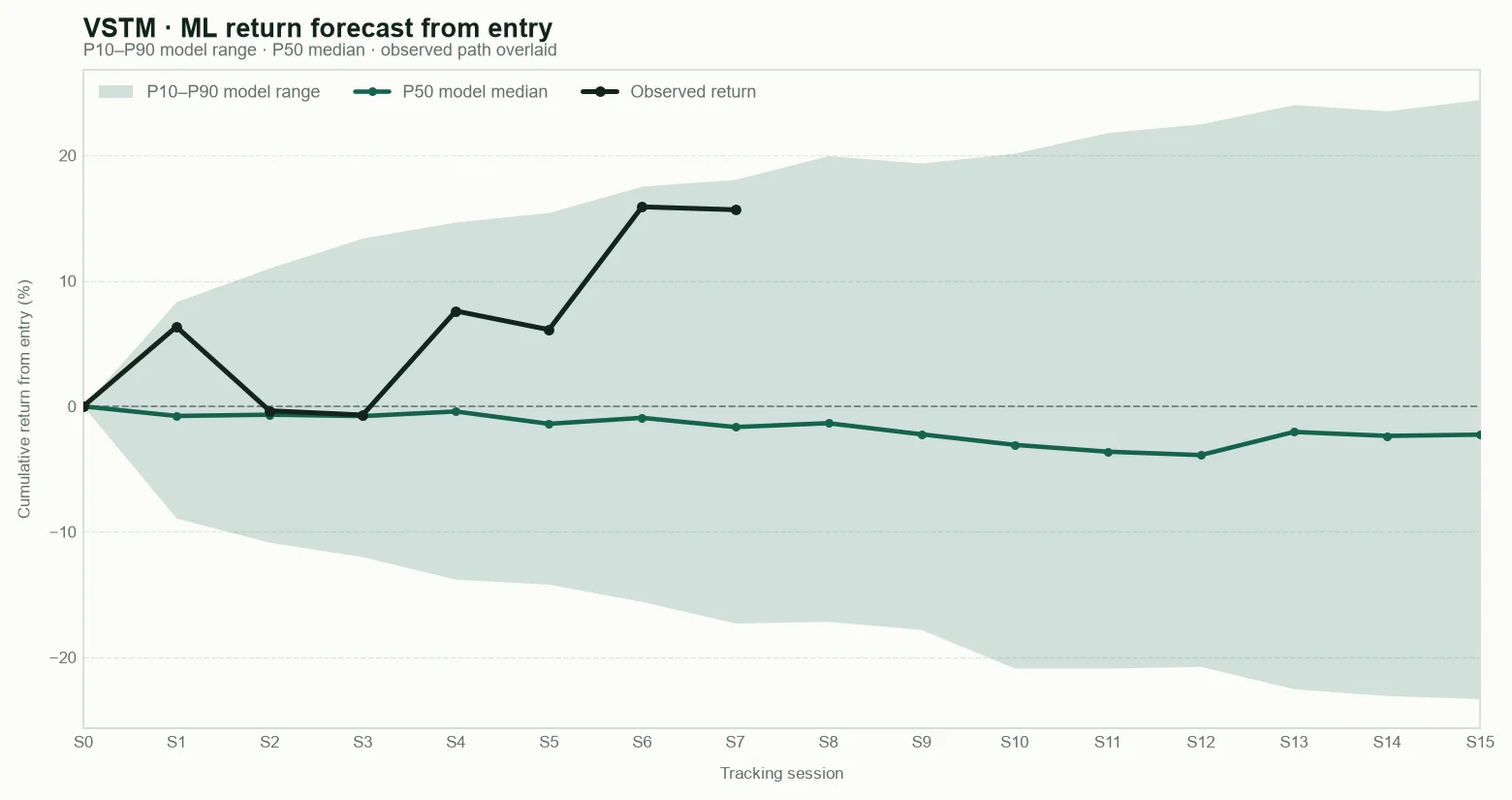
P10 — Cautious outcome: a weak result; most model estimates are above this level.
P50 — Central outcome: the middle estimate; roughly half of the model estimates are above and half below.
P90 — Favourable outcome: a strong result; only the most favourable model estimates are above this level.
These are model reference levels, not guarantees.
Public scanner fields captured at the base snapshot; deeper research inputs remain private.
Snapshot
What was captured at the base
Structure
How price is behaving
Risk and context
What may change the read
Base framework for context and outcome tracking. These are not trading instructions.
Tracking results
Observed daily-bar ranges are retrospective measurements, not targets, stops, or trading instructions.
Tryding Review
Five AI analytical agents reading the same evidence; disagreement stays visible.
“The day opened against a difficult backdrop: September inflation was higher, real hourly earnings fell, and the fresh market report had U.S. stocks lower. Our sealed benchmark snapshot was already outside its own freshness interval by the cutoff, so it frames the day without telling us what any one company will do.”
I support VSTM Raw Try. The next disclosure can test the clinical claim, and the next session can test whether the price holds its supplied prior close. That is a bounded research case, not a claim that the stock will rise.
“The sealed news cut also flags tight gasoil supply and possible further diesel-price pressure. That can matter to household and business costs, but we have no evidence tying it directly to any of these five cases.”
GENK’s restaurant sale has terms to investigate, but its supplied price was 16.67% below VWAP despite exceptional turnover. TCRT’s last pre-cut observation was down 18.481846%, also well below VWAP, and the linked market capitalization does not reconcile cleanly with the reported $350 million placement.
Broader Market Context
The day paired a gasoline-led inflation increase and weaker real purchasing power with pressure across the broad market. Energy-supply risks and the gap between ambitious AI investment plans and available power added competing forces. The older benchmark snapshot and limited breadth proxy warrant care about timing and coverage; none of this explains a company’s clinical results.
The strongest day-level tension was between rising prices and weakening purchasing power. The BLS reported September CPI up 0.6% month over month, with gasoline contributing over half the rise, while real average hourly earnings fell 0.5% from August. The Associated Press reported U.S. stocks lower after the inflation release. In the sealed market context, the benchmark snapshot was already beyond its stated freshness interval by the cutoff; a separate breadth proxy showed pressure in its covered group but was not a measure of the whole market. Energy supply made the inflation story more than a single data release: the IEA warned that tight gasoil conditions could push delivered diesel prices higher again, and the IMF said higher energy prices widen the growth gap between exporters and importers. The room pushed back on turning those observations into a universal company-cost claim; transmission and exposure matter. Another tension was financial ambition against practical capacity. The sealed cut noted leveraged ETFs’ record share of fund launches and tougher financing and power conditions for AI infrastructure. Those current sources cover product mix and reported financing or power constraints; they do not measure today's fund flows or delivered AI capacity. The discussion returned to the VSTM case only to keep the categories straight: a macro backdrop can shape risk and eventual commercial questions, but it does not validate or invalidate a clinical result. The formal Raw Try remains sealed.
Sources consulted: U.S. Bureau of Labor Statistics · U.S. Bureau of Labor Statistics · Financial Times Energy · Associated Press · IMF · The Kobeissi Letter · Jiahan Jim Liu
Coffee conversation
“There are two different pressures in the BLS numbers. September CPI rose 0.6%, with gasoline doing more than half the lifting; real hourly earnings fell 0.5%. “Real” means adjusted for inflation, so measured buying power slipped.”
“And the IEA’s gasoil warning gives that fuel line a supply mechanism: tight conditions could push delivered diesel higher again. That’s a transmission risk, not permission to pin every company’s costs on fuel.”
“Good. The household squeeze is observed; the margin math isn’t. We don’t have company-by-company exposure here, so let’s not make an energy invoice appear out of thin air.”
“The tape did react. AP had U.S. stocks lower after CPI, but the sealed benchmark snapshot was already old by the review cutoff. Those are different clocks; don’t stitch them into one exact late-day reading.”
“And the breadth proxy covered a defined sample, not every U.S. listing. It showed more decliners than advancers in that group. Useful for the session’s tone, limited for claims about the whole market.”
“The IMF’s point is a useful complication: higher energy prices can widen the growth gap between exporters and importers. That does not make every exporter a selected case or tell us which company can pass costs on.”
“The fund-launch statistic is easy to inflate into a flow story. A record share of new launches being leveraged ETFs tells us about product mix, not that investors poured record dollars into them today.”
“Exactly. A product launch is not a market-flow print. A leveraged label cannot explain today’s tape by itself.”
“The day's AI-financing note points to power and funding constraints. Ambition on one side; deliverable capacity on the other.”
“Fair. A financing outlook doesn't settle grid connection or delivered capacity. I was treating an ambition statement as physical proof.”
“That distinction matters for VSTM too. A harsher economic backdrop may shape later funding or commercial questions, but it does not tell us whether a clinical response lasts.”
“And a broad selloff doesn’t grade a trial. Price action, the macro tape, and patient outcomes can share a calendar without being the same evidence.”
Timeline
Verastem scheduled Q3 results and a business update for November 5, adding a dated checkpoint but no new clinical outcome. On session 6, VSTM's tracked gain widened 8.29 points to 14.40%; shares rose 7.60% to $9.91, above VWAP near the session high on 1.49 times average volume. Its 20-session Healthcare lead reached 20.14 points and price remains above $7.45. The model gives only 40.1% same-direction probability through session 15, with a near-flat median and a wide range, so it does not explain the strong tape or settle clinical durability.
VSTM’s tracked return rose 8.29 points to +7.60% on session 4; shares gained 7.60% to $9.28 and held 1.43% above VWAP, with time-adjusted activity at 0.29. Verastem’s Oct. 14 update reported a 41% confirmed response rate (9/22) in 2L+ pancreatic cancer after median follow-up of 6.4 months; the phase 1/2 results remain early. The company priced a $250m offering at $8 per share to support development and general needs, increasing dilution. The rebound improves the tape while clinical validation remains unresolved.
VSTM tracked gain fell 3.69 points to 0.69%; the latest quote dropped 5.04% and sits 1.85% below the session average price weighted by volume. The current price remains above the original $7.45 reference and its 20-session lead over Healthcare is 12.94 points, so the market case weakened without crossing the published price boundary; the initial response data are still early.
VSTM's tracked return improved 14.28 points to a 6.22% gain as shares rose 20.62% in the late-session capture, held 5.56% above their volume-weighted average, and traded 4.67 times normal volume; its 20-session Healthcare lead widened to 17.75 points. The market case strengthened, but the initial VS-7375 response data still lack patient counts, duration and safety detail, while a near-even, wide model range does not settle continuation.
VSTM's tracked loss narrowed 3.12 points to 8.06% as shares rose 5.84% in the early capture, 1.81% above VWAP near the top of the range; it outperformed SPY by 6.17 points, and its 20-session lead over Healthcare widened to 1.98 points. Price remains above the $7.45 reference, but initial VS-7375 response rates still lack patient counts, response duration and safety detail; the model's near-even, broad range leaves follow-through unresolved.
Since publication, VSTM's tracked return stands at -8.41%; the quote has faded from +16.22% at the initial capture to +6.24% versus the $7.45 prior close, and now sits 3.71% below VWAP. Today's volume is 13.67 times its average and the 20-session Healthcare lead is 4.98 points, while the initial clinical response rates still lack patient counts, duration and safety detail. No session-15 estimate is available yet.
Panel thesis: Verastem’s reported initial VS-7375 clinical response data provide a specific research question. The response rates are early evidence; the supplied packet does not establish response duration, patient counts, safety detail, approval, or commercial prospects. Invalidation boundary: A primary disclosure materially revises or qualifies the reported response rates, or the next observed session gives back the event move and fails to recover the supplied $7.45 prior regular close.
Panel comparison
Selected candidate versus the alternatives retained from the panel comparison.
Latest display-only snapshot · Oct 23, 2026 · 18:03 NASDAQCM
Since base +16.44% · Today -0.20% · Since prior +1.47% · Relative volume 1.19 · RSI 66.35 · EMA 9.17 > 8.6 > 7.86 · VWAP above +0.15% · 52-week high 92.80% · As of Oct 23, 2026 · 16:11 NASDAQCM
Since base +0.64% · Today -0.42% · Since prior 0.00% · Relative volume 2.47 · RSI 45.83 · EMA 2.27 > 2.33 > 2.47 · VWAP above · 52-week high 67.34% · As of Oct 14, 2026 · 16:42 NASDAQCM
Since base +2.95% · Today +3.56% · Since prior 0.00% · Relative volume 277.25 · RSI 49.99 · EMA 1.61 > 1.66 > 1.74 · VWAP below · 52-week high 53.12% · As of Oct 14, 2026 · 17:19 NASDAQCM
Since base -32.92% · Today +5.31% · Since prior 0.00% · Relative volume 11.94 · RSI 84.53 · EMA 1.72 > 1.43 > 1.5 · VWAP below · 52-week high 72.78% · As of Oct 14, 2026 · 17:19 NASDAQCM
Since base +0.21% · Today -0.21% · Since prior 0.00% · Relative volume 0.51 · RSI 64.08 · EMA 87.85 > 88.64 > 92.39 · VWAP above · 52-week high 81.44% · As of Oct 14, 2026 · 17:02 NASDAQCM
Company dossier
History, curiosities & sources

Selected facts and links behind the public profile.
Company description
Verastem Oncology is a biopharmaceutical company that develops and commercializes medicines for cancers associated with RAS/MAPK pathways. Its small-molecule programs target RAF/MEK, FAK, and KRAS G12D signaling, and it markets AVMAPKI FAKZYNJA CO-PACK in the United States.
History
- Verastem’s initial public offering took place on January 27, 2012; the company trades on Nasdaq under VSTM.
- In December 2023, Verastem selected VS-7375 as the lead program from its collaboration with GenFleet Therapeutics.
- The company’s pipeline page records FDA accelerated approval on May 8, 2025, for the avutometinib and defactinib regimen for recurrent low-grade serous ovarian cancer.
- On June 24, 2025, Verastem announced that the first patient had been dosed in the U.S. Phase 1/2a VS-7375 trial.
Curiosities
- GenFleet refers to VS-7375 as GFH375 in China; Verastem’s collaboration rights cover territories outside mainland China, Hong Kong, Macau, and Taiwan.
- Verastem describes VS-7375 as a KRAS G12D “ON/OFF” inhibitor, designed to target both active and inactive states of that protein.
- The company’s pipeline spans several signaling targets, including RAF/MEK, FAK, and KRAS G12D.