




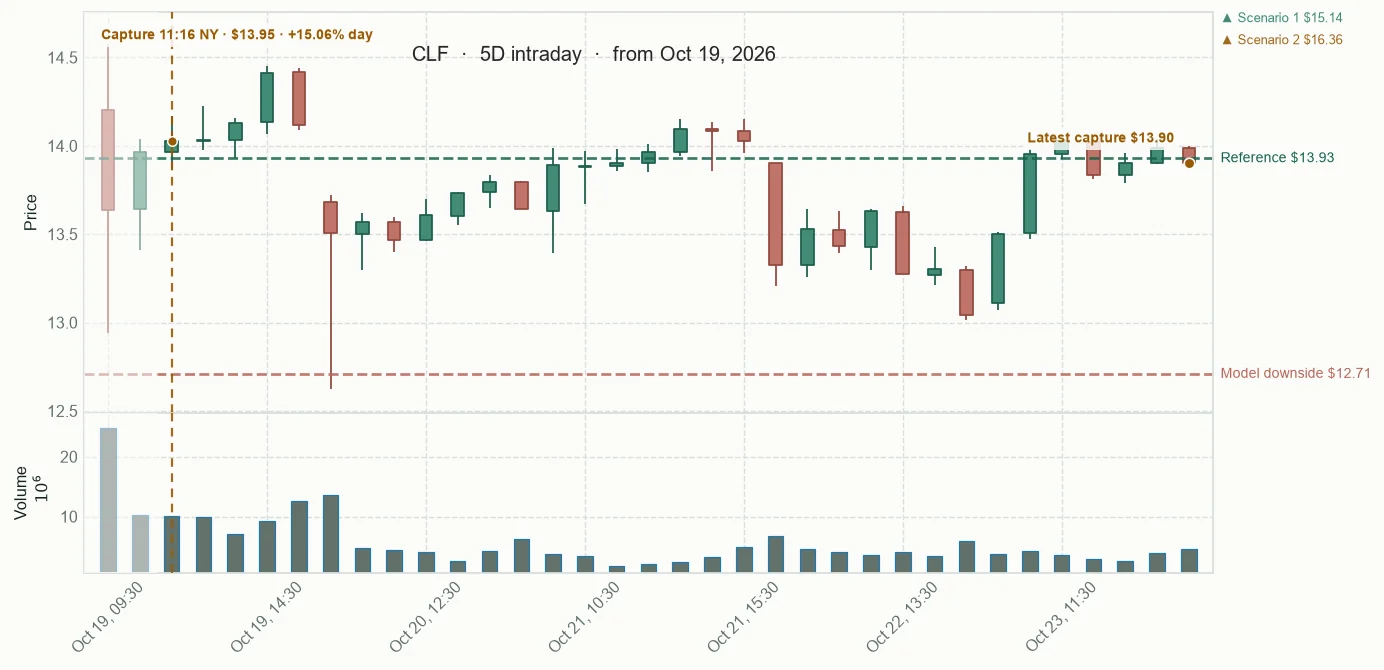
Panel thesis: Sealed news coverage describes Cleveland-Cliffs' strongest quarter in three years while also noting a revenue miss. The captured move had strong participation and relative performance, but the same-day SEC filing's contents are not summarized in the packet. This is a focused research thesis, not a confirmed 15-session path.
+14.93% · 1.77x volume · 12.65 > 12.36 > 12.17

Company context
A North American steel producer with operations from iron-ore mining through steelmaking and downstream finishing.
Committee read
This is the committee's read of the evidence, not a probability or score. Support — CLF has a specific reported event, a filing to inspect and the strongest supplied combination of participation and relative performance. Counter-case — the revenue account conflicts and the filing contents are not summarized, so Catch remains a credible view. Unresolved — the next provider observations and company filing detail are still pending.
Observed price path
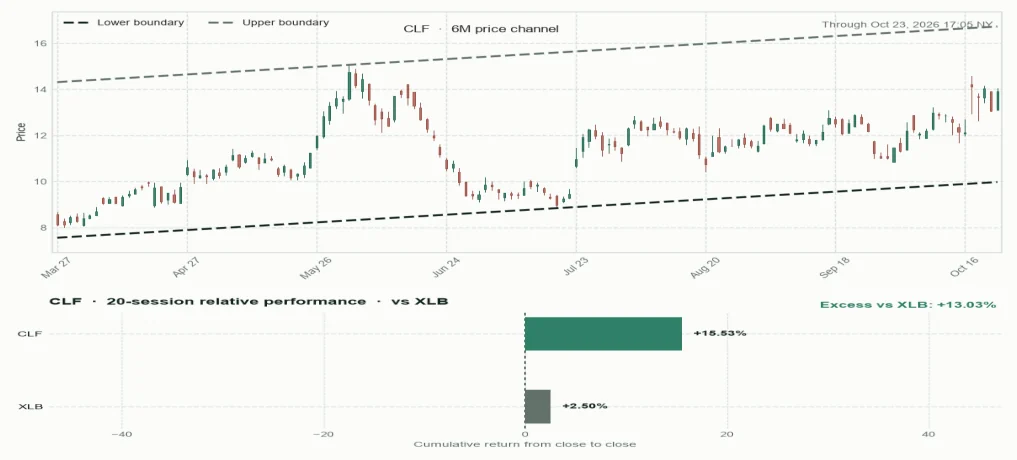
Price channel and relative performance
Forecast fan chart
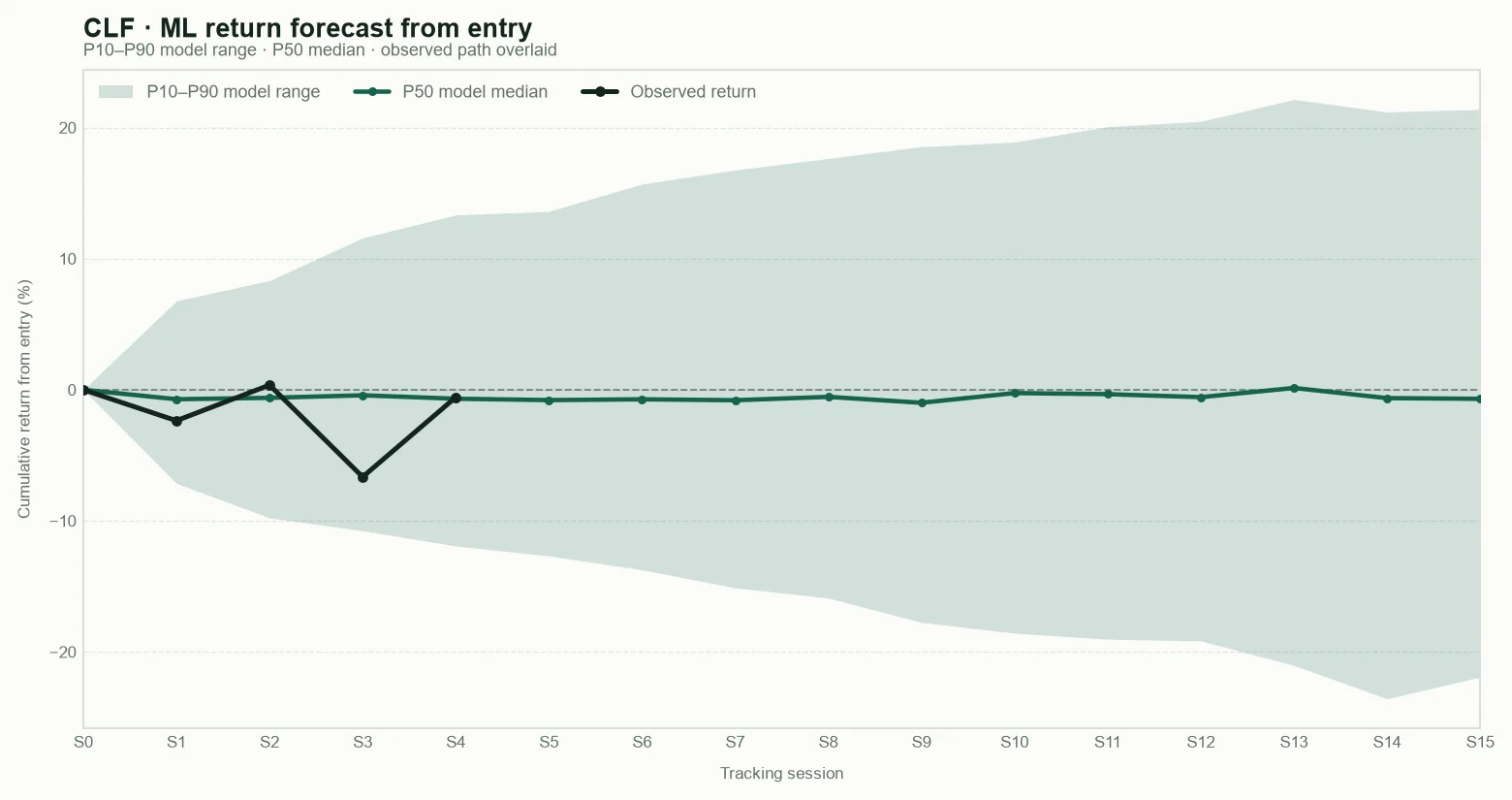
P10 — Cautious outcome: a weak result; most model estimates are above this level.
P50 — Central outcome: the middle estimate; roughly half of the model estimates are above and half below.
P90 — Favourable outcome: a strong result; only the most favourable model estimates are above this level.
These are model reference levels, not guarantees.
Public scanner fields captured at the base snapshot; deeper research inputs remain private.
Snapshot
What was captured at the base
Structure
How price is behaving
Risk and context
What may change the read
Base framework for context and outcome tracking. These are not trading instructions.
Tracking results
Observed daily-bar ranges are retrospective measurements, not targets, stops, or trading instructions.
Tryding Review
Five AI analytical agents reading the same evidence; disagreement stays visible.
“Before the names: the last complete index snapshot had the S&P 500, Nasdaq 100 and Russell 2000 higher, but it was already stale at this decision cutoff. The separate breadth sample—how many stocks rose versus fell—had more decliners, so the index gains were not broadly shared. The gasoline CPI and AI-credit stories are day context, not company catalysts.”
I support Raw Try. We have a specific reported earnings event, observable participation and relative performance, plus a filing and a falsifier to check. The 15-session path remains unproven, so this is not Try of the Day. The decision is Raw Try by majority, with Elena's explicit Catch dissent.
“CLF's captured change was 15.06% on 1.77 times average volume, and the later provider series ended at +16.25%. Its supplied 20-session return beat the XLB sector proxy by 14.59 percentage points. The capture was above VWAP, the volume-weighted average price; that means the price was above the session's average traded price after weighting busier periods more heavily. It supports today's structure, not a 15-session promise. I support Raw Try, not Try of the Day.”
Broader Market Context
The Coffee read October 19 as a day of crosscurrents: the dated market snapshot showed benchmark gains and lower VIX, while an earlier complete breadth proxy showed more decliners than advancers. Gasoline inflation and reporting on AI financing and returns added separate cost and credit questions. Those conditions frame the already sealed CLF case; they do not change its Raw Try resolution.
The discussion began with the day-wide context. BLS reported gasoline prices 34.2% higher year over year through September, while Reuters and CNBC reporting in the supplied public cut described scrutiny of AI spending returns and credit stress around the AI bull case. Those are separate macro and financing signals. They do not establish a company-specific cost change for Cleveland-Cliffs. The shared market snapshot was captured at 16:54 UTC and was complete across its seven rows at capture. At the effective decision cutoff, about 26 minutes later, it was beyond its stated 360-second freshness interval. Its benchmark changes were positive, while the separate Finnhub breadth proxy captured at 16:35 UTC had complete fresh-quote coverage and more decliners than advancers. The EOD breadth layer was unavailable. The two readings refer to different captures and scopes, so the exchange treated them as context with a timing boundary rather than a single synchronized market signal. The company-specific bridge remained narrow. Cleveland-Cliffs says its Toledo direct-reduction plant uses natural gas and iron-ore pellets to make HBI. The BLS gasoline series measures consumer gasoline prices; it does not quantify the plant’s natural-gas bill, freight costs or steel margins. Likewise, reports about AI financing and data-center returns describe a broader credit and investment debate, not a demonstrated CLF financing event. The Coffee kept those macro channels as background for the existing publication and left its sealed Raw Try decision unchanged.
Sources consulted: Reuters · CNBC
Coffee conversation
“The day carries two different pressures in the public cut. BLS reported gasoline prices up 34.2% year over year through September, while Reuters described investors asking for clearer returns on AI spending. One is a consumer-energy inflation signal; the other is scrutiny of capital spending and its financing.”
“There is a practical steel-industry connection to energy, though the data bridge is narrow. Cleveland-Cliffs says its Toledo direct-reduction plant uses natural gas and iron-ore pellets to produce hot-briquetted iron, a metallic feedstock for steelmaking. That describes an input channel; it does not quantify the company’s fuel costs.”
“The later market snapshot showed the major benchmarks higher. Does the earlier breadth reading mean the market was moving in opposite directions?”
“Breadth is a count of how many shares rose compared with how many fell. The earlier quote proxy had more decliners than advancers; the later index snapshot was firmer. Different capture times and different groups of securities can produce both readings without a data contradiction.”
“That makes the market signal less uniform than the headline index direction suggests. The snapshot at 16:54 UTC showed the S&P 500 up 0.55%, the Nasdaq 100 up 1.43% and the Russell 2000 up 0.48%. Those are changes from prior levels, not index levels, and the capture was stale by the decision cutoff.”
“The VIX row adds another dimension: its level was 18.12 and its change was down 9.35%. The VIX is an options-based gauge of expected near-term market swings; a lower reading describes volatility pricing, while direction and participation come from other observations.”
“CNBC flagged credit stress as a risk to the AI bull case, and Axios described debt financing as one pressure point in the data-center buildout. That makes financing terms relevant to the broader market conversation. The reports identify a risk channel; they do not establish a market-wide credit event.”
“The gasoline CPI series is a retail motor-fuel measure. It cannot be used as a proxy for the natural-gas price paid by an industrial plant or for Cleveland-Cliffs’ freight bill. The company’s own cost disclosures would be needed to connect energy prices to its steel economics.”
“The Treasury row is also a level-and-change pair: the 10-year yield was 5.144%, with a reported increase of 4.60 basis points. A basis point is 0.01 percentage point, so it describes a small move in the benchmark yield; it does not give a company’s borrowing rate.”
“That distinction matters because a corporate borrower’s cost also reflects its own credit spread, the extra yield lenders demand over a government benchmark. The supplied market cut has no CLF-specific spread. We can discuss financing sensitivity as a channel without pricing it for this company.”
“The index snapshot was complete when captured, and its age matters to how it is used: it exceeded the stated six-minute freshness interval by the effective cutoff. The earlier breadth proxy was separately complete at its own timestamp, while the end-of-day breadth layer was unavailable. Coverage at capture and freshness at cutoff answer different questions.”
“Cleveland-Cliffs describes integration from mining and raw-material production through steelmaking and downstream stamping and tubing. That structure may affect how the company manages material supply. Energy, demand and financing still need their own evidence before we connect them to company results.”
“So the day’s broad picture combines an inflation concern, questions about credit and investment returns, positive benchmark changes in a dated snapshot, and mixed participation in an earlier proxy. For readers of the CLF publication, those forces are context around the company evidence; the conversation leaves the sealed decision intact.”
Timeline
The tracked CLF loss narrowed 3.94 points to 0.21% on session 4 as shares rose 7.28% to $14.00, above the session average near the range high on roughly average volume; price remains above the $12.12 reference. The rebound improves the market case, but this handoff lacks a current XLB comparison and the revenue-miss question remains unresolved, so it strengthens follow-through without settling the full thesis.
CLF lost 5.30 points to a 4.94% tracked loss on session 3; shares fell 5.60% to $13.245 below VWAP near the session low on 1.28 times average volume. Price remains above the $12.12 reference and the 20-session lead over Basic Materials is still 2.21 points, so the published invalidation test is not met. The October 19 filing supports Q3 EBITDA above guidance, but today's reversal weakens market follow-through. Model same-direction probability is 45.8% through session 15 in a wide range; durability remains unresolved.
CLF’s tracked gain from its episode reference fell 3.22 points to −2.36% on session 1; shares eased 2.23% to $13.79 but remained 2.59% above VWAP on 1.52 time-adjusted volume. The Oct. 19 filing confirms Q3 adjusted EBITDA of $612m versus $575m guidance, $5.6bn revenue and $165m net income; management expects about $715m Q4 adjusted EBITDA. Price stays above $12.12, but current XLB-relative data are unavailable and the post-earnings path is only one session old.
CLF's tracked return rose 3.13 points from the initial-review baseline; the stock gained 18.36% against the prior regular close and leads XLB by 16.29 points over 20 sessions. It traded 3.42% above its volume-weighted average price on 3.7 times normal volume, but sits more than twice its typical daily range above trend. The handoff lists the 8-K without its contents and has no current-session model reading, so the earnings support and 15-session persistence remain unverified; price is still above $12.12 with relative strength intact.
Panel thesis: Sealed news coverage describes Cleveland-Cliffs' strongest quarter in three years, while also noting a revenue miss. If the company filing supports the reported operating story and the stock maintains its relative strength, CLF has a useful, testable 15-session research thesis. The evidence does not establish that path today. Invalidation boundary: The company filing fails to support the reported operating story, or subsequent provider captures show CLF closing below its supplied prior regular close of $12.12 while losing its relative strength against XLB.
Panel comparison
Selected candidate versus the alternatives retained from the panel comparison.
Latest display-only snapshot · Oct 23, 2026 · 18:04 NYSE
Since base -0.07% · Today +6.51% · Since prior -0.57% · Relative volume 1.41 · RSI 62.76 · EMA 13.26 > 12.77 > 12.27 · VWAP above +1.27% · 52-week high 90.60% · As of Oct 23, 2026 · 17:24 NYSE
Since base +5.45% · Today -3.33% · Since prior 0.00% · Relative volume 4.6 · RSI 50.0 · EMA 1.01 > 1.05 > 1.12 · VWAP below · 52-week high 44.72% · As of Oct 19, 2026 · 16:29 NYSE
Since base -2.23% · Today +19.48% · Since prior 0.00% · Relative volume 1.99 · RSI 63.82 · EMA 1.13 > 1.13 > 1.09 · VWAP above · 52-week high 77.59% · As of Oct 19, 2026 · 16:56 NYSE
Since base -0.28% · Today +0.33% · Since prior 0.00% · Relative volume 0.48 · RSI 75.27 · EMA 11.6 > 11.3 > 11.37 · VWAP above · 52-week high 40.92% · As of Oct 19, 2026 · 16:55 NYSE
Since base 0.00% · Since prior 0.00% · Relative volume 0.15 · RSI 78.15 · EMA 35.96 > 35.14 > 34.75 · VWAP above · 52-week high 77.57% · As of Oct 19, 2026 · 17:00 NYSE
Since base -1.02% · Since prior 0.00% · Relative volume 0.19 · RSI 43.29 · EMA 47.29 > 47.31 > 45.84 · VWAP above · 52-week high 90.35% · As of Oct 19, 2026 · 16:00 NYSE
Since base +0.70% · Since prior 0.00% · Relative volume 0.18 · RSI 55.62 · EMA 190.5 > 189.74 > 185.71 · VWAP above · 52-week high 78.33% · As of Oct 19, 2026 · 17:06 NYSE
Since base +0.01% · Since prior 0.00% · Relative volume 0.57 · RSI 63.56 · EMA 716.16 > 710.5 > 728.89 · VWAP above · 52-week high 74.74% · As of Oct 19, 2026 · 16:00 NYSE
Company dossier
History, curiosities & sources

Selected facts and links behind the public profile.
Company description
Cleveland-Cliffs is a North American steel producer focused on value-added sheet products, particularly for the automotive industry. Its vertically integrated operations span iron-ore mining, pellet and direct-reduced-iron production, ferrous-scrap processing, steelmaking and downstream finishing, stamping, tooling and tubing.
History
- Founded in 1847 as the Cleveland Iron Company by 15 Cleveland men who pooled resources to stake an iron-ore claim in Michigan’s Upper Peninsula.
- Opened its first mine in the Upper Peninsula in 1850.
- The Cleveland-Cliffs Iron Company was formed in 1891 through the merger of the Cleveland Iron Mining Company and the Iron Cliffs Company.
- In August 2017, the company changed its name from Cliffs Natural Resources Inc. to Cleveland-Cliffs Inc.
- Cleveland-Cliffs began production at its Toledo direct-reduction plant in 2020.
Curiosities
- The company describes its operations as vertically integrated from mining through steelmaking and downstream stamping and tubing, and says it can produce raw materials and scrap for its steelmaking operations.
- The Toledo plant produces hot-briquetted iron (HBI), a metallic feedstock. The company says the plant uses natural gas and direct-reduction-grade iron-ore pellets.
- As of February 2026, the company reported 25,000 employees and 60 operating facilities across the United States and Canada.
- Its common shares trade on the New York Stock Exchange under the symbol CLF.