



Panel thesis: DUK has the clearest observed current structure: price held above VWAP near the top of the supplied range with normal participation. The equity-units pricing event gives the panel a concrete mechanism to investigate, but financing terms, confirmation, and sector context remain unresolved.
+1.32% · 0.99x volume · 124.1 > 125.25 > 125.13

Company context
Duke Energy Corporation, through its subsidiaries, operates as an energy company in the United States. The company operates through two segments: Electric Utilities and Infrastructure (EU&I); and Gas Utilities and Infrastructure (GU&I).
Committee read
This is the committee's read of the evidence, not a probability or score. The observed DUK path and liquidity make Raw Try more defensible than Caught or TMO, but partial evidence, normal participation, sector headwind, and unresolved financing terms limit conviction.
Observed price path
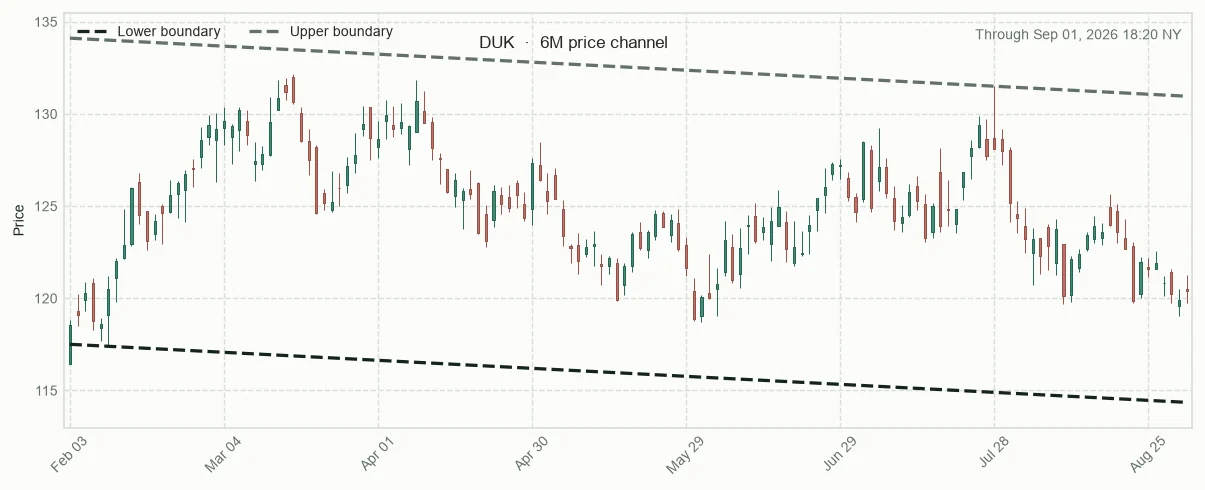
Price channel and relative performance
Public scanner fields captured at the base snapshot; deeper research inputs remain private.
Snapshot
What was captured at the base
Structure
How price is behaving
Risk and context
What may change the read
Base framework for context and outcome tracking. These are not trading instructions.
Tracking results
Observed daily-bar ranges are retrospective measurements, not targets, stops, or trading instructions.
Tryding Review
Five AI analytical agents reading the same evidence; disagreement stays visible.
“Start with the trajectory. DUK has nine ordered observations and a positive path into the supplied window close. TMO also has a path, but it is quiet and extended. Missing evidence is not a vote for Caught; it is a boundary on the claim.”
Resolution: majority selects DUK as Raw Try. The record proves an observed constructive path and a researchable catalyst, not completed confirmation. The decision is separate from the market narrative; no candidate is Caught because DUK supplies a next check and falsifier.
“The live question is DUK's equity-units pricing. Is that defensive capital being raised into a favorable tape, or dilution wearing a utility costume? TMO's five-year India story is interesting, but five years is not a catalyst for this session.”
TMO remains the dissenting alternative, not the selected case. Its India thesis has a long runway, but the evidence does not say why today, and the insider-sale event does not improve the near-term mechanism. DUK gives us a falsifiable question now.
Broader Market Context
The day-first context is a mixed and uncertain US market backdrop: index futures are muted/wavering, the US-Iran impasse is lifting oil prices, and the brief flags possible future earnings-growth risk. It informs uncertainty and keeps the daily candidate decision separate from the market narrative.
The context brief is market framing only. It does not establish a daily selected case, override candidate trajectories, or turn a missing view into negative evidence. The committee used it to test whether DUK's defensive-rotation hypothesis was plausible, then returned to the observed candidate packet for selection.
Sources consulted: Reuters · Yahoo Finance · Investing.com · Motley Fool · Motley Fool · Motley Fool
Timeline
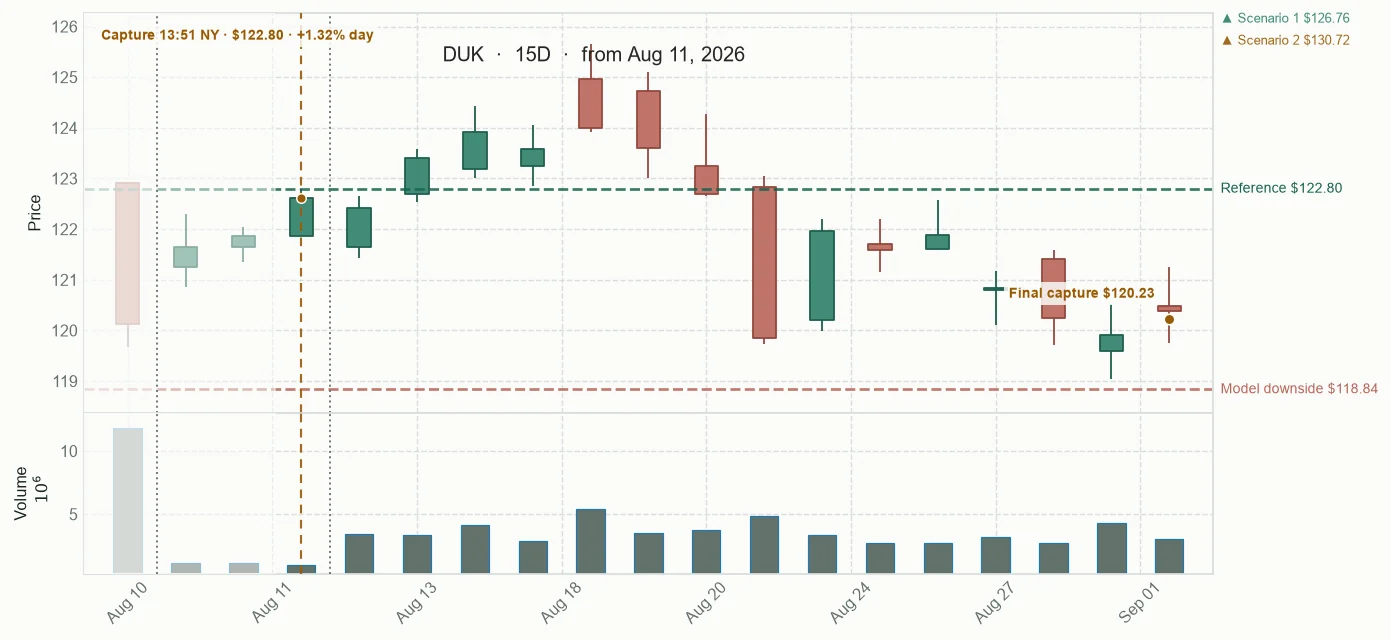
DUK closes after fifteen sessions with a canonical -1.96% result from the published $122.80 reference. The path reached +2.33% at best and -3.06% at worst. The fresh regular capture was $120.39, up 0.40% on the session; the separate post-market quote was $120.07 (-0.27%). The original equity-units thesis remained a research question: early strength did not become durable, participation and structure repeatedly weakened, and the financing mechanism stayed unconfirmed. Current RSI, EMA and 52-week fields are unavailable. Public tracking ends.
Panel thesis: Research whether DUK's capital action is being absorbed as defensive capital access or rejected as dilution risk while the tape holds above VWAP. Invalidation boundary: A materially adverse financing structure, a loss of VWAP with expanding volume, or failure of the observed strength to persist on the next ordered check.
Other candidates
Alternatives retained from the source publication.
Latest display-only snapshot · Sep 1, 2026 · 18:20 NYSE
Since base +0.32% · Today +0.00% · Since prior +2.66% · Relative volume 0.99 · RSI 35.14 · EMA 124.1 > 125.25 > 125.13 · 52-week high 91.28% · As of Aug 11, 2026 · 18:40 NYSE
Company dossier
History, curiosities & sources

Selected facts and links behind the public profile.
Company description
Duke Energy Corporation, through its subsidiaries, operates as an energy company in the United States. The company operates through two segments: Electric Utilities and Infrastructure (EU&I); and Gas Utilities and Infrastructure (GU&I). The EU&I segment generates, transmits, distributes, and sells electricity to customers in the Southeast and Midwest regions. It generates electricity through coal, hydroelectric, natural gas, oil, renewables, and nuclear fuel. This segment also engages in the wholesale of electricity to municipalities, electric cooperative utilities, and other load-serving entities. The GU&I segment distributes natural gas to customers in the residential, commercial, industrial, and power generation natural gas sectors; and invests in pipeline transmission projects, renewable natural gas projects, and natural gas storage facilities. The company was formerly known as Duke Energy Holding Corp. and changed its name to Duke Energy Corporation in April 2006. Duke Energy Corporation was founded in 1904 and is headquartered in Charlotte, North Carolina.
History
- In March 1904, the first hydroelectric dam on the Catawba River began operating with the Victoria Textile Mill as its only customer.
- James B. Duke joined the Catawba Power venture in 1905; it became Southern Power Company, and the Great Falls Dam began sending power to Charlotte in 1907.
- Southern Power began accepting residential customers in the 1910s after textile manufacturers asked it to serve workers living near their mills.
- Oconee Nuclear Station became Duke Power's first nuclear station, with Unit 1 entering commercial operation in 1973 and Units 2 and 3 in 1974.
- Duke Energy has studied batteries and microgrids since 2008, including a 9-megawatt battery in Asheville and a solar-battery microgrid in Great Smoky Mountains National Park.
Curiosities
- A house call for James B. Duke's sore toe helped start a conversation about using the Catawba River for industrial electrification.
- The first Catawba River dam had just one customer, a textile mill in Rock Hill, South Carolina.
- The company's archive includes original Catawba Power Company books, utility meters and collections from several legacy utilities.
- The Great Smoky Mountains microgrid uses solar panels and a battery to power communications equipment on Mount Sterling.
- Catawba Nuclear Station Unit 1 has a renewed operating license that runs through December 5, 2043.