



Panel thesis: The Desk selects General Motors as Try of the Day after a Canadian labor agreement tied to more than C$1 billion of investment and next-generation GMC Sierra production in Ontario. The mechanism is specific and sourced, although the first market response was modest.
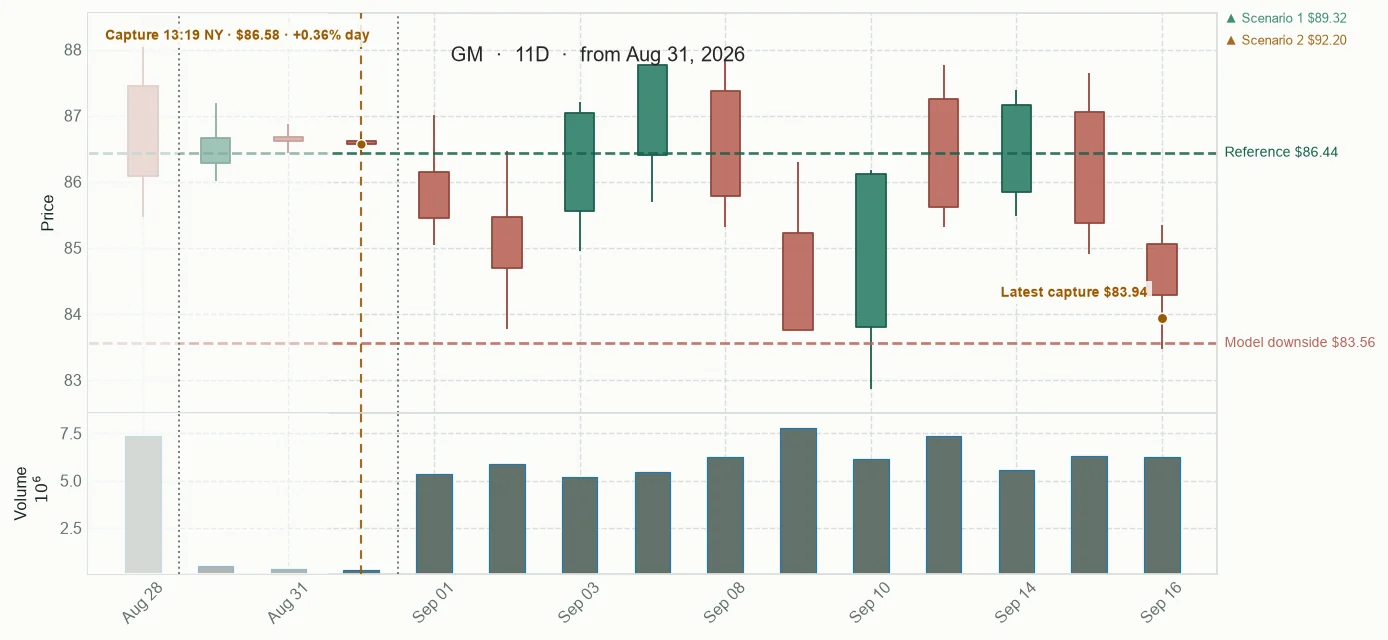
+0.36% · 0.18x volume · 86.34 > 85.95 > 84.31

Company context
General Motors Company designs, builds, and sells trucks, crossovers, cars, and automobile parts worldwide. It operates through GM North America, GM International, and GM Financial segments.
Committee read
This is the committee's read of the evidence, not a probability or score. A specific primary-supported operating catalyst, complete evidence, and modest relative resilience outweigh weaker causal matches; immediate tape softness keeps the counter-case live.
Observed price path
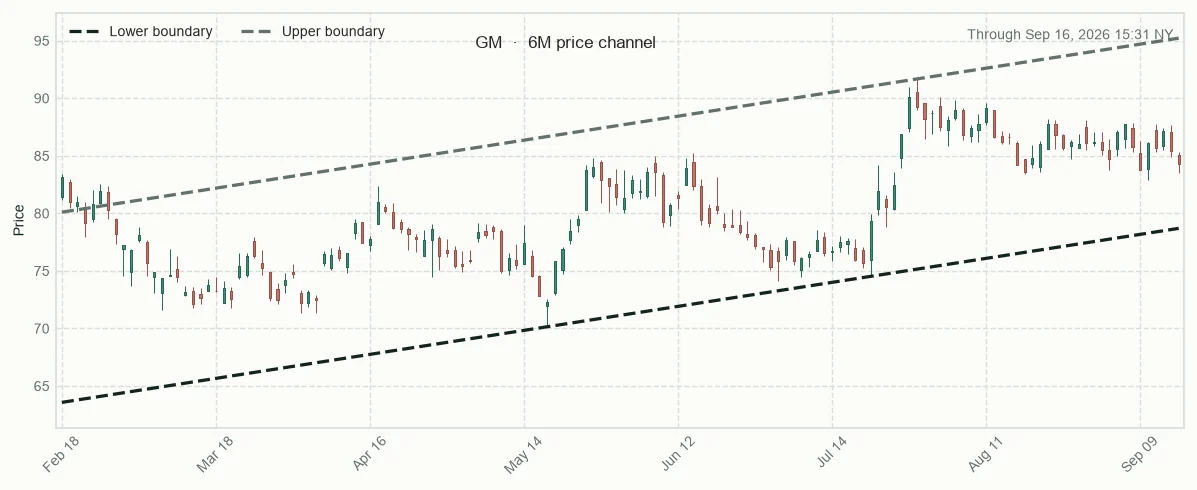
Price channel and relative performance
Public scanner fields captured at the base snapshot; deeper research inputs remain private.
Snapshot
What was captured at the base
Structure
How price is behaving
Risk and context
What may change the read
Base framework for context and outcome tracking. These are not trading instructions.
Tracking results
Observed daily-bar ranges are retrospective measurements, not targets, stops, or trading instructions.
Tryding Review
Five AI analytical agents reading the same evidence; disagreement stays visible.
“I want a case whose mechanism survives ordinary friction: a gap, thin liquidity, and a weak tape should not be mistaken for an edge. I will ask what can actually invalidate the story over fifteen sessions.”
Then my dissent is about immediacy, not identity. Consumer-cyclical pressure, tariff uncertainty, and intraday softness can overwhelm a good corporate fact. I support GM only as a monitored research case: no target, no entry, no portfolio instruction. The next evidence should be execution, not louder adjectives.
“My first question is provenance. I want to know which facts were available when the case was sealed, how much of the market record is complete, and where missing fields stop the inference.”
Resolution: GM is Try of the Day by majority with dissent on near-term tape confirmation. The committee has compared all 33 valid candidates, retained EC, VVX, AGCO, and RNXT as the strongest alternatives, and marked the next falsifier. The formal decision is complete; the context roundtable may add public background but cannot reopen selection.
Broader Market Context
A broad day-first market context conversation followed the formal GM decision without reopening selection.
The public context points to a risk-off day shaped by renewed Middle East escalation, higher oil sensitivity, and renewed attention to rates and Treasury yields. The roundtable uses that background to explain why modest relative resilience matters while refusing to turn macro weather into company-specific proof. The formal GM decision is preserved, the next falsifier stays operational, and no X material is included because the bounded cursor had no usable record in the current window.
Sources consulted: Source · Source · Source · Source · Source · Source
Coffee conversation
“Coffee first: the broad public picture is risk-off. AP described stocks lower as oil rose after renewed Iran-related escalation, while the market-day reporting also put rate expectations and Treasury yields back in the room. That is useful weather for the case, not a new candidate filter.”
“And the sealed market snapshot agrees on participation: 100 advancers, 199 decliners, and one unchanged issue, with complete intraday coverage. The end-of-day layer is absent, so the correct sentence is broad weakness in the available snapshot, not a grand closing verdict.”
“Which makes the GM response interesting but not magical. A risk-off backdrop can make relative resilience informative, while the same backdrop can pressure a consumer-cyclical company and complicate tariff-sensitive production. Macro context raises the question; it does not answer it.”
“Right. The tape is the quiet colleague at the table. It is not confirming a triumph, and it is not screaming failure. Since GM has no supplied structural view, I am keeping the visual claim narrow and letting the dated operating fact carry the burden.”
“The formal decision stays preserved: GM is Try of the Day, with dissent about immediacy. This coffee is allowed to sharpen the public explanation, not to hold a second vote. The useful distinction is traceable evidence versus atmosphere.”
“Exactly. The Canadian agreement is not a hedge against war, and I will not sell it that way. Its mechanism is narrower: investment and named production create an operating path that can be checked. The SEC filing and corroborating reports make that path public and dated.”
“Good, because the lazy macro sentence would be that geopolitical stress somehow helps GM. It does not. The stress can change costs, demand, and policy conditions in either direction. The falsifier remains execution plus later market behavior, not a louder oil headline.”
“The public context also says the rate path is less comfortable, with inflation and possible September tightening in focus. That is a cross-asset constraint, not GM evidence. It belongs in uncertainty, alongside the missing end-of-day layer, and nowhere in the selection formula.”
“It also changes the alternative set. RNXT's chart is cleaner, but small-cap clinical stories carry more gap risk when the tape gets defensive. EC gets a better oil backdrop, yet oil is still not a company-specific confirmation. GM remains the less theatrical case.”
“That is the reframe I can live with: not safe, not obvious, simply more traceable. The model signal helps rank the sealed field, but the editorial decision rests on the event, the corroboration, and the explicit way it could fail.”
“And EC should remain visible in the public comparison precisely because the energy context is live. Its transaction is real; it just asks the reader to make one extra inferential jump from sector weather to company repricing. GM asks for fewer jumps.”
“No target, no entry language, no portfolio detour. Over the fifteen-session journal, the question is whether the investment-and-production link stays credible and whether the market response remains consistent with that explanation. If not, the story gets smaller.”
“The bounded X cursor was checked after the formal resolution and contained no usable record in the current window. I am leaving X out rather than laundering older or out-of-window material into today's context.”
“Then the public close is clean: broad risk-off context, a specific GM operating event, modest relative resilience, and a named falsifier. No second selection, no borrowed certainty.”
Timeline
GM tracked result improved 3.11 points to 0.00% from the last panel note, but the latest capture slipped 0.39% to $86.60 and sat 0.39% below VWAP in the lower part of its range on 0.09 times average volume. The Canadian investment and production mechanism remains specific, and relative resilience versus its weak sector persists; however, the current tape does not confirm operating follow-through or a durable hold.
GM's tracked result moved from -1.81% to -3.11% since the last public note as the latest capture fell 2.37% to $83.76, below VWAP near the lower third of its range on 1.09x average volume. The Canadian investment and production agreement remains a specific operating mechanism, but the market has not supplied follow-through or restored relative resilience.
Panel thesis: The labor agreement links a stated investment commitment and named Ontario production to a checkable operating path over the fifteen-session horizon. Invalidation boundary: The thesis is weakened if later evidence fails to connect the agreement to execution, or if GM loses its relative resilience as the market stabilizes; a reversal without operating follow-through would be the clearest combined falsifier.
Panel comparison
Selected candidate versus the alternatives retained from the panel comparison.
Latest display-only snapshot · Sep 16, 2026 · 16:27 NYSE
Since base -3.25% · Today -2.03% · Since prior -0.93% · Relative volume 0.55 · RSI 41.94 · EMA 85.5 > 85.72 > 84.57 · VWAP below -1.16% · 52-week high 91.10% · As of Sep 16, 2026 · 15:21 NYSE
Since base +1.05% · Today +0.60% · Since prior 0.00% · Relative volume 0.48 · RSI 43.24 · EMA 16.86 > 16.87 > 16.45 · VWAP below · 52-week high 91.52% · As of Aug 31, 2026 · 17:45 NYSE
Since base +0.14% · Since prior 0.00% · Relative volume 0.17 · RSI 38.53 · EMA 78.47 > 79.82 > 80.77 · VWAP above · 52-week high 82.05% · As of Aug 31, 2026 · 17:34 NYSE
Since base +1.10% · Today +0.88% · Since prior 0.00% · Relative volume 0.57 · RSI 80.02 · EMA 110.57 > 108.35 > 109.76 · VWAP above · 52-week high 82.11% · As of Aug 31, 2026 · 17:05 NYSE
Since base +11.57% · Today +1.03% · Since prior 0.00% · Relative volume 3.1 · RSI 74.22 · EMA 1.49 > 1.32 > 1.14 · VWAP below · 52-week high 97.07% · As of Aug 31, 2026 · 17:59 NYSE
Company dossier
History, curiosities & sources

Selected facts and links behind the public profile.
Company description
General Motors Company designs, builds, and sells trucks, crossovers, cars, and automobile parts worldwide. It operates through GM North America, GM International, and GM Financial segments. The company markets its vehicles primarily under the Buick, Cadillac, Chevrolet, GMC, Baojun, and Wuling brand names. In addition, it sells trucks, crossovers, cars, and automobile parts through retail dealers, distributors and dealers, as well as to fleet customers, including daily rental car companies, commercial fleet customers, leasing companies, and governments. Further, the company offers various range of after-sale services through dealer network, such as maintenance, light repairs, collision repairs, vehicle accessories, and extended service warranties. Additionally, it provides automotive financing; and software-enabled services and subscriptions. General Motors Company was founded in 1908 and is based in Detroit, Michigan.
History
- In 1886, William Crapo “Billy” Durant and Josiah Dallas Dort formed the Flint Road Cart Company, later known as the Durant-Dort Carriage Company.
- General Motors was incorporated on September 16, 1908, as a holding company bringing Buick and Oldsmobile together.
- Within 16 months of incorporation, Durant had purchased 22 companies, including Cadillac, Oakland (later Pontiac), Oldsmobile, McLaughlin (GM Canada), and GMC.
- Durant and Louis Chevrolet founded Chevrolet Motor Company in 1911; Chevrolet launched two models in 1914 with a valve-in-head engine.
- GM’s EV1 debuted in 1996 as the first mass-produced electric car from a major automaker; the Chevrolet Volt followed in 2010 as the first commercially available plug-in hybrid in the U.S.
Curiosities
- In 1909, Durant nearly bought Ford for $8 million; a bank loan committee declined the deal, which would have made Ford a GM division.
- GM’s 1966 Electrovan used 32 fuel cells, and its powerplant and electric-drive systems accounted for 3,900 of the vehicle’s 7,100 pounds.
- The Electrovan’s safety startup procedure averaged about three hours, and the vehicle was never driven on public roads.
- GM’s 1969 XP 512E electric concept was only 86.3 inches long and 56 inches wide; its battery charged from a household 115-volt outlet in about seven hours.
- During the COVID-19 pandemic, GM says it produced 30,000 ventilators for frontline efforts.