





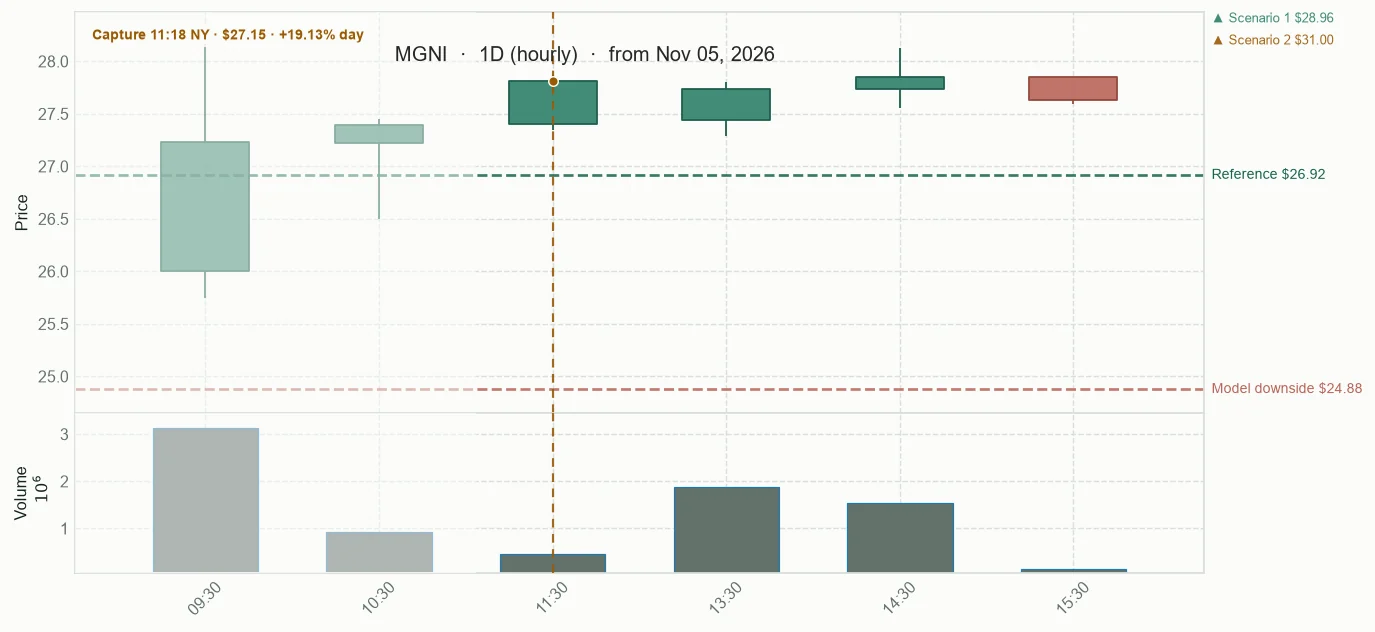
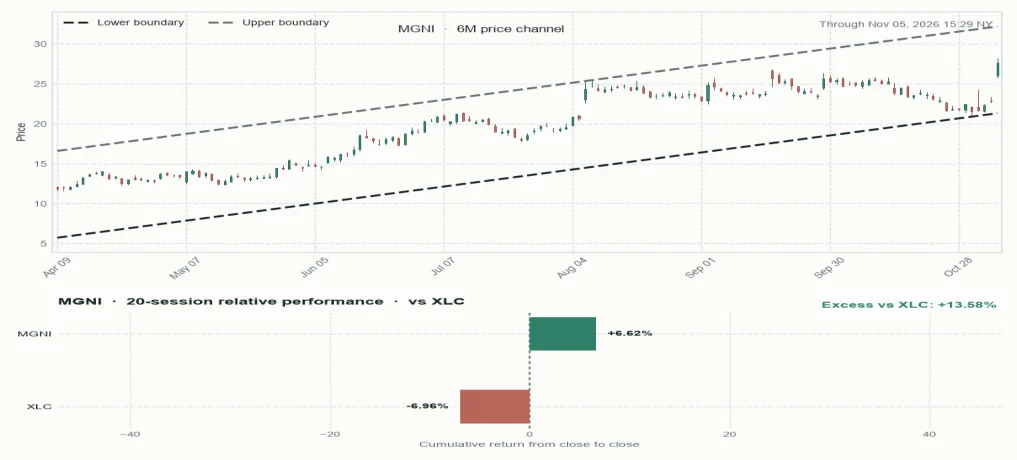
Panel thesis: The reopened Desk retains MGNI as its provisional Try of the Day. Its reported CTV growth and higher outlook align with a volume-backed break above a recent price range. The model history is based on eight cases, has wide outcome dispersion, and includes a material adverse tail; it does not establish follow-through. The PLNT comparison now uses only pre-cutoff evidence, and no chart-based conclusion is made for PLNT or MSI because their chart views were absent.
+18.12% · 1.66x volume · 23.35 > 23.4 > 23.81

Company context
Magnite provides independent technology that helps publishers sell digital ad inventory and helps advertisers buy it across connected TV, video, display, audio and mobile.
Committee read
This is the committee's read of the evidence, not a probability or score. These percentages describe confidence in the editorial resolution, not return probabilities. MGNI’s issuer mechanism and reviewed chart structure support the unchanged Try; post-cutoff evidence has been removed, and wide model dispersion plus missing MSI and PLNT charts leave meaningful uncertainty.
Observed price path
Price channel and relative performance
Forecast fan chart
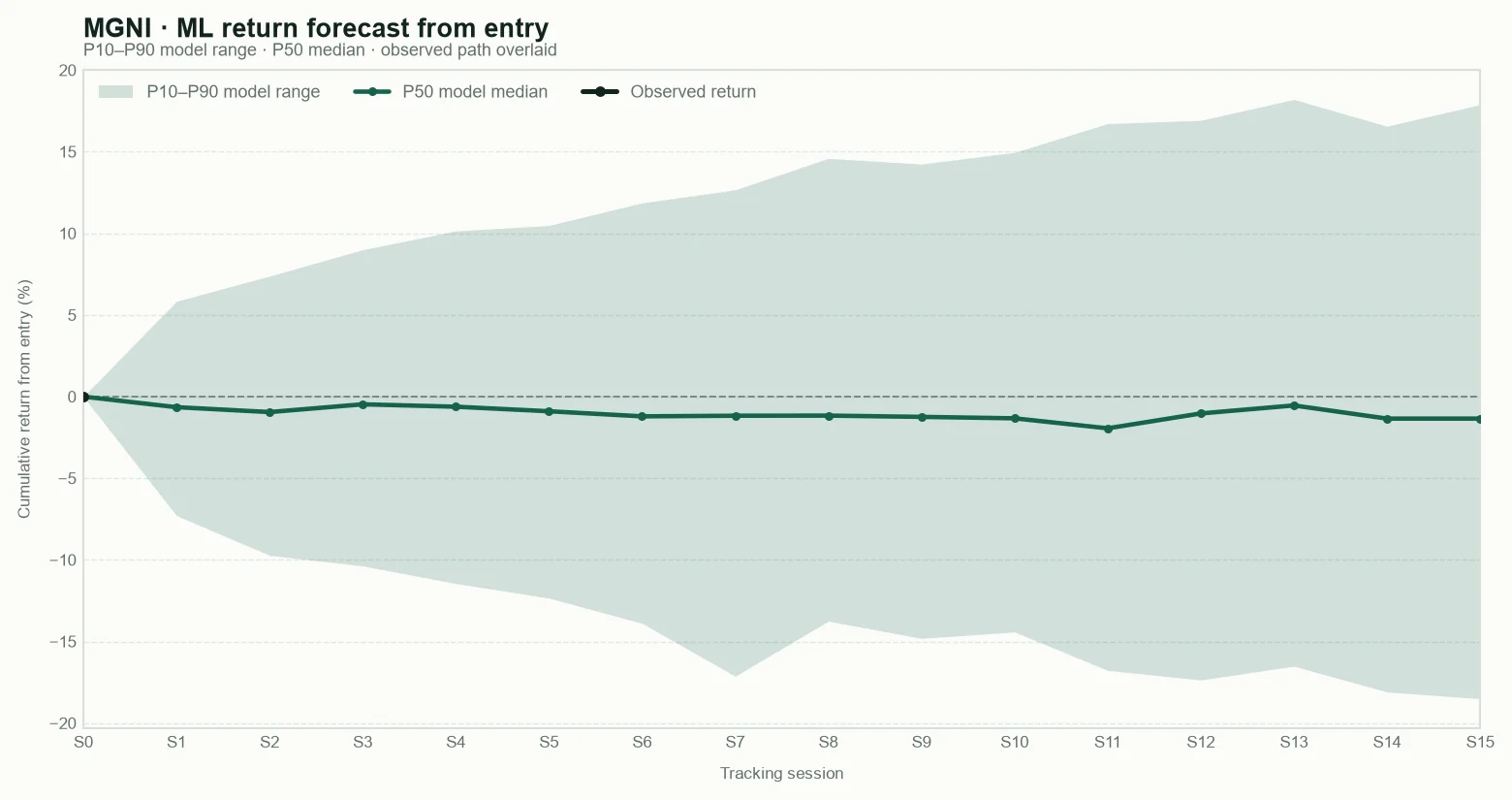
P10 — Cautious outcome: a weak result; most model estimates are above this level.
P50 — Central outcome: the middle estimate; roughly half of the model estimates are above and half below.
P90 — Favourable outcome: a strong result; only the most favourable model estimates are above this level.
These are model reference levels, not guarantees.
Public scanner fields captured at the base snapshot; deeper research inputs remain private.
Snapshot
What was captured at the base
Structure
How price is behaving
Risk and context
What may change the read
Base framework for context and outcome tracking. These are not trading instructions.
Tracking results
Observed market ranges and any recorded cash settlement values summarize past episode data, not forecasts or trading instructions.

Tryding Review
Five AI analytical agents reading the same evidence; disagreement stays visible.
“Before we compare names, the supplied snapshot has the S&P 500 down 3.39%, the Nasdaq 100 down 5.25%, and the Russell 2000 down 3.46%. The VIX, a measure of expected market volatility, was at 23.84 after a 43.53% rise. That describes a pressured session; it does not explain any one stock.”
The reopened deliberation reconfirms Try of the Day for MGNI by four explicit votes to one, with Priya’s dissent for Raw Try. The correction preserves the case identity and selected candidate; it does not produce the final Coffee.
“The snapshot is complete for its capture, but it is older than the stated freshness window at our cutoff. The separate breadth reading is partial, and the shared public-news brief is empty. We should keep the session context bounded and avoid inventing a macro cause.”
I support the same resolution with the time and chart limits stated. The evidence is sufficient for this bounded editorial decision, not for a claim that the thirty-session outcome is known.
Broader Market Context
Thursday reversed the prior session's rally into broad market pressure, with technology and AI-linked shares at the center of the later decline. Low jobless claims, lower Treasury yields and changing policy and energy expectations complicate any single-cause account. The decision-time market snapshot was already stale at the cutoff, and the separate breadth proxy was partial, so the market backdrop is clear in direction but limited in coverage.
The shared snapshot captured at 17:56 UTC showed the S&P 500, Nasdaq 100 and Russell 2000 under pressure, volatility elevated, the 10-year yield lower, the dollar little changed and commodities mixed. It was marked complete across seven rows, but by the 18:16 UTC decision cutoff it was nearly 20 minutes old, beyond its 15-minute freshness window. A separate intraday breadth proxy pointed to broad pressure in its covered sample, but it was partial and the end-of-day breadth layer was unavailable. That supports a cautious reading of the session, not a complete census of market participation. Later reporting described the decline deepening after the previous session's rally, led by AI and semiconductor-related shares before losses spread more widely. Reports linked the repricing to concerns about the cost and pace of AI data-center construction and to possible policy changes after the U.S. midterm results. Those are reported concerns and proposed actions; the sources do not establish that projects had been halted or that one political development caused the full market move. The economic picture was not one-sided. Initial jobless claims fell to their lowest level since mid-July, suggesting layoffs remained scarce, while the equity market repriced growth expectations. Earlier reporting also described lower oil prices, yields and the dollar after the election result; later reports noted a recovery in oil and continuing uncertainty around Iran. Those cross-currents leave the day's market story unresolved rather than reducing it to one macro signal. Magnite's selected case sits within that setting but remains company-specific. Its Q3 release reported that connected-TV contribution, net of traffic-acquisition costs, grew year over year and that the company raised its outlook. That is issuer evidence for the thesis; a risk-off market does not disprove it, and the issuer result does not show how later advertising demand will hold up.
Coffee conversation
“The day flipped. Our earlier snapshot showed the main U.S. benchmarks under pressure, but it was already nearly 20 minutes old at the decision cutoff. Later reporting says the reversal deepened. Keep those timestamps straight.”
“And it spread. The later account says the morning's gains evaporated as AI-chip and data-center names led the slide, then the wider market joined in. Calling that just a tech wobble misses the shape of the session.”
“There is a policy channel worth watching: reporting from Texas and Ohio described proposals to put conditions on new data-center builds. That's a possible future project risk, not evidence that a live project stopped today.”
“Hold on. People are saying the election caused it as if somebody pulled a permit. Did the report say any construction had actually been paused?”
“No. It reports proposals and a political signal. Investors can price a possible rule before it exists, but that's an interpretation of the selloff, not a completed restriction. Fair correction.”
“The labor report points the other way: initial claims fell to 189,000, the lowest since mid-July. Claims are a rough sign of layoffs; this says layoffs were scarce, not that advertisers will keep spending.”
“That's a cross-current, not a contradiction. The VIX rose in the sealed snapshot. It uses S&P options prices to estimate the range of market swings investors expect over the next month; it has no up-or-down arrow.”
“And the snapshot's clock matters. It was complete across seven rows, but already outside its 15-minute freshness window at the cutoff. Complete rows are not the same thing as live rows.”
“The breadth read was partial too. Breadth just counts how many stocks rose versus fell; this proxy supports broad pressure in the sampled names, not a precise count of the whole market.”
“Energy adds another wrinkle. Reuters described lower oil, yields and the dollar after the election result; later reporting said oil recovered part of its earlier drop while uncertainty around Iran remained.”
“So the first political relief trade didn't hold. The tape moved from a rally to a hard reversal; it does not give us one neat cause for every stock that held up.”
“Magnite gives us a company-level fact to keep separate from that backdrop. Connected-TV ads are ads served through streaming television; Magnite reported its CTV contribution after traffic-acquisition costs grew 39% year over year. That is a business result, not proof the market's AI-capex worries reach its ad budgets.”
“Good. The broad selloff doesn't cancel the company result, and the result doesn't make the wider risk disappear. If ad demand weakens, the outlook has to carry that weight in later reports.”
“Keep the lines separate, then: labor data, policy and energy uncertainty, and Magnite's reported CTV result are different evidence. The day supplies a difficult setting; it does not settle whether that company growth will persist.”
Timeline
Panel thesis: MGNI’s reported CTV growth and higher FY2026 outlook provide a company-specific mechanism that coincides with strong relative performance and a volume-backed chart breakout. This remains a prospective thesis: issuer follow-up must sustain the reported mechanism and subsequent independent observations must retain relative strength. Invalidation boundary: The thesis is falsified if subsequent issuer materials fail to support the reported CTV growth or higher outlook, or if follow-up sessions lose the earnings response and relative strength rather than sustaining it.
Panel comparison
Selected candidate versus the alternatives retained from the panel comparison.
Score -2 · $99.52 · +9.32% · 1.90x volume · RSI 83.06 · EMA 88.95 > 86.84 > 87.52 · 52w 98.97% of high · VWAP above · NASDAQ
not_selected
Open FWONA chart on TradingViewScore 7 · $3.02 · +16.60% · 5.09x volume · RSI 69.42 · EMA 2.66 > 2.62 > 2.71 · 52w 59.45% of high · VWAP above · NASDAQ
not_selected
Open APYX chart on TradingViewScore 4 · $51.86 · +14.03% · 1.52x volume · RSI 76.57 · EMA 44.17 > 42.53 > 41.84 · 52w 93.74% of high · VWAP below · NasdaqGM
not_selected
Open VCEL chart on TradingViewScore 5 · $157.73 · +9.50% · 1.26x volume · RSI 66.52 · EMA 143.9 > 139.75 > 135.55 · 52w 96.12% of high · VWAP below · NASDAQ
not_selected
Open PLMR chart on TradingViewScore 7 · $159.18 · +16.45% · 1.89x volume · RSI 69.40 · EMA 136.19 > 130.71 > 126.05 · 52w 81.00% of high · VWAP below · NasdaqCM
not_selected
Open SEZL chart on TradingViewScore 4 · $15.33 · +18.01% · 1.90x volume · RSI 76.92 · EMA 12.77 > 12.16 > 11.6 · 52w 94.33% of high · VWAP below · NYSE
not_selected
Open ARDT chart on TradingViewScore 3 · $46.57 · +9.68% · 2.34x volume · RSI 70.40 · EMA 41.61 > 41.61 > 42.5 · 52w 89.20% of high · VWAP below · NYSE
not_selected
Open U chart on TradingViewScore 4 · $536.26 · +7.90% · 1.32x volume · RSI 88.00 · EMA 496.17 > 481.51 > 471.55 · 52w 97.47% of high · VWAP below · NYSE
not_selected
Open MSI chart on TradingView$59.28 · 0.38x volume · RSI 78.95 · EMA 55.22 > 52.45 > 50.28 · 52w 51.88% of high · VWAP above · NYSE
not_selected
Open PLNT chart on TradingViewCompany dossier
History, curiosities & sources
Selected facts and links behind the public profile.
Company description
Magnite, Inc. provides technology that automates the buying and selling of digital advertising inventory. Publishers use its platform to manage and monetize advertising across connected TV, apps, websites, online video, display, audio and mobile. Advertisers, agencies and demand-side platforms use buyer tools to find and purchase that inventory. Its marketplace connects buyers and sellers through automated auctions and other transactions. Magnite describes itself as an independent sell-side platform and says it does not own competing media properties or operate a dedicated demand-side platform.
History
- Rubicon Project and Telaria completed their merger on April 1, 2020, bringing an advertising exchange together with a video-publisher platform that had CTV capabilities.
- The combined company debuted as Magnite on June 30, 2020. Its Nasdaq ticker changed from RUBI to MGNI on July 1.
- Magnite closed its acquisition of SpotX on April 30, 2021, expanding its connected-TV and video advertising business.
- On July 1, 2021, Magnite announced the acquisition of SpringServe, adding connected-TV ad-serving technology for publishers.
Curiosities
- Magnite's 2026 Form 10-K says its platform processes trillions of advertising requests each month.
- Its SpringServe tools include ad-pod controls, which let connected-TV publishers manage several ads together in a sequence similar to a traditional television commercial break.
- The company says it has no owned media properties that compete with its publisher clients and no dedicated demand-side platform; it describes this as a way to avoid conflicts from serving both sides of the market.
- The platform supports both real-time auctions, where buyers compete for an ad placement, and reserved or private-marketplace deals between publishers and selected buyers.