



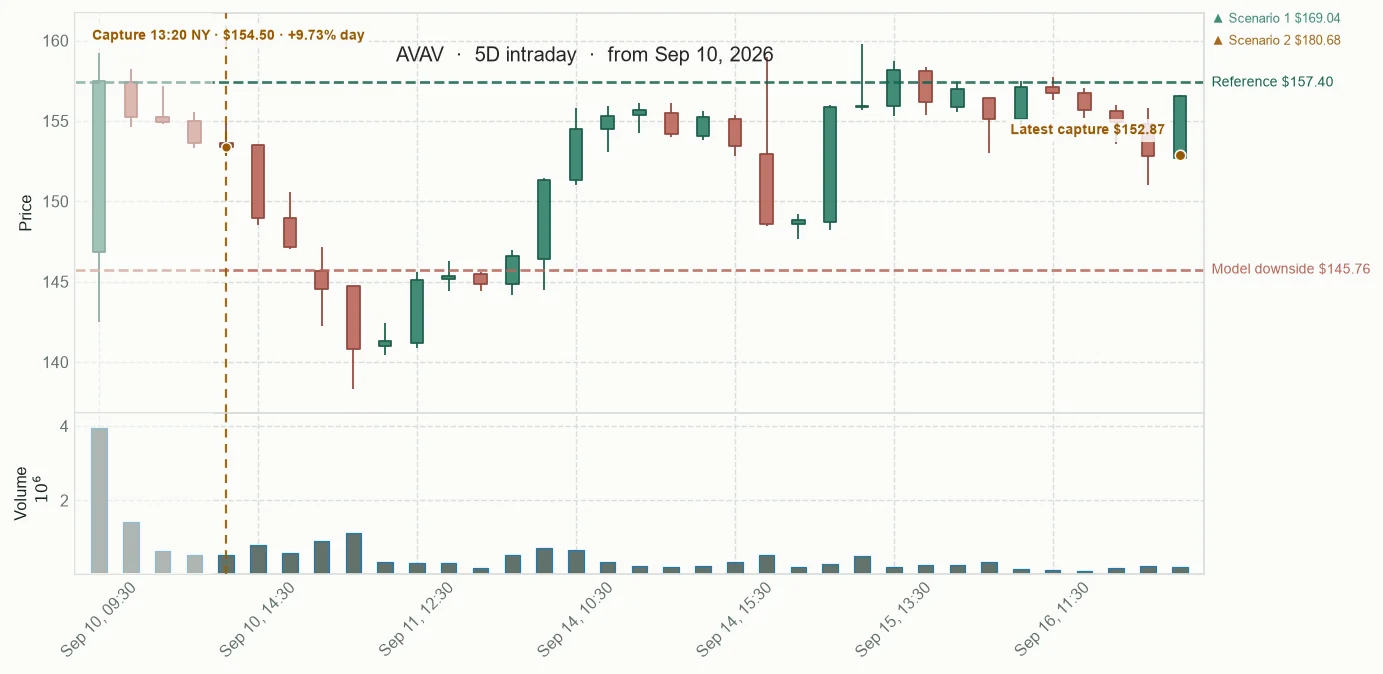
Panel thesis: The latest ordered AVAV prices are approximately 154.50-154.55 against the 153.21 VWAP reference, implying an immediate cushion of approximately 0.8-0.9%. These captures are not synchronous. MDA’s active H15 model context is 53.7% versus AVAV’s 50.4%, with a less adverse sealed H15 tail; both are bounded context from eight comparable cases, not a selection rule. AVAV’s larger-frame weakness, execution risk and need for dated backlog or program-conversion evidence remain explicit.
+11.79% · 3.00x volume · 148.91 > 154.07 > 158.19

Company context
AeroVironment, Inc., a defense technology provider, designs, develops, produces, delivers, and supports a portfolio of robotic systems and related services for government agencies and businesses in the United States and internationally. The company operates in two segments,…
Committee read
This is the committee's read of the evidence, not a probability or score. Support remains in the issuer-linked mechanism, operating context and retained participation. The counter-case is stronger after correcting the immediate cushion and acknowledging MDA’s more favorable active-model context. Larger-frame structure, execution conversion and asynchronous captures remain unresolved.
Observed price path
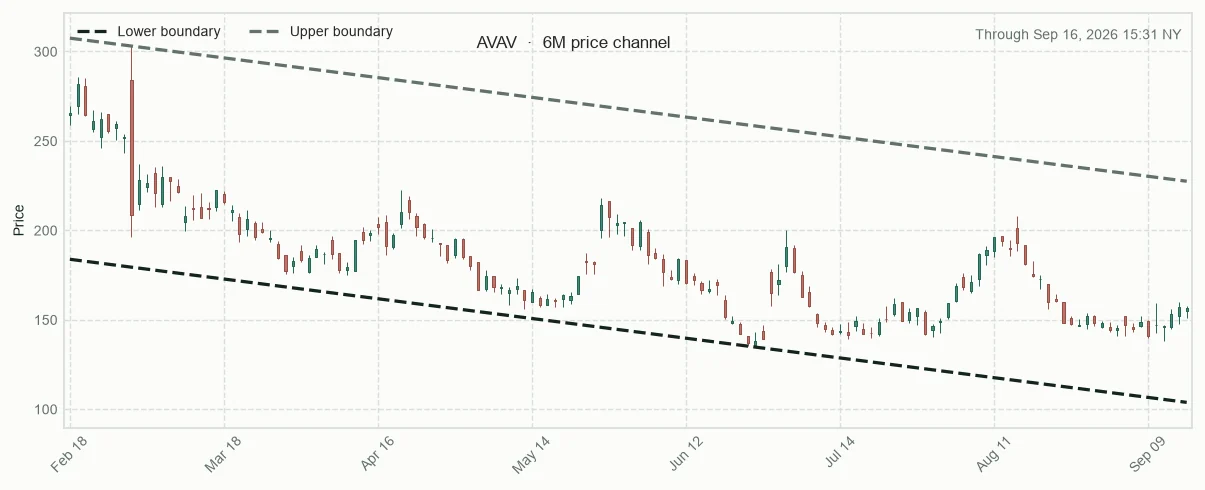
Price channel and relative performance
Public scanner fields captured at the base snapshot; deeper research inputs remain private.
Snapshot
What was captured at the base
Structure
How price is behaving
Risk and context
What may change the read
Base framework for context and outcome tracking. These are not trading instructions.
Tracking results
Observed daily-bar ranges are retrospective measurements, not targets, stops, or trading instructions.
Tryding Review
Five AI analytical agents reading the same evidence; disagreement stays visible.
“Start with the day, not the tickers. The sealed proxy has 208 decliners against 91 advancers across 300 fresh quotes. Oil, producer prices and yields make this a demanding environment for continuation, although breadth is context rather than a ranking formula.”
Both model comparisons come from eight comparable cases, and the SEC-aware inputs are contextual rather than point-in-time validated. The public record now presents probability and adverse tail together instead of using one side asymmetrically.
“Then the policy question is prospective: which company mechanism can remain useful through fifteen sessions? A large print, an internal score or a good story cannot substitute for mechanism, participation, relative behavior and a falsifiable path.”
After these repairs, AVAV still holds the same provisional Try of the Day. The thesis is narrower at the margin: the market response and dated program conversion must survive the next checks.
Broader Market Context
The day’s broad backdrop was defensive participation under simultaneous energy, inflation, rate and geopolitical pressure. The complete 300-name intraday proxy recorded 208 decliners and 91 advancers, a net -39%, with 100% fresh-quote coverage; the EOD breadth layer was unavailable. Index futures were comparatively resilient, but that resilience was narrow rather than broad market permission.
Oil remained above $100 as U.S.-Iran escalation raised geopolitical risk, while August U.S. PPI final demand rose 0.4%, including a 1.1% increase in goods and 0.1% in services. Treasury yields rose despite reported intervention, and the ECB raised key rates by 25 basis points as the conflict pushed prices higher. OPEC’s 2026 demand outlook was modest and uneven, with OECD demand forecast down 0.1 million barrels per day and non-OECD demand up 0.5 million. Against that pressure, futures and selected large-cap leadership held up, including Nvidia’s reported relative strength. The contrast matters: index stability can coexist with weak participation and concentrated leadership. For the selected AVAV episode, the defense context is relevant background, but this Coffee does not rescore the candidate or reopen the sealed decision. It simply records the macro conditions that the existing thesis must operate within.
Sources consulted: MT Newswires · Barrons.com · Motley Fool · Motley Fool · Investor's Business Daily · BLS-Labor Statistics · The Kobeissi Letter · The Kobeissi Letter · OPEC · European Central Bank
Coffee conversation
“The broad tape is defensive, not uniformly broken. The complete intraday proxy has 208 decliners against 91 advancers, or -39% net, with every quote fresh. The EOD breadth layer is unavailable, so we should keep this as an intraday participation reading.”
“That explains the apparent contradiction between resilient futures and weak breadth. A few index leaders can hold the headline while participation thins underneath. Nvidia’s relative strength is evidence of concentration, not proof that risk appetite is broad.”
“The cross-asset pressure is coherent. Oil above $100, firmer producer prices and rising long-term yields all make duration and operating-cost assumptions harder to underwrite. That is a background risk boundary for every company story, not a candidate score.”
“Policy is leaning against the market’s wish for easy conditions. The ECB’s 25-basis-point increase, explicitly linked to conflict-driven prices, shows how geopolitical supply risk can become a monetary-policy problem. The OPEC outlook is also uneven rather than a simple global-demand boom.”
“The important market-structure distinction is between headline resilience and underlying breadth. The intraday proxy has complete coverage, but its source delay ranges up to 264.6 seconds even though the median is zero. That makes the direction useful context while keeping precision bounded.”
“The inflation evidence is specific enough to matter without being exaggerated. Final-demand PPI rose 0.4% in August, with goods contributing 1.1% and services 0.1%; those are levels of reported monthly change, not a claim about every company’s costs.”
“The market is therefore sorting for mechanisms that can survive a less forgiving discount-rate and energy backdrop. That helps explain why a defense-linked AVAV narrative can remain relevant in the day’s context, but it does not add evidence to the sealed company dossier or alter the decision.”
“OPEC’s split forecast reinforces the need for selectivity: OECD demand is projected down 0.1 million barrels per day while non-OECD demand is projected up 0.5 million. Aggregate growth of 0.4 million is positive, but its distribution is uneven and does not remove regional or financing risk.”
“Source quality also differs across the day. BLS, OPEC and the ECB provide primary signals; the futures, oil and index-regime items are contextual reporting. We can connect them as a backdrop, but we should not turn headlines into a new ranking exercise.”
“So the closing read is simple: futures resilience, concentrated leadership and defensive breadth can all be true at once. The sealed AVAV decision remains unchanged; this Coffee supplies the day-level conditions against which its already-defined checks will be observed.”
Timeline
AVAV has recovered the immediate price test: it is up 1.31% at $155.41, 0.68% above VWAP and ahead of SPY's -0.5% move. But the deeper claim is still exposed: the tracked return is -0.67%, Industrials trails the market over twenty sessions, participation is only around average, and no structure confirms that the backlog story is converting into durable demand.
AVAV first tracked session is down 5.52% from the initial reference despite a 6.16% latest-session rise to USD 149.47. The move carried 4.54 times average volume, but price remained 2.34% below VWAP in the middle of the range, with no confirmed structure; over twenty sessions AVAV is down 22.77% versus an 8.49% decline for Industrials. The operating and backlog thesis remains a question, while the market has not yet confirmed the proposed path.
Panel thesis: AVAV is the Try of the Day because its issuer-linked event, defense-demand mechanism, exceptional participation and largely retained same-day reaction form the docket's most defensible prospective S0-to-S15 path. The thesis requires the market response to hold while dated issuer evidence converts backlog and program demand into orders, revenue or delivery progress. Invalidation boundary: The thesis fails if AVAV loses the 153.21 VWAP reference and then the supplied 145.76 downside reference without recovery, or if subsequent issuer evidence shows backlog deterioration, missing program conversion or weakening cash-flow execution.
Panel comparison
Selected candidate versus the alternatives retained from the panel comparison.
Latest display-only snapshot · Sep 16, 2026 · 16:27 NASDAQ
Since base -3.88% · Today -3.62% · Since prior -2.19% · Relative volume 0.56 · RSI 54.04 · EMA 150.42 > 153.08 > 158.81 · VWAP below -2.36% · 52-week high 36.20% · As of Sep 16, 2026 · 15:21 NASDAQ
Since base -1.86% · Today +1.49% · Since prior 0.00% · Relative volume 0.39 · RSI 42.84 · EMA 29.52 > 30.42 > 32.22 · VWAP above · 52-week high 60.52% · As of Sep 10, 2026 · 16:00 NASDAQ
Since base -1.31% · Today -0.32% · Since prior 0.00% · Relative volume 2.98 · RSI 80.78 · EMA 2.61 > 2.52 > 2.61 · VWAP above · 52-week high 56.18% · As of Sep 10, 2026 · 17:16 NASDAQ
Since base -0.04% · Today +0.22% · Since prior 0.00% · Relative volume 26.3 · RSI 77.23 · EMA 3.49 > 3.45 > 3.41 · VWAP below · 52-week high 80.00% · As of Sep 10, 2026 · 17:19 NASDAQ
Since base -0.76% · Today +1.46% · Since prior 0.00% · Relative volume 2.23 · RSI 55.28 · EMA 8.52 > 8.89 > 9.78 · 52-week high 41.94% · As of Sep 10, 2026 · 17:20 NASDAQ
Company dossier
History, curiosities & sources

Selected facts and links behind the public profile.
Company description
AeroVironment, Inc., a defense technology provider, designs, develops, produces, delivers, and supports a portfolio of robotic systems and related services for government agencies and businesses in the United States and internationally. The company operates in two segments, Autonomous Systems; and Space, Cyber and Directed Energy. The company provides uncrewed aircraft systems (UAS), which include small and medium UAS, and kinesis command and control software; and counter-UAS and precision strike, a loitering munitions solution that deliver actionable intelligence and precision firepower modern warfighters, including precision strike, radio frequency and kinetic C-UAS, and electronic warfare systems. It also offers autonomy, AI, and platform technologies; unmanned maritime; and uncrewed ground systems. The company provides digital beamforming technology, a multi-band/beam software defined antenna tile that allows simultaneous communication with multiple satellites; laser communications, a data transmission systems for space operations; space-qualified hardware for line of sight stabilization and control electronics in low, medium, and geostationary earth orbit, as well as cislunar orbits; phased array antenna technology to supports hypersonic telemetry and tracking, and other missile testing; and directed energy solution. It also offers cyber solutions for national security and defense operations. AeroVironment, Inc. was incorporated in 1971 and is headquartered in Arlington, Virginia.
History
- 1971: Dr. Paul B. MacCready founded AeroVironment as an engineering firm focused on difficult aerodynamic and energy problems.
- 1977: The Gossamer Condor completed the first sustained, controlled human-powered flight and won the Kremer Prize.
- AeroVironment’s Pathfinder Plus and Helios programs set high-altitude solar-powered uncrewed-flight records.
- 2007: AeroVironment became publicly traded.
- 2025: AeroVironment completed its combination with BlueHalo, expanding into space, cyber, electronic warfare and directed-energy systems.
Curiosities
- MacCready Works identifies seven AeroVironment innovations in the Smithsonian Institution’s collection.
- AeroVironment engineers worked with NASA/JPL on Ingenuity, the first powered aircraft flight on another world; Ingenuity completed 72 flights.
- The Gossamer Albatross became the first human-powered aircraft to cross the English Channel.
- AeroVironment developed the Nano Hummingbird, a flapping-wing nano uncrewed aircraft designed for precise hover and omnidirectional flight.
- The company’s historical projects include the GM Impact prototype associated with modern consumer electric-car development.