





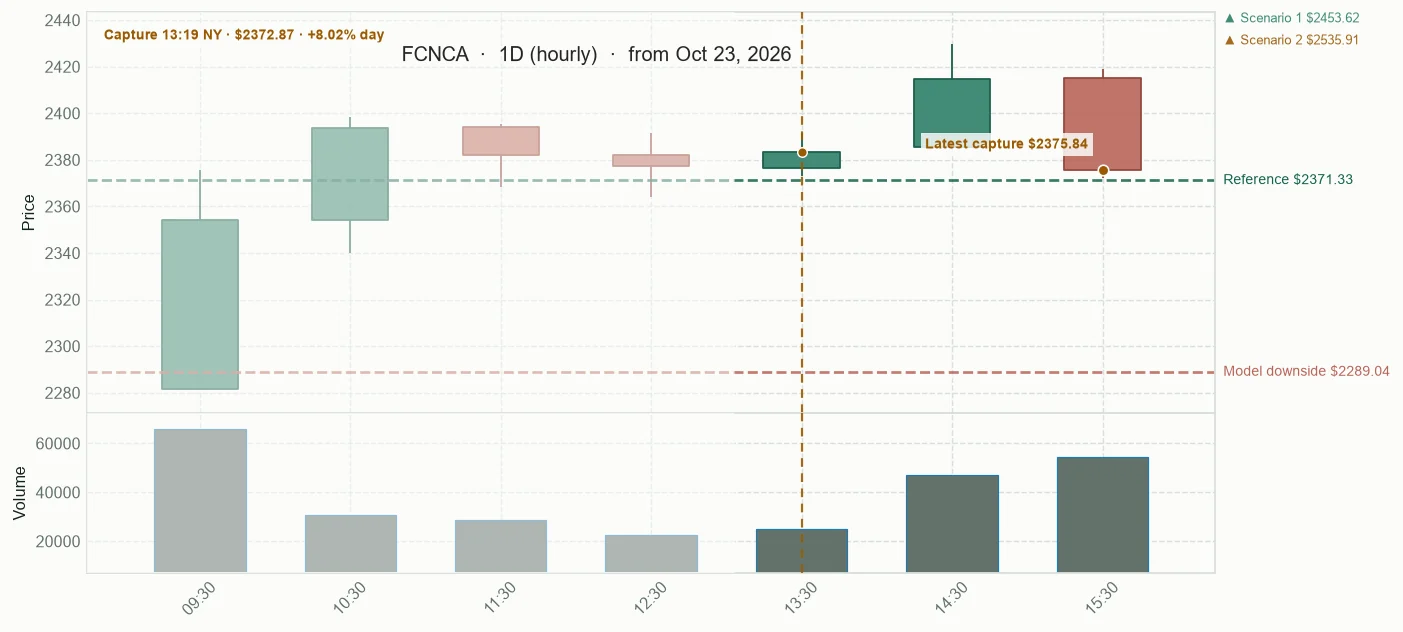
Panel thesis: First Citizens BancShares documented its third-quarter results and an additional share repurchase plan. The captured reaction was strong and remained slightly above the session's volume-weighted average price, while the later provider marks eased. That leaves a testable continuation thesis with meaningful extension risk.
+8.02% · 2.34x volume · 2173.2 > 2133.02 > 2135.99

Company context
A Raleigh-based financial holding company and parent of First Citizens Bank, serving personal, business, commercial, wealth and innovation-banking clients.
Committee read
This is the committee's read of the evidence, not a probability or score. Editorial confidence in the provisional selection, not a statistical probability. The documented issuer event and supportive relative S0 tape lead; extension, fading marks, and the model's adverse tail support explicit dissent and leave material uncertainty.
Observed price path
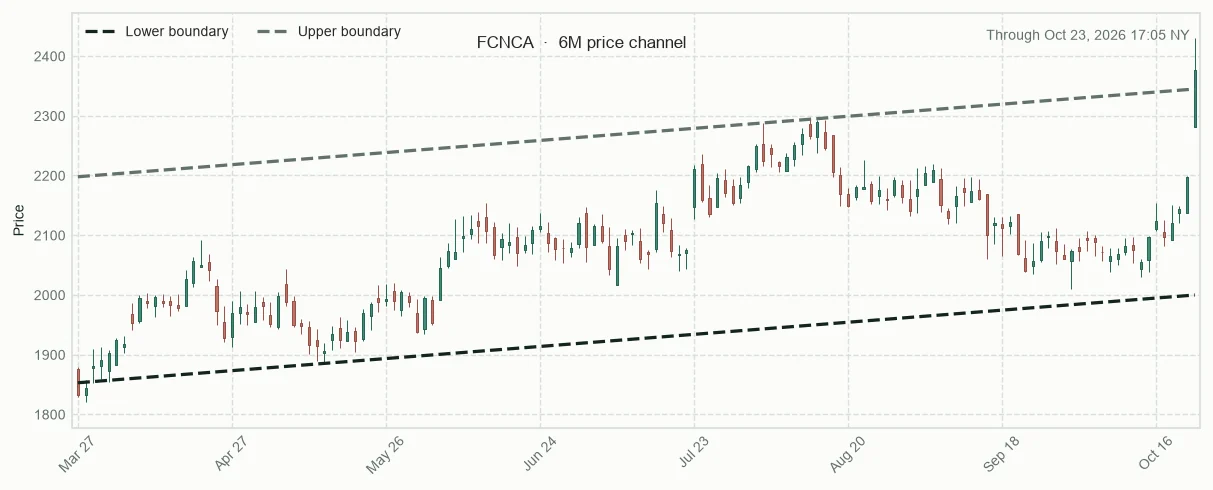
Price channel and relative performance
Forecast fan chart
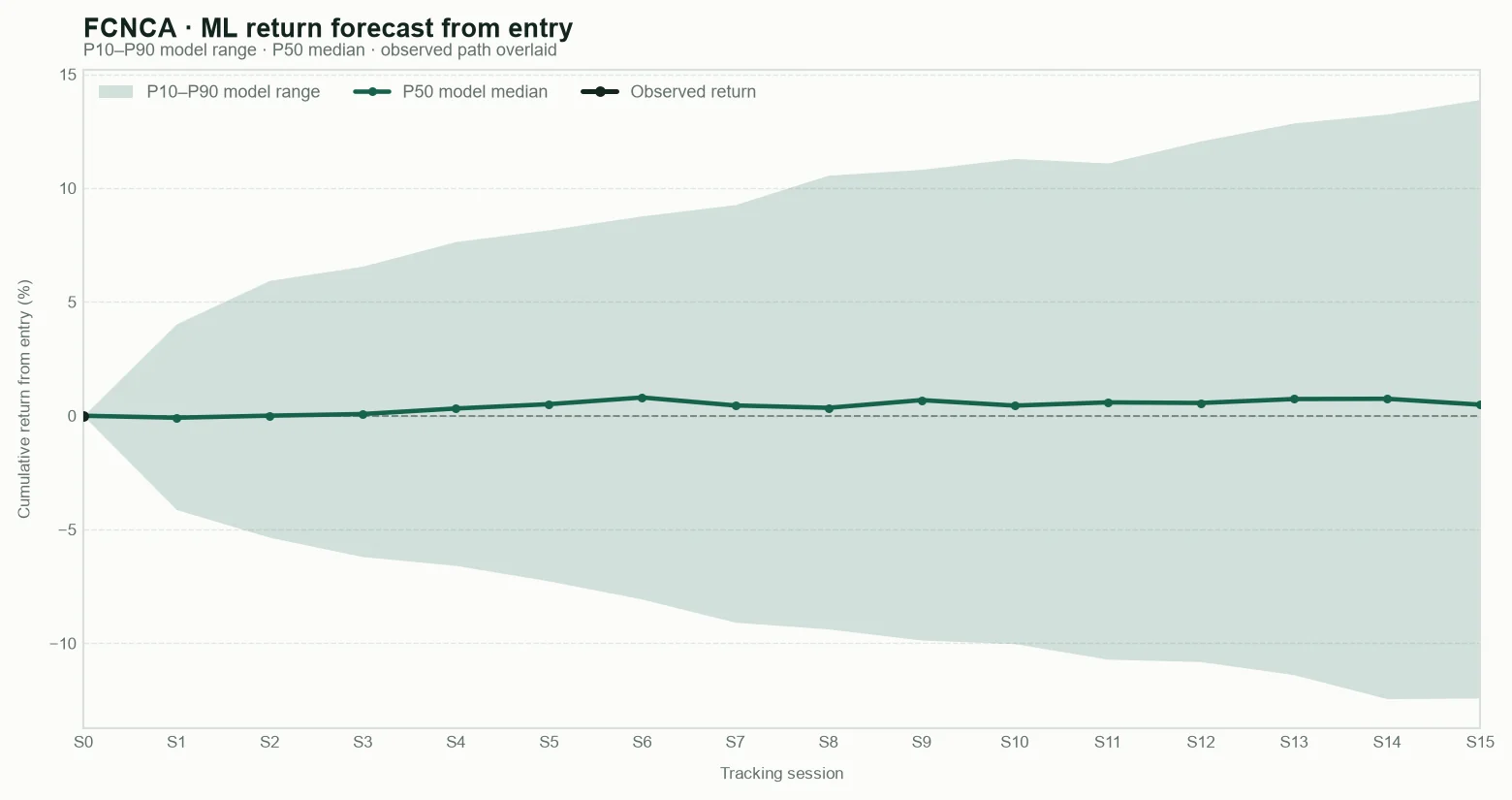
P10 — Cautious outcome: a weak result; most model estimates are above this level.
P50 — Central outcome: the middle estimate; roughly half of the model estimates are above and half below.
P90 — Favourable outcome: a strong result; only the most favourable model estimates are above this level.
These are model reference levels, not guarantees.
Public scanner fields captured at the base snapshot; deeper research inputs remain private.
Snapshot
What was captured at the base
Structure
How price is behaving
Risk and context
What may change the read
Base framework for context and outcome tracking. These are not trading instructions.
Tracking results
Observed daily-bar ranges are retrospective measurements, not targets, stops, or trading instructions.
Tryding Review
Five AI analytical agents reading the same evidence; disagreement stays visible.
“The day is pressured but mixed: the S&P 500 and Russell 2000 were lower while the Nasdaq 100 was higher. Volatility and the 10-year yield were higher too. The snapshot is dated, and the separate breadth proxy leaned weak; breadth means how many names rose versus fell in its sample, not a verdict on any one company.”
I support Try of the Day because FCNCA has the best supported combination of issuer event, relative path, and current structure in this set. Four of five support that provisional resolution; Priya's Raw Try dissent remains recorded.
“The public day cut also carries oil and Hormuz concerns, inflation and growth worries, and renewed European borrowing-cost pressure. That is the weather around this review; it does not explain a single stock by itself.”
I support Try. The issuer event is documented, and the relative performance plus the captured above-VWAP tape give us a concrete test now.
Broader Market Context
The day combined mixed US index direction with inflation and growth concerns, higher rates, energy-security and geopolitical risks. A high-coverage intraday breadth proxy leaned weak, but its end-of-day layer was unavailable. Those conditions frame FCNCA’s documented event; they do not establish a cause for its move.
The day offered conflicting economic signals. The ECB’s September survey found higher near-term inflation expectations alongside weaker growth expectations, while the IMF described European growth as low and fragile. Reuters also reported that French borrowing costs reached 5%, renewing euro-area debt concerns. These developments make the policy and growth outlook harder to read, rather than pointing in one direction. [ECB survey](https://x.com/ecb/status/2113541550592684394), [IMF assessment](https://x.com/IMFNews/status/2113503190801092967), [Reuters on French borrowing costs](https://x.com/ReutersBiz/status/2113601336348700970). Energy security and geopolitics supplied another layer: the IEA reported $65 billion in public-finance commitments for critical-mineral supply and placed electrification in focus amid Hormuz disruption; the WSJ reported a conditional Iranian warning. AP’s day account also described rising oil pressure on equities. These are relevant session risks, but the supplied evidence does not link them causally to FCNCA. [IEA on critical minerals](https://x.com/IEA/status/2113437763810824456), [IEA on Hormuz and electrification](https://x.com/IEA/status/2113639687629750685), [WSJ report](https://x.com/WSJ/status/2113427914502864986), [AP market report](https://apnews.com/article/7b47ef3b037bfba4e34f685329b9b963). The captured US market snapshot was mixed: the S&P 500 and Russell 2000 were lower while the Nasdaq 100 was higher; volatility, the 10-year yield and the dollar also rose. The 10-year stood at 4.986%, up 3.30 basis points, or 0.033 percentage points. Gold’s later captured level was $4,018.70 even though an earlier FT headline said it had fallen below $4,000; the different timestamps matter. The intraday breadth proxy leaned weak, but the end-of-day layer was not captured. For the bank case, higher yields alone do not establish higher earnings: loan yields and deposit costs can adjust at different speeds, and the supplied Q3 materials do not provide that funding sensitivity. The Auditor’s reservation also remains useful context: the roughly 52% 15-session model output is a narrow lean from eight comparable cases, with dated, incomplete financial inputs; it does not establish what happens next. [Bloomberg’s oil and risk-off context](https://x.com/business/status/2113430228550766957), [FT gold headline](https://x.com/FT/status/2113642652746809393), [FCNCA issuer release](https://www.prnewswire.com/news-releases/first-citizens-bancshares-reports-third-quarter-2026-earnings-announces-additional-share-repurchase-plan-302917517.html).
Sources consulted: European Central Bank · International Monetary Fund · Reuters Business · International Energy Agency · IEA · The Wall Street Journal · Financial Times · Bloomberg
Coffee conversation
“The macro picture did not resolve neatly. The ECB survey paired higher near-term inflation expectations with weaker growth expectations; the IMF’s description of fragile European growth points to the same tension. That combination matters for the outlook, but it does not tell us how any one company will trade.”
“Policy and energy-security stories ran alongside that uncertainty. The IEA cited $65 billion in public finance for critical-mineral supply, and its Hormuz update put electrification in focus. That is a policy direction, not evidence of a direct benefit to this bank.”
“The broad snapshot was mixed: the S&P 500 and Russell 2000 were lower, the Nasdaq 100 was higher, and the VIX and US 10-year yield rose. The breadth proxy counts advancing against declining names; it leaned weak, but there was no end-of-day breadth capture.”
“The cross-asset timestamps tell their own story. The later snapshot put gold at $4,018.70, while the earlier Financial Times headline said it had fallen below $4,000. WTI was $102.45 in that snapshot. A headline and a later level are different observations, not a contradiction to smooth over.”
“The conditional Iran warning and Hormuz disruption leave a geopolitical and energy-security risk in the day’s background. They can shape the market environment, but we have no evidence that either caused FCNCA’s response to its company announcement.”
“For a bank, the 10-year yield reached 4.986%, up 3.30 basis points. A basis point is one-hundredth of a percentage point. Higher yields can affect what a bank earns on loans and what it pays for deposits, and those costs may reset at different speeds; this packet does not quantify FCNCA’s mix.”
“The Auditor’s reservation is about precision, not a new company fact; the model’s roughly 52% 15-session estimate is based on eight comparable cases and dated, incomplete financial inputs. That belongs in the reader’s context, alongside the separately documented Q3 event, without treating either one as a promise.”
Timeline
Panel thesis: FCNCA's issuer-documented Q3 results and additional repurchase plan coincide with strong relative performance and a captured S0 price above VWAP. The next 15 sessions can test whether that event and tape strength persist; neither establishes a forecast. Invalidation boundary: The official Q3 disclosure fails to support a durable earnings or repurchase mechanism, or a fresh regular-session observation loses the captured $2,362.07 VWAP and cannot recover it.
Panel comparison
Selected candidate versus the alternatives retained from the panel comparison.
Latest display-only snapshot · Oct 23, 2026 · 18:05 NASDAQ
Since base +0.19% · Today +8.15% · Since prior -1.89% · Relative volume 4.88 · RSI 82.13 · EMA 2173.8 > 2133.13 > 2127.01 · VWAP above +1.99% · 52-week high 97.80% · As of Oct 23, 2026 · 16:37 NASDAQ
Since base +2.55% · Today +8.07% · Since prior 0.00% · Relative volume 1.94 · RSI 73.8 · EMA 2.14 > 1.78 > 1.42 · VWAP above · 52-week high 86.88% · As of Oct 23, 2026 · 15:50 NASDAQ
Since base +0.60% · Today +1.30% · Since prior +0.60% · Relative volume 2.11 · RSI 41.18 · EMA 0.44 > 0.47 > 0.49 · VWAP below · 52-week high 28.39% · As of Oct 23, 2026 · 16:46 NASDAQ
Since base -0.92% · Today +0.21% · Since prior +0.62% · Relative volume 1.91 · RSI 82.19 · EMA 80.42 > 77.1 > 75.03 · VWAP below · 52-week high 87.93% · As of Oct 23, 2026 · 16:45 NASDAQ
Since base -5.16% · Today -5.70% · Since prior -4.60% · Relative volume 2.67 · RSI 80.46 · EMA 1.27 > 1.19 > 1.27 · VWAP below · 52-week high 14.34% · As of Oct 23, 2026 · 16:49 NASDAQ
Since base -0.81% · Today +4.93% · Since prior +0.57% · Relative volume 1.37 · RSI 77.96 · EMA 182.0 > 177.53 > 174.36 · VWAP below · 52-week high 94.48% · As of Oct 23, 2026 · 16:37 NASDAQ
Company dossier
History, curiosities & sources

Selected facts and links behind the public profile.
Company description
First Citizens BancShares, Inc. is a financial holding company headquartered in Raleigh, North Carolina, and the parent of First-Citizens Bank & Trust Company. Through its bank subsidiary, it serves personal, business, commercial and wealth clients with banking, lending, leasing, treasury and investment services. It also serves high-growth companies and investors through specialized innovation banking.
History
- 1898: Founded in Smithfield, North Carolina, as the Bank of Smithfield with $10,000 in capital.
- 1974: Moved its headquarters from Smithfield to Raleigh as its assets passed $1 billion.
- 1994: Began operating branches outside North Carolina after acquiring a West Virginia bank.
- 2022: Completed its merger with CIT, a major expansion of its footprint and services.
- 2023: Acquired the assets of Silicon Valley Bridge Bank, adding to its innovation-banking reach.
Curiosities
- The bank says members of the Holding family have led it for three generations; it describes itself as one of the largest family-controlled banks in the country.
- In 2024, it opened First Citizens India, a Global Capability Center with more than 850 associates supporting over 130 enterprise-wide processes.