





Panel thesis: Hasbro leads the provisional comparison on a reported earnings and outlook event, successive pre-cut gains, and stronger 20-session relative performance. The sealed packet does not reproduce the filing's detailed contents, and the move is extended; the next check is to reconcile the issuer release and test whether price holds its prior close.
+5.83% · 1.99x volume · 97.43 > 94.37 > 93.14

Company context
A games, toys, intellectual-property and entertainment company built around owned and licensed franchises.
Committee read
This is the committee's read of the evidence, not a probability or score. The reported issuer event, successive pre-cut captures, and relative performance support HAS. The primary-detail gap and extension remain live objections, and Priya explicitly supports Raw Try.
Observed price path
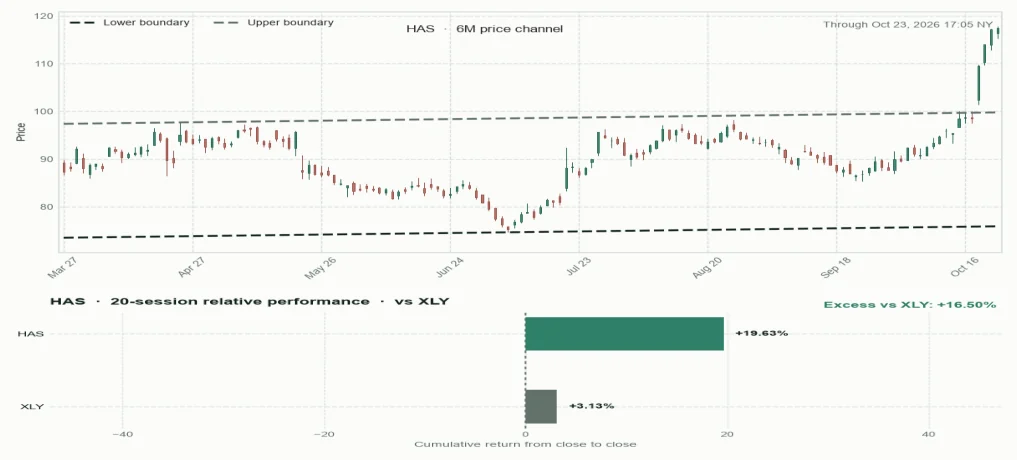
Price channel and relative performance
Forecast fan chart
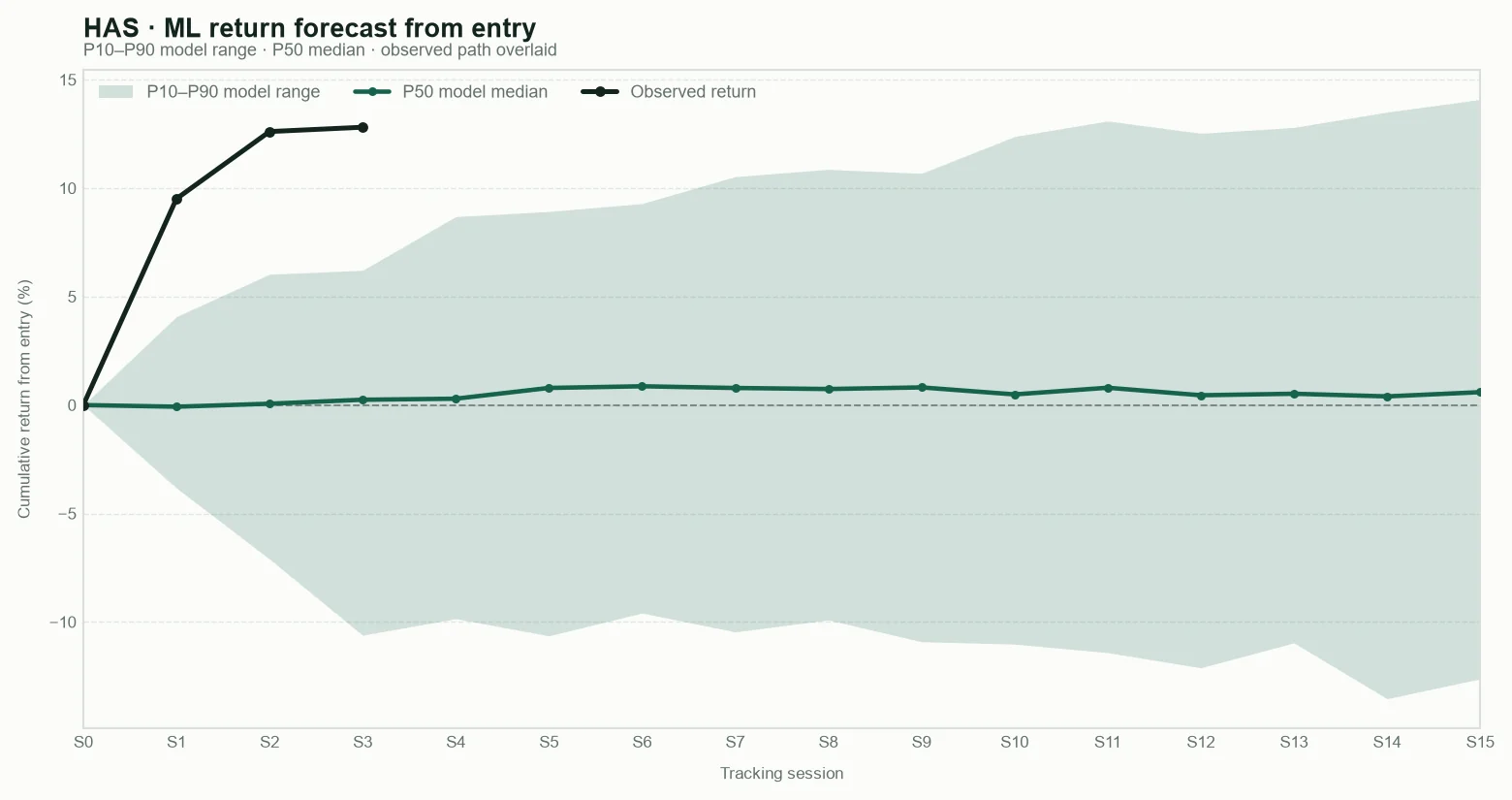
P10 — Cautious outcome: a weak result; most model estimates are above this level.
P50 — Central outcome: the middle estimate; roughly half of the model estimates are above and half below.
P90 — Favourable outcome: a strong result; only the most favourable model estimates are above this level.
These are model reference levels, not guarantees.
Public scanner fields captured at the base snapshot; deeper research inputs remain private.
Snapshot
What was captured at the base
Structure
How price is behaving
Risk and context
What may change the read
Base framework for context and outcome tracking. These are not trading instructions.
Tracking results
Observed daily-bar ranges are retrospective measurements, not targets, stops, or trading instructions.
Tryding Review
Five AI analytical agents reading the same evidence; disagreement stays visible.
“The wider session is mixed. The 14:07 UTC snapshot showed the S&P 500 up 0.28%, the Russell 2000 up 0.73%, and the Nasdaq-100 unchanged. The VIX level was 18.49, up 0.27%. That capture is about three and a half hours old at our cut, and breadth was not captured, so it is orientation rather than a live market verdict.”
YMAT's 52.65% 20-session return against XLB's 1.03% is impressive, but the Houston site is still under negotiation. Its captured volume was 1,547.9% of reported float—the public shares available to trade. That is repeated turnover, not proof of net buying. The 401.5-basis-point spread estimate is a daily-price proxy, not a live executable quote.
“The day also has real cross-currents: the IEA says AI efficiency is improving while data-center power demand rises, and NVIDIA says some workloads may shift to ease grid pressure. Reuters reports European EV sales rose 70% in September to about 30% share. Interesting forces; none is an issuer catalyst here without a direct link.”
My position is Try of the Day for HAS, on that narrow basis. Four of us support the stronger prospective path; Priya's Raw Try dissent remains explicit. The next check is the issuer text and whether the price holds its supplied $98.49 prior close.
Broader Market Context
The supplied market snapshot was modestly firm across the S&P 500 and Russell 2000, but it was more than three hours old at the effective cutoff and breadth was unavailable. The day’s other signals were mixed: GDPNow estimated 3.5% annualized Q3 growth while housing indicators showed pressure; European EV adoption and data-center power demand remain active transitions, and the tanker-policy report described a possibility rather than a confirmed change. The panel treated these as broad context, not evidence about Hasbro’s reported results.
The snapshot captured at 14:07 UTC showed the S&P 500 up 0.28%, the Russell 2000 up 0.73%, and the Nasdaq 100 essentially unchanged. VIX was at 18.49, up 0.27%; the 10-year yield was at 5.106%, down 3 basis points; and DXY was at 101.671, down 0.30%. Gold and WTI were reported at $4,146.30 and $98.45, with changes of −0.33% and −0.09%. These were captured levels and changes, not a current closing read: the snapshot was over three hours old at the effective cutoff. Market breadth—the count of advancing versus declining stocks—was unavailable, so the index readings do not establish how widely gains were shared. The Atlanta Fed’s GDPNow estimate for Q3 was 3.5% annualized. GDPNow is a running model estimate based on available data, not an official Fed forecast or the final GDP result. That growth estimate can coexist with weaker housing measures: the supplied Axios context reported September housing starts down 5.2%, pending home sales down 7.3%, and a 7.4% mortgage rate earlier in the month. The panel treated the housing figures as a possible financing and demand pressure, not proof of an effect on any particular company. The sector and policy stories also carried different levels of certainty. Reuters reported European EV sales rose 70% in September to about 30% market share, a specific regional adoption signal. The IEA described improving AI efficiency alongside rising data-center electricity demand; NVIDIA’s statement said workloads may shift to support grid relief, which is a possible operating response rather than evidence that grid constraints are resolved. The tanker item said sanctioned vessels may be allowed to resume legitimate crude shipping, not that such a policy change had occurred. The World Bank’s small-AI and jobs statement was framed as potential. For the selected HAS case, these wider conditions remain background; they do not verify the company-specific earnings and outlook report.
Sources consulted: Federal Reserve Bank of Atlanta · Axios · International Energy Agency · Javier Blas · Reuters Business · World Bank Group · NVIDIA
Coffee conversation
“The captured market tone looks firm but uneven: at 14:07 UTC the S&P 500 was up 0.28% and the Russell 2000 up 0.73%, while the Nasdaq 100 was essentially flat. But that snapshot predates our effective cutoff by more than three hours.”
“The Russell reading suggests smaller-company shares were stronger in that snapshot. I would call that a difference between the indexes, not proof that most stocks joined in.”
“Right, breadth means counting how many stocks rose versus fell. That measure was unavailable, so we cannot tell from these index numbers whether the move was broad or concentrated.”
“And the snapshot’s own freshness window was six minutes. By the cutoff it was a useful dated reference, but it cannot stand in for the market’s closing picture.”
“Keep levels and changes separate: VIX was at 18.49, up 0.27%; the 10-year yield was at 5.106%, down 3 basis points. A basis point is one hundredth of a percentage point, so that yield move is 0.03 percentage points.”
“There is also a growth signal. GDPNow estimated Q3 real GDP growth at 3.5% annualized on October 20.”
“When you say GDPNow, is that the government’s reported GDP number?”
“No. It is a running model estimate built from data available before the official GDP release. The Atlanta Fed says it is not an official forecast; 3.5% is an estimate, not the final result.”
“And the housing figures pull the other way: September starts were down 5.2%, pending sales down 7.3%, with mortgage rates at 7.4% earlier in the month. That is a financing-sensitive part of the economy under pressure.”
“Those readings can coexist. GDPNow estimates the whole economy’s quarterly growth; housing is one area where borrowing costs can weigh on activity.”
“Reuters also reported September European EV sales rose 70% to about 30% market share. That is a concrete adoption signal, but it is tied to one region and one month.”
“The tanker story is softer still: the wording is that sanctioned vessels may be allowed to resume legitimate shipping. That records a possibility, not an enacted policy or resumed traffic.”
“On AI, the IEA describes better efficiency at the same time data-center electricity demand is rising. Those can both be true if total computing grows faster than power used per task.”
“NVIDIA’s grid-relief point is about where or when workloads might run. It is a possible way to ease peaks, not proof that the underlying grid constraint has gone away.”
“The World Bank also says small AI and stronger businesses can help create jobs in developing countries. “Can” matters here: it is a possible path, not a measured result in this day’s evidence.”
“For the selected HAS episode, these forces set the wider scene. They do not establish how the reported earnings or outlook translate into the company’s own demand and results.”
Timeline
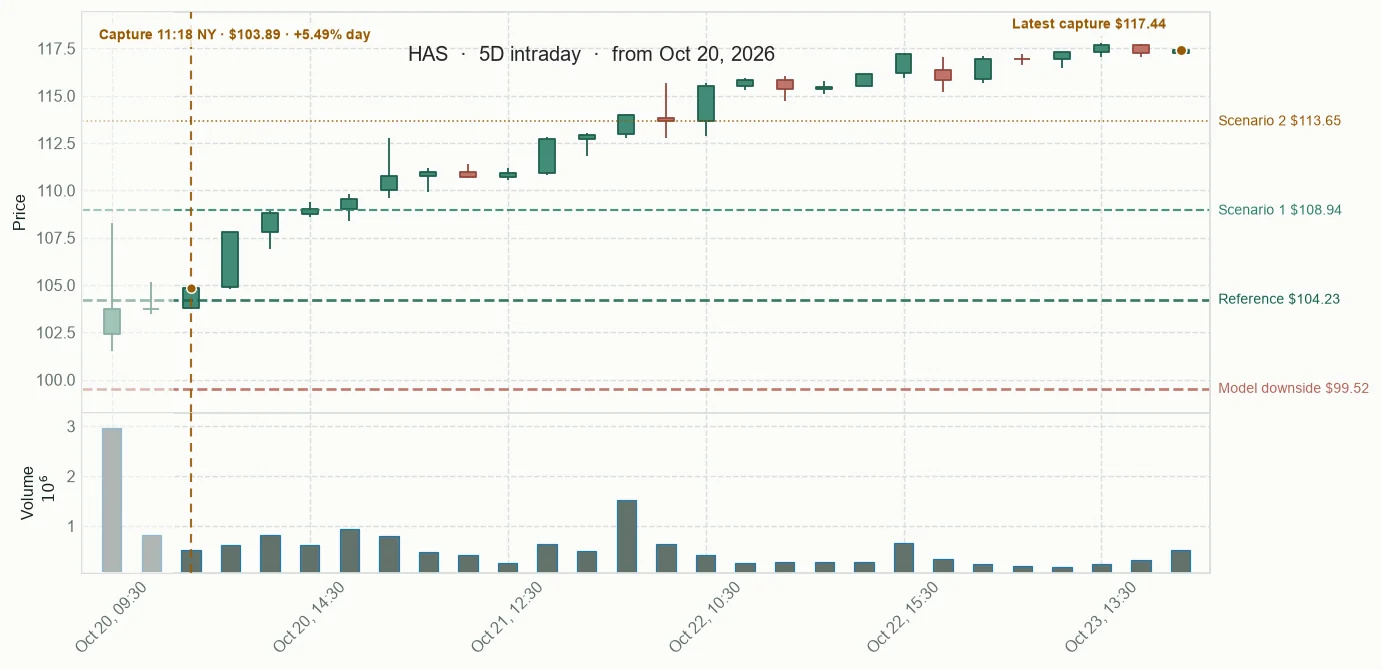
HAS added 1.2 points to its tracked gain since the previous public update, reaching 12.61%, and sits 3.1 points above the prior panel baseline. The latest cut rose 2.83% to $117.23 on 1.83 times average volume and held above VWAP near its high, while twenty-session performance remains 30.79 points ahead of Consumer Cyclical. A new primary Hasbro IR release is consistent with the raised-outlook thesis, but the price is about 5.4 typical daily ranges above its 21-day average and model persistence remains near even, leaving durability open.
HAS added 4.30 percentage points to its tracked return, reaching +9.51% on session 1. At the latest regular-session cut shares were up 4.09% to $114, 1.12% above VWAP near the top of the range, with volume 2.82 times its three-month average and time-relative activity accelerating. Over twenty sessions HAS leads Consumer Cyclical by 27.35 points, and the flow measure remains accumulation. The prior earnings and raised-guidance thesis is now accompanied by stronger price acceptance. The active next-session model is near flat with outcomes spanning both sides, and the sealed handoff adds no filing detail to revise the operating evidence.
Hasbro’s tracker shows a +5.21% return at session 0 after the Oct. 20 earnings; the sealed handoff lacks a current quote or VWAP sample, so the $98.49 price-hold test cannot be assessed. The filing reports Q3 revenue up 15%, Magic topping $600m for the first time, and raised FY2026 guidance to 7–9% constant-currency growth and $1.575–1.625bn adjusted EBITDA. Results include $55m of tariff refunds and about $40m of game revenue shifted out of Q4. The earnings catalyst is verified; post-event price persistence remains unconfirmed.
Panel thesis: Over the next fifteen sessions, HAS may sustain a stronger path if the reported Magic-led Q3 performance and raised FY2026 outlook are borne out and the earnings-driven relative strength persists. The current extension makes a sharp reset a material risk. Invalidation boundary: The thesis is falsified if a subsequent company update withdraws or materially reduces the raised outlook, or if the post-earnings price closes below the supplied $98.49 prior regular close.
Panel comparison
Selected candidate versus the alternatives retained from the panel comparison.
Latest display-only snapshot · Oct 23, 2026 · 18:04 NASDAQ
Since base +12.68% · Today +0.18% · Since prior +0.20% · Relative volume 1.46 · RSI 92.02 · EMA 107.29 > 100.19 > 95.17 · VWAP above +0.28% · 52-week high 99.70% · As of Oct 23, 2026 · 17:22 NASDAQ
Since base -2.34% · Today +9.85% · Since prior 0.00% · Relative volume 2.34 · RSI 40.89 · EMA 23.33 > 24.23 > 25.66 · VWAP above · 52-week high 76.16% · As of Oct 20, 2026 · 17:07 NASDAQ
Since base +3.33% · Today -0.50% · Since prior 0.00% · Relative volume 2.47 · RSI 56.39 · EMA 1.69 > 1.64 > 1.67 · VWAP above · 52-week high 14.88% · As of Oct 20, 2026 · 17:20 NASDAQ
Since base -4.11% · Today +10.61% · Since prior 0.00% · Relative volume 2.42 · RSI 70.0 · EMA 1.19 > 1.15 > 1.1 · VWAP above · 52-week high 83.91% · As of Oct 20, 2026 · 17:18 NASDAQ
Since base -1.78% · Today +4.92% · Since prior 0.00% · Relative volume 2.34 · RSI 32.34 · EMA 3.05 > 3.52 > 4.23 · VWAP above · 52-week high 30.20% · As of Oct 20, 2026 · 17:11 NASDAQ
Company dossier
History, curiosities & sources

Selected facts and links behind the public profile.
Company description
Hasbro, Inc. is a US games, intellectual-property and toy company headquartered in Pawtucket, Rhode Island. Its businesses include consumer products, tabletop and digital games through Wizards of the Coast, and film, television, animation and digital entertainment. Its owned and licensed portfolio includes Monopoly, Nerf, Transformers, Play-Doh, Magic: The Gathering and Dungeons & Dragons.
History
- 1923: Henry and Hillel Hassenfeld founded the business. It first sold textile remnants before moving into pencil boxes and school supplies.
- 1952: Mr. Potato Head was introduced; Hasbro’s company timeline identifies it as the first toy advertised on television.
- 1964: Hasbro launched its first action figure, G.I. Joe.
- 1999: Hasbro acquired Wizards of the Coast, bringing Magic: The Gathering into its portfolio.
Curiosities
- Mr. Potato Head began as plastic facial pieces that could be stuck into real potatoes and other produce. Hasbro later added a plastic body after safety rules changed and parents raised concerns about forgotten vegetables.
- Hasbro’s 2022 Selfie Series let US fans aged 16 and older create a custom six-inch action figure based on their likeness through the Hasbro Pulse app, using proprietary software and a 3D-printing partnership.