



Panel thesis: The panel selects HCM as Try of the Day for a bounded public research case. Its issuer-linked oncology partnership thesis, direct SEC record, exceptional participation and constructive intraday structure align, while causality, commercial value and persistence remain conditional.
+14.87% · 4.09x volume · 12.53 > 12.28 > 11.82

Company context
HUTCHMED (China) Limited, together with its subsidiaries, discovers, develops, and commercializes targeted therapeutics and immunotherapies to treat cancer and immunological diseases in Hong Kong, the United States, and internationally. It provides Fruquintinib, a selective and…
Committee read
This is the committee's read of the evidence, not a probability or score. HCM is the clearest balanced case because a direct issuer-linked mechanism, exceptional participation, above-VWAP structure and relative strength reinforce one another; extension, causal attribution and persistence keep a material counter-case alive.
Observed price path
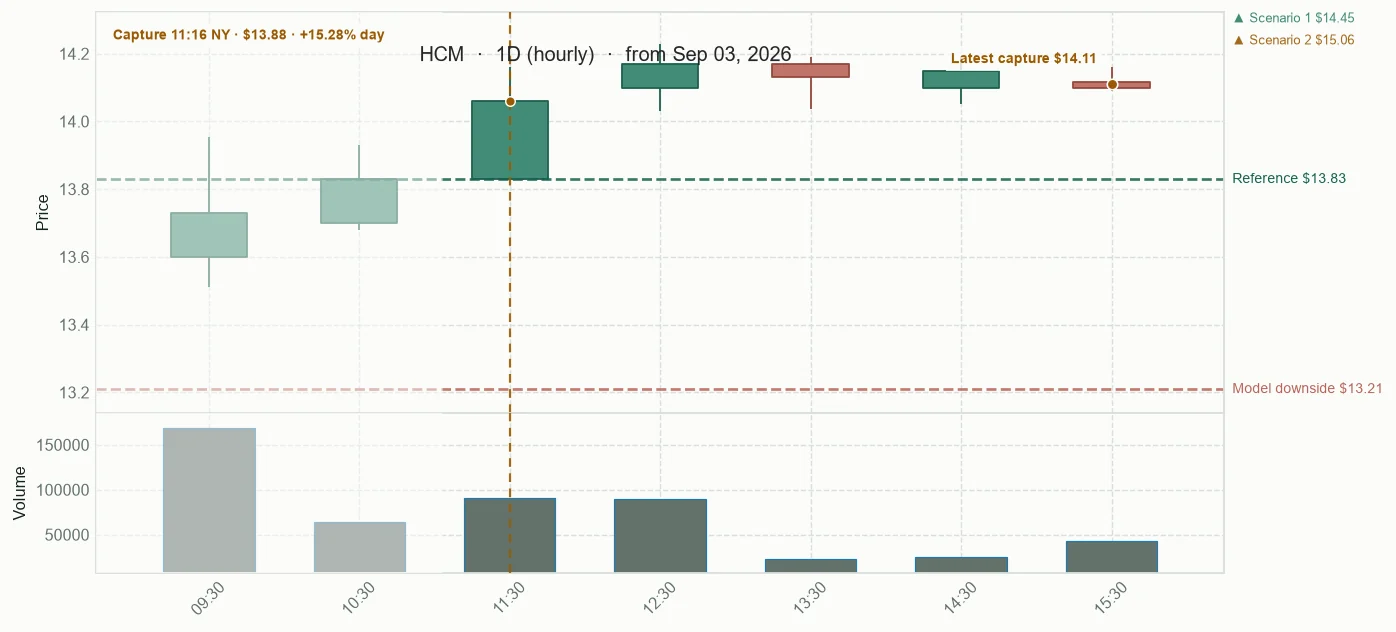
Price channel and relative performance
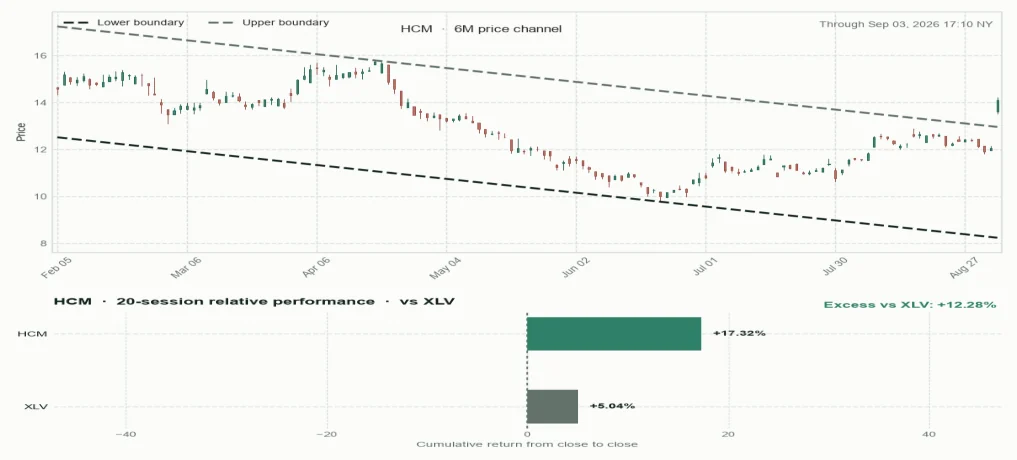
Public scanner fields captured at the base snapshot; deeper research inputs remain private.
Snapshot
What was captured at the base
Structure
How price is behaving
Risk and context
What may change the read
Base framework for context and outcome tracking. These are not trading instructions.
Tracking results
Observed daily-bar ranges are retrospective measurements, not targets, stops, or trading instructions.
Tryding Review
Five AI analytical agents reading the same evidence; disagreement stays visible.
“HCM is the most balanced case: a direct issuer record, exceptional participation and a constructive intraday structure, but the causal chain remains conditional.”
A clean combination of tape and filing still does not prove that the partnership caused the move or will create durable value.
“The GSK partnership and A830 licensing transcript give HCM a specific company question rather than a generic momentum story.”
The SEC record establishes disclosure provenance; it does not by itself establish commercial or clinical success.
Broader Market Context
The public context is mixed rather than directional: policy uncertainty, oil and gold remain active cross-asset signals, while the sealed breadth layer is unavailable. Those forces may amplify an issuer event, but they do not select a candidate or establish causality.
The day-first reading keeps the macro layer in its proper place. The Federal Reserve discussion leaves the path dependent on incoming inflation, labor and growth information; market reporting keeps oil, yields and geopolitical risk in view; and the gold report shows that softer dollar and yields can shift cross-asset attention. For this review, that backdrop raises the value of explicit invalidation and makes a company-specific mechanism more useful than a generic momentum label. It does not turn the context into a score, a breadth substitute or a second selection round.
Sources consulted: Federal Reserve · Associated Press · Kitco (Reuters)
Coffee conversation
“The public backdrop is uncertain, so it should bound claims rather than manufacture a market direction. Policy and incoming data can change how an issuer move is interpreted.”
“Oil, geopolitical risk and earnings are part of the day's attention map. They explain why a headline can travel quickly, but they do not explain HCM without the issuer-linked record.”
“The breadth artifact is unavailable in the sealed handoff. That is a confidence boundary, not a negative reading and not a reason to reject a candidate with its own complete evidence.”
“Cross-asset movement increases the importance of survivability after the first reaction. A public case needs a mechanism and a falsifier that remain readable if the backdrop changes.”
“The context does not replace the tape. HCM still has to demonstrate that its constructive structure is more than a single session response, and the chart pack is the direct evidence for that current observation.”
“That leaves one useful bridge into the formal room: use the macro layer to state uncertainty, then compare candidates on their own mechanism, participation and continuity.”
“Agreed. HCM's advantage is not that macro is favorable; it is that the public question remains specific when macro is noisy.”
“The context therefore supports conditional language and visible limits. It does not change the route or add a second vote.”
Timeline
HCM tracked loss narrowed 5.83 points to -2.01% as the current capture rose 6.16% to $13.61 and moved 0.67% above VWAP. That repairs the immediate price location after the recent failure, and Healthcare-relative performance remains supportive, but volume is only 0.61 times average and no structure is confirmed; the GSK partnership and A830 licensing case has regained a test, not durable market confirmation.
HCM tracked loss widened 2.81 points to -5.25% since the last public note. The latest capture fell 2.87% to about USD 13.18, 0.90% below VWAP at the bottom of its range on 0.04 times average volume, with decelerating participation and no confirmed structure. Healthcare-relative strength keeps the partnership case specific, but the current tape offers no price support for the published continuation thesis.
Panel thesis: HCM merits a fifteen-session public research follow-up because the GSK partnership and A830 licensing record provide a specific mechanism to test against the observed tape; the filing does not prove commercial value, clinical success or that the headline caused the whole move. Invalidation boundary: The thesis weakens if the above-VWAP structure fails, participation fades materially, the post-gap path cannot hold its constructive range, or subsequent issuer evidence does not support the proposed partnership mechanism.
Panel comparison
Selected candidate versus the alternatives retained from the panel comparison.
Latest display-only snapshot · Sep 16, 2026 · 16:27 NASDAQ
Since base -3.18% · Today -2.90% · Since prior -0.41% · Relative volume 0.26 · RSI 59.58 · EMA 13.34 > 12.95 > 12.42 · VWAP below -0.61% · 52-week high 75.70% · As of Sep 16, 2026 · 15:21 NASDAQ
Since base -3.56% · Today -1.22% · Since prior 0.00% · Relative volume 2.38 · RSI 69.31 · EMA 3.0 > 2.87 > 2.71 · VWAP above · 52-week high 16.19% · As of Sep 3, 2026 · 17:01 NASDAQ
Since base +1.27% · Today -1.79% · Since prior 0.00% · Relative volume 20.31 · RSI 61.84 · EMA 3.83 > 3.88 > 4.05 · VWAP above · 52-week high 85.03% · As of Sep 3, 2026 · 17:19 NASDAQ
Since base +4.67% · Today -0.49% · Since prior 0.00% · Relative volume 1.22 · RSI 83.25 · EMA 4.97 > 4.26 > 3.59 · VWAP above · 52-week high 30.38% · As of Sep 3, 2026 · 17:19 NASDAQ
Since base +6.45% · Today +0.16% · Since prior 0.00% · Relative volume 1.28 · RSI 70.77 · EMA 5.17 > 4.84 > 4.82 · VWAP below · 52-week high 42.05% · As of Sep 3, 2026 · 17:19 NASDAQ
Company dossier
History, curiosities & sources

Selected facts and links behind the public profile.
Company description
HUTCHMED (China) Limited, together with its subsidiaries, discovers, develops, and commercializes targeted therapeutics and immunotherapies to treat cancer and immunological diseases in Hong Kong, the United States, and internationally. It provides Fruquintinib, a selective and potent oral inhibitor of vascular endothelial growth factor receptors for treatment of colorectal cancer (CRC), breast cancer, gastric cancer (GC), microsatellite stable-CRC endometrial cancer (EMC), non-small cell lung cancer (NSCLC), renal cell carcinoma (RCC), endometrial cancer (EMC); and Savolitinib, a potent and selective inhibitor of mesenchymal-epithelial transition receptor to treat NSCLC, papillary RCC, and GC. It also develops Surufatinib to treat pancreatic neuroendocrine tumor (NET), non pancreatic NET, and pancreatic ductal adenocarcinoma; Sovleplenib, to treat immune thrombocytopenic purpura and warm autoimmune hemolytic anemia; and Tazemetostat, a treatment for epithelioid sarcoma and follicular lymphoma; Fanregratinib that treats intrahepatic cholangiocarcinoma; and Ranosidenib, a novel dual-inhibitor of dehydrogenase-1 and isocitrate dehydrogenase-2 enzymes to treat acute myeloid leukemia (AML). In addition, the company is developing HMPL-760, which is in phase I and II clinical trial to treat relapsed and/or refractory diffuse large B cell lymphoma, chronic lymphocytic leukemia, small lymphocytic lymphoma, and other B-NHL; HMPL-506 to treat Mixed-lineage leukemia-rearrange/rearrangement and nucleophosmin 1-mutantAML. It has collaboration agreements with AstraZeneca AB (publ), Lilly (Shanghai) Management Company Limited, Takeda, Inmagene Biopharmaceuticals Co. Ltd., Innovent Biologics Co., Inc., and Epizyme, Inc., and Epizyme, Inc. The company was formerly known as Hutchison China MediTech Limited and changed its name to HUTCHMED (China) Limited in May 2021. HUTCHMED (China) Limited was incorporated in 2000 and is headquartered in Hong Kong, Hong Kong.
History
- HUTCHMED states that it was founded in 2000.
- The company launched its Oncology/Immunology operations in 2002.
- The group adopted the HUTCHMED name in 2021, consolidating the earlier Chi-Med and Hutchison MediPharma identities.
- HUTCHMED describes an integrated path spanning drug discovery, development, manufacturing and commercialization.
Curiosities
- The company says its first three medicines are marketed in China, with the first also approved in the United States, Europe and Japan.
- HUTCHMED reports more than 20 novel drug candidates created by its in-house discovery engine.
- Its public About Us page reports approximately 40 clinical trials worldwide, including more than 13 registration studies.
- The company reports that more than 150,000 patients have been treated by its novel medicines.
- HUTCHMED says its growing scientific team includes about 900 scientists and staff across Shanghai and its international clinical operation in New Jersey.