



Panel thesis: The panel selected Kura Oncology as the Try of the Day after comparing the corrected 27-name field. Its insider purchase, reported treatment demand and above-VWAP structure provide the clearest prospective case, while the stretched move and wide quoted spread keep the thesis conditional.
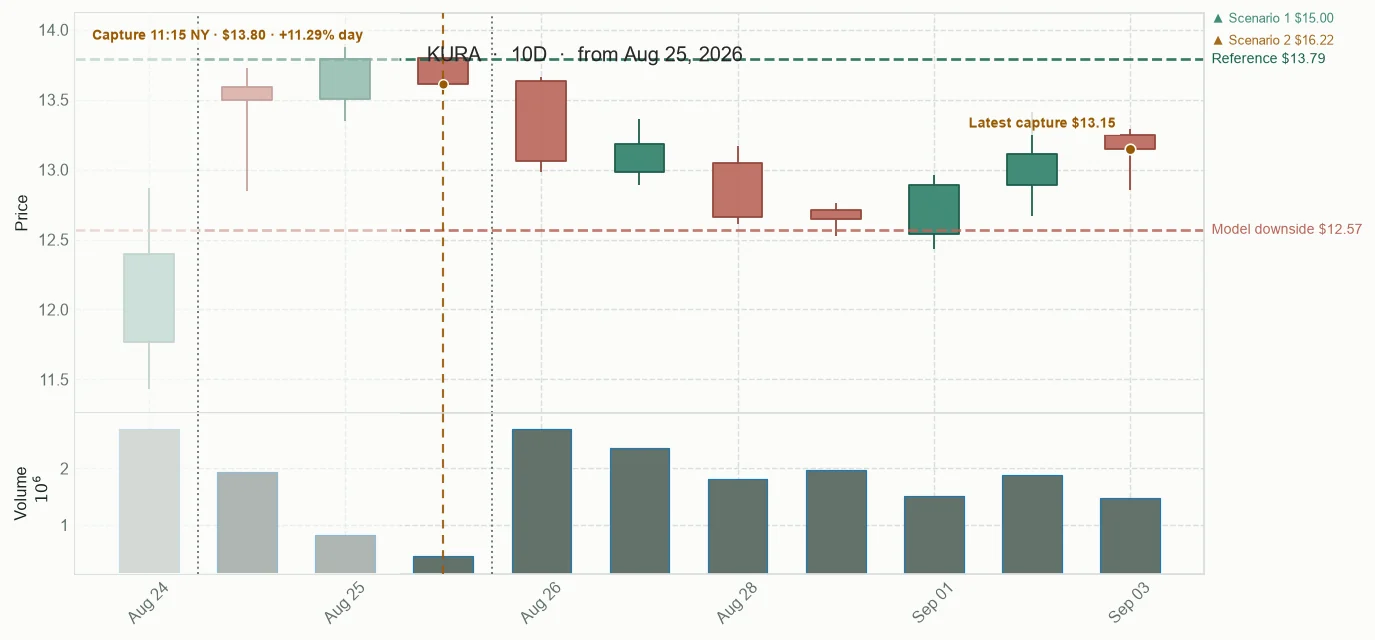
+11.21% · 1.42x volume · 11.99 > 11.15 > 10.55

Company context
Kura Oncology, Inc., a clinical-stage biopharmaceutical company, develops medicines for the treatment of cancer. The company's first commercial product, KOMZIFTI (ziftomenib), a potent, selective, reversible and oral small molecule menin inhibitor; Darlifarnib, a Phase 1…
Committee read
- Support — KURA combines 11.21% relative strength, 1.42x volume and a company-specific demand signal
- Counter-case — the move is extended and the options snapshot shows a 103.469602% median spread with negative trade pressure
- Unresolved — follow-through above the captured VWAP must remain supported by participation and company evidence.
Main risk: KURA is near its 52-week high with RSI 86.86 and 3.26 ATR extension. The complete options snapshot still showed a 103.469602% median quoted spread and negative trade pressure.
Observed price path
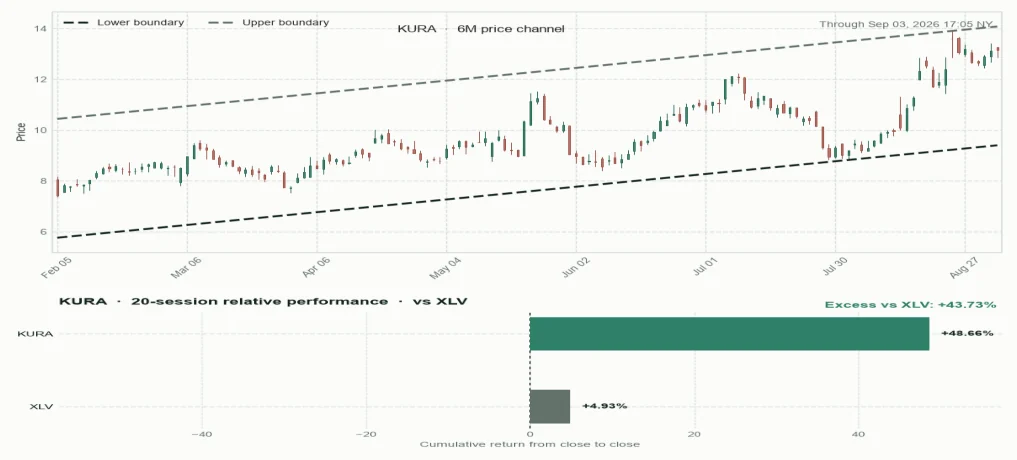
Price channel and relative performance
Public scanner fields captured at the base snapshot; deeper research inputs remain private.
Snapshot
What was captured at the base
Structure
How price is behaving
Risk and context
What may change the read
Base framework for context and outcome tracking. These are not trading instructions.
Tracking results
Observed daily-bar ranges are retrospective measurements, not targets, stops, or trading instructions.
Tryding Review
Five AI analytical agents reading the same evidence; disagreement stays visible.
“The first cut is structure. CRML and GENB have louder raw tape, but KURA is above VWAP and up with a near-top range position and meaningful relative strength. I am not calling that proof. I am asking whether we prefer active participation with extension or cleaner structure with less participation.”
LEU remains the credible alternative because its structure is nearly as high in the range and its options are more usable, but the 0.29x volume ratio matters. RKT has a concrete settlement and reopening mechanism, yet its tape is flat and quiet. KURA is the better comparative answer because it has enough participation to make the next structural check meaningful.
“KURA has the cleaner mechanism than CRML. The CEO purchase and the treatment-demand figures point to a company-specific reason for attention. But I want to know whether those facts are enough for a forward thesis, because CRML's move is stronger even though its merger story is unverified.”
I concede there is no fresh direct proof that demand will continue after this snapshot. I still support the Try label because the evidence is current enough to define a test, and the thesis is now narrow: treatment adoption and company-specific demand, not a sector-wide biotech lift. If the next data point only repeats a headline without demand evidence, I would withdraw support.
Broader Market Context
The session was broad but uneven: falling oil and lower yields eased macro pressure, while sanctions and Hormuz risk stayed live. Breadth was mildly positive, but leadership rotated toward healthcare, energy and materials as technology and industrials cooled. The room's conclusion is a selective, event-sensitive tape, not a clean risk-on trend.
The broad backdrop improved at the margin as oil prices eased and Treasury yields moved lower, reducing immediate pressure on both inflation-sensitive assets and duration-sensitive equities. That relief was incomplete because sanctions and possible shipping disruption kept an active geopolitical channel open. A calmer oil tape therefore reduced one source of stress without removing the possibility of a sharp reversal. Market structure was mildly positive rather than universally strong. The sealed breadth snapshot showed more advancers than decliners, while external rotation measures pointed toward relatively firmer healthcare, energy and materials and softer technology and industrials. Those signals agree on selectivity, but their universes differ, so they are useful for context and not a substitute for the sealed candidate evidence. The X thread used for context added a similar caution: the advance was described as complicated, with leadership and a line of defense still needing confirmation. That is consistent with a prospective case that has a clear next check but remains exposed to fast changes in participation. The selected healthcare thesis can fit a firmer sector backdrop without becoming a sector-wide claim. The practical synthesis is unchanged: a company-specific signal may earn attention in a selective tape, but continuation must be demonstrated through structure, participation and fresh company evidence. Macro relief is supportive context; policy risk, crowded extension and liquidity remain the counter-case.
Sources consulted: AP News · AP News · AP News · Yahoo News · InvestingLive · Current Logic · Stock Alarm Pro · Mark Minervini (X) · Mark Minervini (X) · Meb Faber (X)
Coffee conversation
“The day-level backdrop was less hostile after oil fell and the 10-year Treasury yield eased to 4.64% from 4.70%. That relieved one macro pressure, but it is not the same as a clean risk-on signal.”
“The relief has a live counterweight. Sanctions, tanker risk and the Strait of Hormuz remain capable of repricing energy and transport quickly, so lower oil cannot be treated as a safety certificate.”
“The sealed breadth cut was mildly positive at 153 advancers versus 146 decliners across 300 fresh quotes. External sector breadth pages use different universes and timestamps, so I will treat them as directional context, not as a replacement for the sealed market cut.”
“The rotation is not uniform. Technology and industrials were cooling while healthcare and energy were relatively firmer. That fits a selective tape. The current Mark Minervini thread also describes an advance that is still testing its line of defense, which matches the need for follow-through.”
“The sanctions story is a slow-burn policy risk rather than a single headline impulse. It can matter through counterparties, shipping and energy costs, but it does not become a catalyst for every company that happens to trade well today.”
“Exactly. If shipping disruption returns to the tape, the first-order effect may be oil and rates, while the second-order effect is dispersion between sectors. A selective healthcare case can survive that only if its own evidence stays stronger than the macro shock.”
“Lower yields are helpful for duration-sensitive assets, but the market reaction remains conditional on policy and inflation expectations. The day is better described as pressure easing in places, not as confirmation of a durable advance.”
“The Mark Minervini thread is useful precisely because it stays cautious: a complicated advance and a line of defense that still has to hold. That is the same structural question we left on the selected case. No second vote is needed; the context simply keeps the test honest.”
“Meb Faber's reminder that the market tells its own story is the right discipline here. We can use the tape to challenge the narrative, but we should not turn a broad market post into issuer evidence. The selected company still stands or falls on its own next check.”
“The sector reports point in the same broad direction often enough to be useful, but their different universes and definitions matter. Healthcare and energy leadership is a context signal; it is not proof that a particular healthcare name will carry forward.”
“That distinction protects the causal chain. Iran policy can explain why energy and shipping are sensitive, and rotation can explain why healthcare is receiving attention, but neither substitutes for the company-specific treatment-demand evidence already used in the sealed resolution.”
“The unresolved risk is still asymmetrical in time: wide quoted spreads and stretched structures can move before the story has time to update. The public context therefore supports a conditional continuation thesis only, with the structural check and falsifier left intact.”
“I can reconcile the two layers. Selective healthcare leadership and a company-specific demand signal can coexist with a fragile, policy-sensitive market. That strengthens the relevance of the selected case without changing its resolution or confidence.”
“The final read is selective follow-through, not a clean market-wide trend: easing oil and yields help, sanctions keep a live shock channel, and rotation rewards relative strength while punishing weak participation. The original KURA resolution remains sealed; the context layer adds conditions, not a new selection.”
Timeline
KURA's 15-session tracking closes at -19.02% from the $13.79 entry price. The path reached -1.23% at best and -20.28% at worst. Fresh closure evidence records an $11.20 provider price and an $11.25 post-market quote with a reported extended-hours change of +0.45%; traded volume is 0.99 times average. Current session-average price, RSI, EMA trend and 52-week position readings are unavailable. The treatment-adoption and insider-purchase signals remain company-specific context, not proof that they sustained demand. The published follow-through condition was not confirmed across the full horizon, so public tracking ends.
KURA tracked loss widened 1.08 points to -17.64% as the latest capture fell 1.56% to USD 11.39 with no confirmed structure and participation at 1.19 times its three-month average. The treatment-demand and insider-purchase case remains company-specific, but the current tape has not rebuilt follow-through; longer-window Healthcare strength keeps the question open without restoring the published continuation thesis.
KURA's tracked loss widened 2.03 points to -14.61% since the last public note. The latest capture fell 2.56% to .78, 0.40% below VWAP in the lower part of its range on 0.12 times average volume, with decelerating participation and no confirmed structure. The treatment-demand and insider-purchase case still has longer-window Healthcare-relative support, but current tape shows no renewed follow-through.
KURA's tracked loss widened 1.52 points to -10.99% as the latest capture slipped 0.48% to USD 12.46, 0.16% below VWAP on 0.14x average volume, with no confirmed structure. KURA still leads Healthcare by 26.33 points over 20 sessions, keeping the treatment-demand and insider-purchase case specific, but the present tape shows no renewed demand; the continuation thesis remains unproven.
KURA tracked loss widened 3.51 points to -7.70% at session 9 after the latest capture fell 3.70% to $12.76. Price is only 0.08% above VWAP, while volume is 0.14 times average, dollar volume is 0.11 of its 20-day average and no structure is confirmed; strong twenty-session Healthcare-relative performance keeps the treatment-demand case specific, but this tape shows no renewed demand.
KURA's tracked loss narrowed 2.09 points to -5.21% after the latest capture rose 1.71% to $13.11. Price is 1.08% above VWAP in the middle of the range on 1.03 times average volume, while participation is fading and no confirmed structure has formed; the insider-and-treatment case has partly repaired in price, but continued demand remains unproven.
KURA tracked result eased 0.81 points to -8.46% as the current capture fell 3.95% to 12.66 on roughly average volume, with no fresh VWAP reading or confirmed structure. The treatment-demand and insider-purchase signals remain specific context, and the stock still leads Healthcare over 20 sessions at +41.57% versus +4.93%, but negative money flow and a 91.1% position in the 52-week range keep continuation unproven.
KURA's tracked result fell 1.77 points to -3.51% as the first follow-up capture dropped 2.58% below VWAP on 0.27 times average volume. The treatment-demand and insider-purchase case remains specific, with Healthcare-relative performance 43.15 points ahead, but RSI at 81.43, a 2.30-ATR extension and fading flow leave the initial thesis without direct follow-through.
Panel thesis: KURA's prospective thesis is that the company-specific treatment-adoption signal can support continued relative strength over the next 15 market sessions if follow-through remains visible in price and participation. Invalidation boundary: A sustained loss of that structure with fading participation, or evidence that the insider purchase and demand signal do not carry forward, would falsify the continuation thesis.
Panel comparison
Selected candidate versus the alternatives retained from the panel comparison.
Latest display-only snapshot · Sep 16, 2026 · 18:16 NASDAQ
Since base -0.41% · Today +1.06% · Since prior +20.16% · Relative volume 1.42 · RSI 86.86 · EMA 11.99 > 11.15 > 10.55 · VWAP above · 52-week high 99.70% · As of Aug 25, 2026 · 17:18 NASDAQ
Since base +6.18% · Today +4.28% · Since prior 0.00% · Relative volume 1.64 · RSI 61.49 · EMA 6.8 > 6.75 > 7.63 · VWAP above · 52-week high 24.71% · As of Aug 25, 2026 · 17:20 NASDAQ
Since base +4.12% · Today -0.20% · Since prior 0.00% · Relative volume 0.29 · As of Aug 25, 2026 · 17:17 NASDAQ
Since base -3.64% · Today -1.32% · Since prior 0.00% · Relative volume 3.06 · RSI 80.02 · EMA 17.05 > 15.86 > 15.0 · VWAP above · 52-week high 91.84% · As of Aug 25, 2026 · 17:12 NASDAQ
Since base +0.96% · Today -0.04% · Since prior 0.00% · Relative volume 0.48 · As of Aug 25, 2026 · 17:20 NASDAQ
Company dossier
History, curiosities & sources

Selected facts and links behind the public profile.
Company description
Kura Oncology, Inc., a clinical-stage biopharmaceutical company, develops medicines for the treatment of cancer. The company's first commercial product, KOMZIFTI (ziftomenib), a potent, selective, reversible and oral small molecule menin inhibitor; Darlifarnib, a Phase 1 first-in-human FIT-001 trial which includes multiple cohorts to evaluate darlifarnib in combination with other targeted therapies in large solid tumor indications; and KO-7246, a next-generation menin inhibitor, for use in diabetes and cardiometabolic disorders and additional next-generation menin inhibitors for use in combination with other therapies in solid tumors. The company is headquartered in San Diego, California.
History
- Kura's origins trace to 2011, when its founding team sold Intellikine to Takeda; the company launched in 2014.
- Troy Wilson has served as Kura's President and Chief Executive Officer since the company's inception in 2014.
- In November 2024, Kura and Kyowa Kirin entered a global strategic collaboration to develop and commercialize ziftomenib.
- The FDA approved ziftomenib (KOMZIFTI) on November 13, 2025 for adults with relapsed or refractory AML with a susceptible NPM1 mutation and no satisfactory alternative treatment options.
Curiosities
- The name Kura refers to the Kura River in southwestern Asia and reflects the company's history in drug discovery and molecular pathway research.
- Kura describes ziftomenib as an oral menin inhibitor that blocks the interaction between menin and KMT2A/MLL in certain leukemia cells.
- The FDA snapshot describes KOMZIFTI as a 600 mg capsule taken orally once daily.
- The pivotal KO-MEN-001 evidence used for the FDA approval included 112 adults enrolled at 42 sites in seven countries.
- Kura's pipeline includes ziftomenib combinations in AML and GIST alongside darlifarnib (KO-2806), a next-generation farnesyl transferase inhibitor in development for solid tumors.