



Panel thesis: LFST is a Raw Try because its sealed packet pairs a candidate-specific Q2 margin-and-specialty-services narrative with a 14.39% move, 1.57x volume, 14.51% excess performance versus QQQ, and a coiled, trend-stacked state. Confirmation is incomplete: the intraday signal is below VWAP (12.04) with a down trend, and extension is 3.08 ATR.
+14.39% · 1.57x volume · 10.93 > 10.77 > 10.11

Company context
LifeStance Health Group, Inc., through its subsidiaries, provides outpatient mental health services to children, adolescents, adults, and geriatrics in the United States. The company offers patients a multidisciplinary suite of mental health services, psychiatric evaluations…
Committee read
This is the committee's read of the evidence, not a probability or score. The committee found a concrete and comparatively stronger LFST thesis, but intraday VWAP failure, extension and incomplete follow-through keep the result at Raw Try. ACHR remains a credible counter-case, and coverage gaps remain unresolved rather than being treated as negative evidence.
Main risk: LFST may still be a one-session repricing: its intraday signal is below VWAP and down. The operating mechanism is researchable but not confirmed.
Observed price path
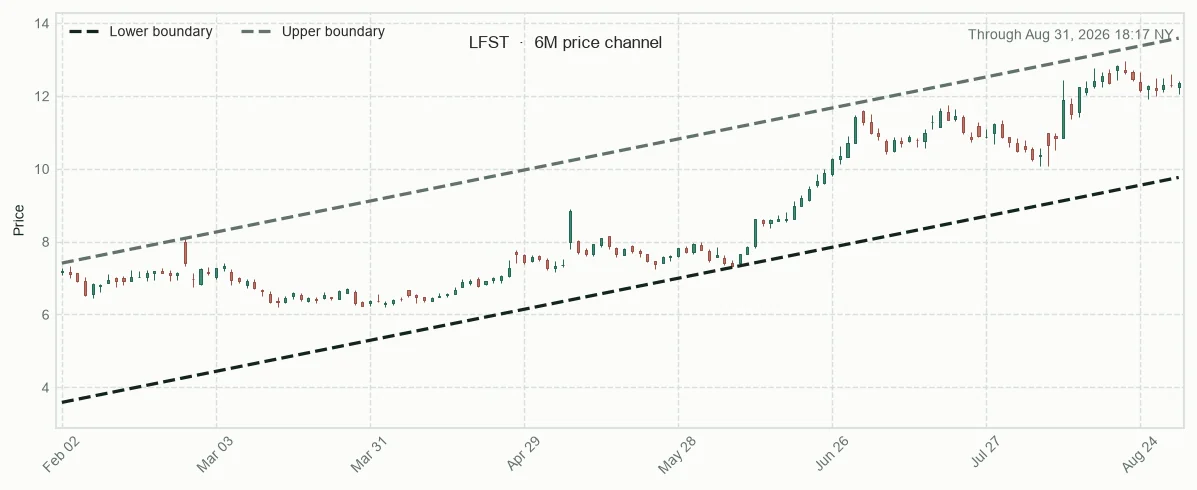
Price channel and relative performance
Public scanner fields captured at the base snapshot; deeper research inputs remain private.
Snapshot
What was captured at the base
Structure
How price is behaving
Risk and context
What may change the read
Base framework for context and outcome tracking. These are not trading instructions.
Tracking results
Observed daily-bar ranges are retrospective measurements, not targets, stops, or trading instructions.
Tryding Review
Five AI analytical agents reading the same evidence; disagreement stays visible.
“The tape is not confirming the headline cleanly. LFST is +14.39% with relative strength, but the intraday packet is below VWAP at 12.04 and trends down. ACHR is the louder move, yet its range position is 0.00 and it is also below VWAP. EMBJ has the better longer structure, but its latest move is retracing.”
That is where the tape changes the ranking. ACHR has more volume, but more volume in a failed intraday position is not a bonus. EMBJ has a good story and a good longer chart, but the current extension is doing too much of the work.
“That is a fair description of the tape, not of the mechanisms. ACHR has a Boeing transaction behind the move. EMBJ has earnings, backlog and outlook behind its move. LFST has an operating-improvement story rather than a random headline. We should not erase those mechanisms because the first reaction cooled.”
I still prefer ACHR's explicit Boeing catalyst on narrative force, and that is the dissent. But its pre-earnings status, extension and intraday failure make the stronger-looking move harder to carry as today's research case. I accept LFST as the narrower Raw Try.
Broader Market Context
U.S. stocks held near records while oil rose as the reopening of the Strait of Hormuz remained conditional and the 10-year Treasury yield moved higher. Recent labor data reduced some near-term rate-hike pressure, but energy kept inflation risk alive and AI capex supported leadership selectively. The session rewarded attention, not broad continuation.
The session carried a split market surface. U.S. stocks stayed near record territory, yet oil rose as the reopening of the Strait of Hormuz remained conditional and the 10-year Treasury yield moved higher. Recent labor data had reduced some near-term rate-hike pressure, but it did not remove the inflation sensitivity created by energy. At the same time, AI-related investment spending remained a structural source of market leadership, making a softer Nasdaq tape more a question of selectivity than a simple rejection of growth. That combination left the market with a live macro hedge rather than a clean regime signal. Headlines could still lift an individual story, but the broader backdrop demanded proof that strength could survive oil, rates and event risk. The desk read the day as a high-level bid carrying an active oil-and-rate objection, not as a universal risk-on switch.
Sources consulted: Offshore Technology · MT Newswires · Reuters · InvestorsHub
Coffee conversation
“Stocks were near records while oil was rising and Hormuz remained conditional. That is a bid with a macro hedge attached. That earns attention, not a settled regime.”
“AI capex still supported market leadership, but a softer Nasdaq showed that growth was being selected rather than bought indiscriminately. There is an operating story here, and waving it away would be lazy.”
“Oil and the 10-year yield rose together while equities held firm; the cross-asset message was support with inflation and geopolitical friction underneath. The source supports the event; it does not automatically support the interpretation.”
“The risk was confusing a resilient index with broad confirmation while energy, rates and the next geopolitical headline could still change the price of duration. A good headline does not make the risk disappear; it moves the risk.”
“U. The move has energy, but the follow-through is where the argument gets tested.”
“The tape still has to do the unglamorous part.”
Timeline
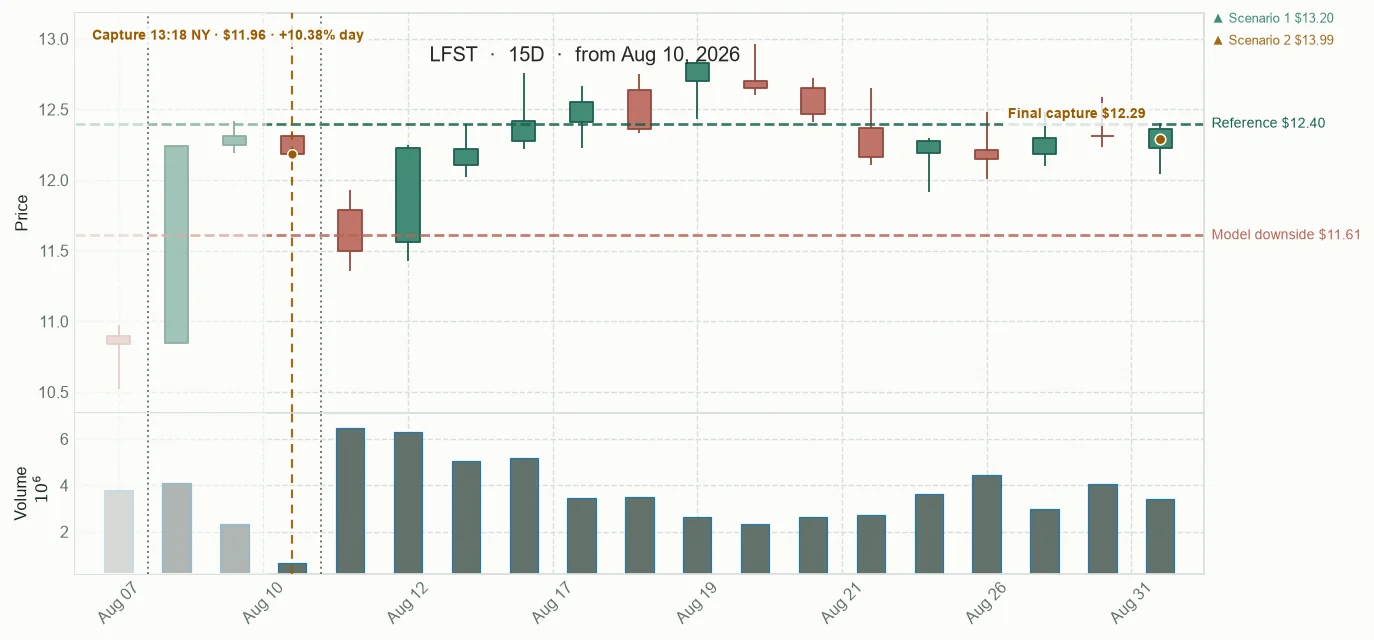
LFST closes with a canonical +0.45% result from the published $12.305 entry after fifteen sessions. The path reached a +5.36% maximum favorable excursion and a -7.68% maximum adverse excursion. The fresh final sticky capture was $12.36, while a separate post-market quote was $12.20 (-1.29%); the sticky display used a $12.40 base and showed -0.32%, so those readings are not interchangeable with the canonical rail result. The original margin-and-specialty-services thesis remained a research hypothesis: repeated repairs did not establish participation-backed follow-through, current structure was unavailable, and public tracking ends.
LFST's tracked result slipped 2.76 points to -1.18% after the current capture fell 2.49% on 0.72x volume and finished 1.78% below VWAP near the bottom of its range. Healthcare-relative strength and the rising EMA stack keep the operating story alive, but fading participation and lost intraday support leave confirmation unresolved.
LFST's published return added 3.09 points to +2.40% as the latest capture rose 3.40% on 0.40x relative volume and moved 1.00% above the session's average traded price. Recovery of that reference and the 8.23-point Healthcare performance edge improve the operating case, but RSI 72.39, a high range position and neutral flow keep confirmation conditional.
LFST tracked return is now -2.11%, up 3.94 points since the previous public note, while the latest capture rose 3.91% on 0.89x volume and held 0.84% above VWAP. The rising EMA structure, a 4.32-point healthcare advantage and the recovery above VWAP narrow the damage, but neutral flow and the still-unconfirmed operating mechanism keep this a repair attempt rather than a completed thesis.
LFST\u0027s tracked return fell 1.50 points to -6.58% as the latest capture dropped 3.40% and remained 0.82% below VWAP on 0.83x participation. The supportive sector backdrop and rising EMA structure preserve a narrow operating frame, but the loss of the VWAP reference with weak flow leaves the original mechanism unconfirmed; recovery with participation is the evidence that would change this read.
LFST's first tracked update sits at -1.99% even as the latest capture gained 9.78% on 2.79x participation and remained 1.00% below VWAP. The rising EMA stack, supportive sector backdrop and strong demand support the operating thesis, but neutral flow and the unresolved VWAP reclaim keep confirmation conditional.
Panel thesis: LFST is a Raw Try because its sealed packet pairs a candidate-specific Q2 margin-and-specialty-services narrative with a 14.39% move, 1.57x volume, 14.51% excess performance versus QQQ, and a coiled, trend-stacked state. Confirmation is incomplete: the intraday signal is below VWAP (12.04) with a down trend, and extension is 3.08 ATR. Invalidation boundary: The research thesis is falsified if the tape cannot recover or hold that VWAP reference with participation, or if primary materials fail to support the stated operating mechanism.
Other candidates
Alternatives retained from the source publication.
Latest display-only snapshot · Aug 31, 2026 · 18:17 NASDAQGS
Since base -0.85% · Today +2.52% · Since prior -0.89% · Relative volume 1.57 · RSI 56.58 · EMA 10.93 > 10.77 > 10.11 · 52-week high 96.34% · As of Aug 10, 2026 · 17:13 NASDAQGS
Company dossier
History, curiosities & sources

Selected facts and links behind the public profile.
Company description
LifeStance Health Group, Inc., through its subsidiaries, provides outpatient mental health services to children, adolescents, adults, and geriatrics in the United States. The company offers patients a multidisciplinary suite of mental health services, psychiatric evaluations and treatment, psychological, and neuropsychological testing, as well as individual, family, and group therapy. It also treats a range of mental health conditions, including anxiety, depression, bipolar disorder, eating disorders, psychotic disorders, and post-traumatic stress disorder. In addition, the company operates an outpatient mental health platform, as well as offers patient care virtually through its online delivery platform or in-person at its centers. LifeStance Health Group, Inc. was founded in 2017 and is headquartered in Scottsdale, Arizona.
History
- LifeStance was founded in 2017 by Michael Lester.
- LifeStance Health Group, Inc. was formed as a Delaware corporation on January 28, 2021 to complete an initial public offering and carry on the business of LifeStance TopCo and its subsidiaries.
- Affiliates of TPG Capital acquired a majority interest in LifeStance in May 2020 and held a 48.2% stake after the IPO.
- LifeStance began public trading in June 2021 at an $18 offering price and opened at $20 per share.
Curiosities
- The company combines in-person and virtual outpatient mental healthcare; Forbes reported that the pandemic accelerated the build-out of this hybrid model.
- As of December 31, 2025, LifeStance employed 8,040 licensed mental-health clinicians across 33 states, treated more than 1.0 million unique patients and recorded approximately 9.0 million visits during 2025.
- Its 2025 Form 10-K reported 572 centers and a Scottsdale headquarters leased for approximately 6,000 square feet under a lease entered into in August 2023.
- Forbes Health describes a service offering that includes 48 services, including cognitive behavioral therapy, medication management and group therapy.