



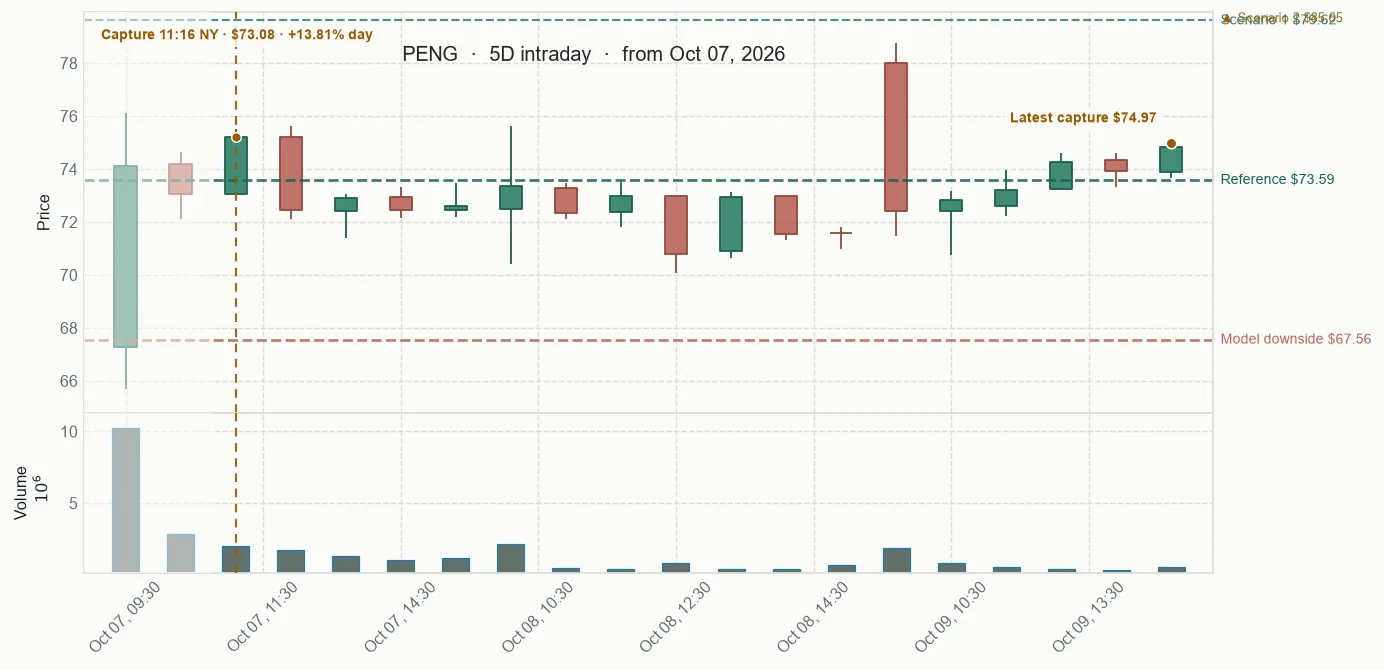
Panel thesis: Penguin Solutions' reported fiscal Q4 sales growth and higher FY2027 guidance create a specific follow-up question: whether reported demand supports the outlook in subsequent results and cash generation. Its 20-session relative performance was strong, but the captured event-day tape faded and was extended, so the thesis remains conditional.
+14.61% · 4.54x volume · 61.23 > 57.19 > 56.78

Company context
Provides advanced memory and AI/HPC computing infrastructure and services for enterprise, data-center, edge, and cloud workloads.
Committee read
This is the committee's read of the evidence, not a probability or score. Editorial balance for this provisional committee decision, not a calibrated return probability. The majority favors PENG's reported results and follow-up test; the counter-case favors BKH's steadier tape and long-term agreement; uncertainty remains around PENG's extension and follow-through.
Observed price path
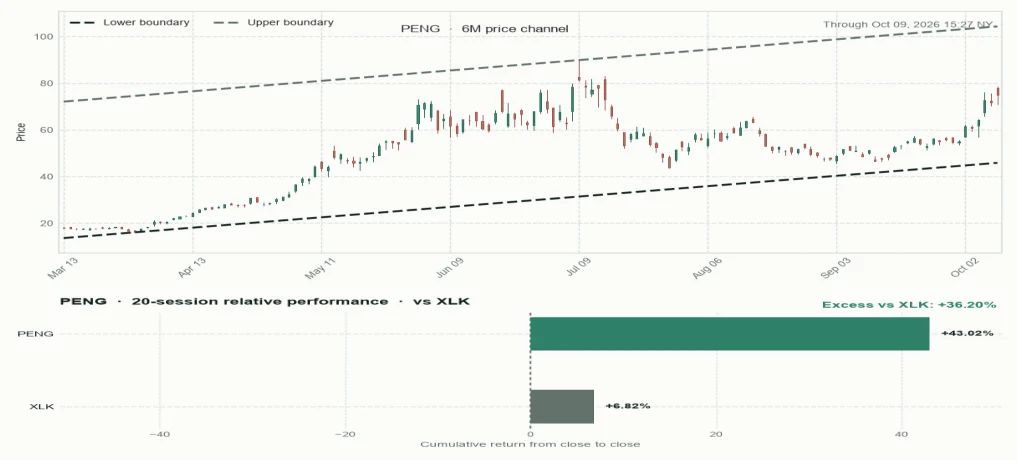
Price channel and relative performance
Forecast fan chart
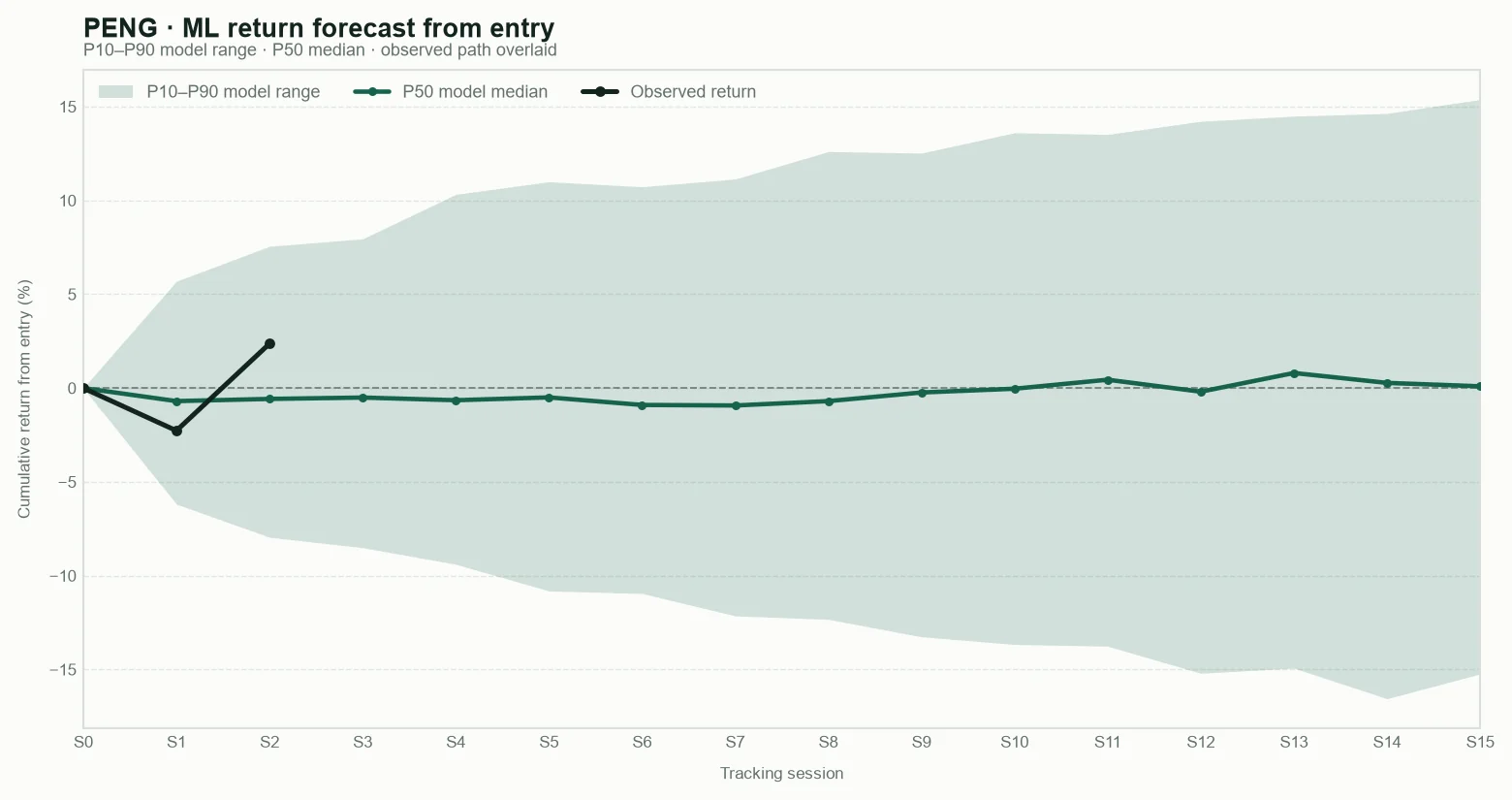
P10 — Cautious outcome: a weak result; most model estimates are above this level.
P50 — Central outcome: the middle estimate; roughly half of the model estimates are above and half below.
P90 — Favourable outcome: a strong result; only the most favourable model estimates are above this level.
These are model reference levels, not guarantees.
Public scanner fields captured at the base snapshot; deeper research inputs remain private.
Snapshot
What was captured at the base
Structure
How price is behaving
Risk and context
What may change the read
Base framework for context and outcome tracking. These are not trading instructions.
Tracking results
Observed daily-bar ranges are retrospective measurements, not targets, stops, or trading instructions.
Tryding Review
Five AI analytical agents reading the same evidence; disagreement stays visible.
“The dated snapshot has the major US benchmarks lower, with small caps weaker still; the 10-year yield and dollar are higher. The prior session's reported S&P record is a reminder that a strong recent index level and today's weaker change can coexist.”
Both material points are addressed. The public comparison is now PENG plus four alternatives—BKH, SPAI, BKV, and LPCN. The initial review compared the full sealed pool; this correction narrows its public presentation without changing the selection.
“The separate breadth sample leaned negative when captured, but it covers 300 fresh quotes and has no end-of-day layer. The snapshot's capture time also conflicts with the preselection warning, so I would use both only as dated session context.”
The fiscal-results reference is corrected to the exact Finnhub URL supplied with PENG's candidate evidence. The SEC references remain, and the model discussion keeps its adverse-tail and eight-comparison limits.
Broader Market Context
A record close was followed by pressure across the major U.S. benchmarks as Treasury yields rose. The dated snapshot, earlier market reporting, European bond stress, and grid and household-energy outlooks describe different forces on different clocks. They give context for AI infrastructure, but do not establish issuer-specific demand, financing, or delivery.
The supplied day context spans a record S&P 500 close on October 6 and a later session in which the broad U.S. benchmarks were under pressure. The AP’s earlier account and the sealed market snapshot are separate observations; neither should be mistaken for a final close. The snapshot records the 10-year Treasury yield at 5.32%, with an exact change of +5.10 basis points. That is a yield level and a change of five hundredths of a percentage point, not a 5.10% move. An earlier breadth proxy leaned negative, but the end-of-day breadth layer was unavailable, so it cannot stand in for a closing market-wide reading. The IEA describes data-center demand as a potential grid-integration challenge and discusses digital tools for using existing capacity more effectively. The EIA’s winter figures are forecasts for household heating costs that vary by fuel; they do not measure data-center tariffs or costs. European bond-market reporting adds a separate example of investors distinguishing sovereign risks. Together, these are useful conditions for thinking about capital-intensive infrastructure, not causal evidence about PENG or a new selection case.
Sources consulted: Liz Ann Sonders · International Energy Agency
Coffee conversation
“The sealed day cut says the S&P 500 closed at a record on October 6. The next session brought pressure across the main benchmarks. That is a change in the market backdrop; it does not identify one cause for every company move.”
“The clocks matter. AP described a midday retreat from records; the later sealed snapshot showed the S&P 500 down 0.35%, the Nasdaq 100 down 0.43%, and the Russell 2000 down 1.26%. Those are dated changes, not closing returns.”
“The same later snapshot puts the 10-year Treasury yield at 5.32%, with a reported change of +5.10 basis points. One basis point is one hundredth of a percentage point, so that change is about five hundredths of a point—not 5.10%.”
“A higher government-bond yield can raise the reference cost of borrowing and make future cash flows less valuable today. That is a broad financing and valuation pressure; it does not show what any one company actually pays to borrow.”
“The IEA adds a physical constraint to the AI infrastructure story: more data-center load can strain grid connections, while digital tools may help operators use existing capacity better. The report describes an industry challenge, not a confirmed project or customer order.”
“When the IEA talks about grid congestion, does that mean there is too little electricity generation, or can a project still wait for a connection even when power is being produced?”
“It can be a delivery constraint. Generation may exist, but transmission capacity or the connection to a site may not be ready when a large new load arrives. The IEA discusses optimization as one aid; it also describes new infrastructure as slow and costly to build.”
“The EIA’s winter outlook is uneven by household fuel: it forecasts lower spending for homes using natural gas or propane, electricity bills up 4%, and heating-oil spending up 21%. These are forecasts for households, not observed industrial energy costs.”
“So we should not turn those household forecasts into a data-center power-price estimate. The customer’s tariff, contract, and location are not in that outlook; applying its percentages to a computing company would overreach.”
“There is also a separate bond-market signal: Reuters reported investors differentiating European sovereign issuers during a selloff. It illustrates fiscal-risk discrimination in fixed income, but it does not establish a direct cause for U.S. technology shares.”
“The earlier quote-based breadth proxy leaned negative, but its end-of-day layer was unavailable. It is a limited intraday reading, separate from the later benchmark snapshot, and cannot tell us the final breadth of the session.”
“Penguin Solutions describes its business as including AI and high-performance-computing infrastructure. In that industry, power access can affect when a customer deploys a system; the grid report does not tell us whether a particular Penguin customer has power or when equipment will be installed.”
“Financing conditions and site readiness are different hurdles: one changes the price of capital, the other affects physical delivery. The shared context supports watching both, but it gives no company-specific measure for either hurdle.”
“That leaves a useful boundary for the day: broad market pressure and infrastructure constraints shape the setting, but they do not settle a company’s operating story. The next evidence still has to show whether plans become delivered systems and reported business results.”
Timeline
PENG's tracked loss turned into a 2.37% gain, up 4.34 points since the last note, as shares rose 4.61% and traded above VWAP on 1.59 times average volume. The twenty-session Technology lead expanded to 40.30 points, but price remains 3.18 ATR above its 21-day average; reported fiscal Q4 growth and higher FY2027 guidance support the case, while durable demand and cash generation remain untested and the model's final-session range stays wide.
Panel thesis: Penguin Solutions' reported fiscal Q4 sales growth and higher FY2027 guidance provide a concrete test of whether reported demand can support subsequent results. Its strong 20-session relative performance supports investigation, while the event-day extension and modeled adverse path keep the thesis conditional. Invalidation boundary: A subsequent company report cuts the raised FY2027 outlook or fails to substantiate the reported demand in revenue and cash generation.
Panel comparison
Selected candidate versus the alternatives retained from the panel comparison.
Latest display-only snapshot · Oct 9, 2026 · 15:41 NASDAQ
Since base +1.74% · Today +4.61% · Since prior +2.62% · Relative volume 1.59 · RSI 78.5 · EMA 65.55 > 59.94 > 56.88 · VWAP above +1.93% · 52-week high 83.30% · As of Oct 9, 2026 · 15:21 NASDAQ
Since base -2.46% · Today +9.91% · Since prior 0.00% · Relative volume 1.72 · RSI 70.89 · EMA 71.95 > 71.57 > 71.99 · VWAP above · 52-week high 98.48% · As of Oct 7, 2026 · 16:50 NASDAQ
Since base +1.14% · Today -4.23% · Since prior 0.00% · Relative volume 20.97 · RSI 41.47 · EMA 4.33 > 4.44 > 4.47 · VWAP above · 52-week high 46.52% · As of Oct 7, 2026 · 17:20 NASDAQ
Since base -2.22% · Today -0.34% · Since prior 0.00% · Relative volume 1.79 · RSI 62.07 · EMA 22.43 > 22.9 > 23.82 · VWAP above · 52-week high 73.51% · As of Oct 7, 2026 · 17:05 NASDAQ
Since base -3.96% · Today -0.91% · Since prior 0.00% · Relative volume 2797.31 · RSI 54.29 · EMA 2.14 > 2.16 > 2.19 · VWAP below · 52-week high 18.39% · As of Oct 7, 2026 · 17:19 NASDAQ
Company dossier
History, curiosities & sources

Selected facts and links behind the public profile.
Company description
Penguin Solutions designs, builds and supports computing infrastructure that brings together advanced memory, AI and high-performance computing systems, infrastructure software, and deployment services for enterprise, data-center, edge, and cloud workloads.
History
- The company traces its roots to a specialty memory business founded in 1988.
- In 2018, it acquired Penguin Computing, expanding its computing and high-performance-computing offerings.
- In 2022, it brought Penguin Computing and Penguin Edge together under the Penguin Solutions brand and acquired Stratus Technologies.
- On October 15, 2024, SMART Global Holdings changed its corporate name to Penguin Solutions and its Nasdaq ticker to PENG.
Curiosities
- Penguin Computing helped commercialize the Beowulf cluster architecture developed at NASA, a connection highlighted in the company’s account of its high-performance-computing history.
- For its 2025 conservation campaign, the company introduced Finn, a six-foot emperor-penguin mascot.