



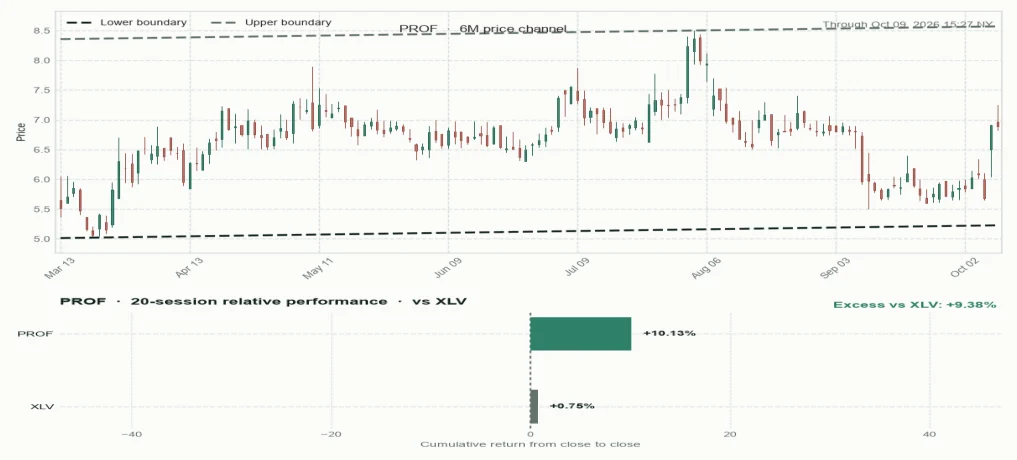
Panel thesis: Profound Medical remains a useful research case because a company-filed preliminary Q3 revenue range can be checked against final results. Its strong recent healthcare-relative performance supports the question, but does not establish a durable 15-session path. The active model has eight comparable cases and shows a 42.0% S15 positive-return estimate alongside a -15.02% median adverse excursion and a -33.24% P10 adverse excursion. Medtronic’s bounded horizon estimates are more favorable, though its exchange-ratio economics remain unresolved. The comparison does not support presenting Profound as Try of the Day.
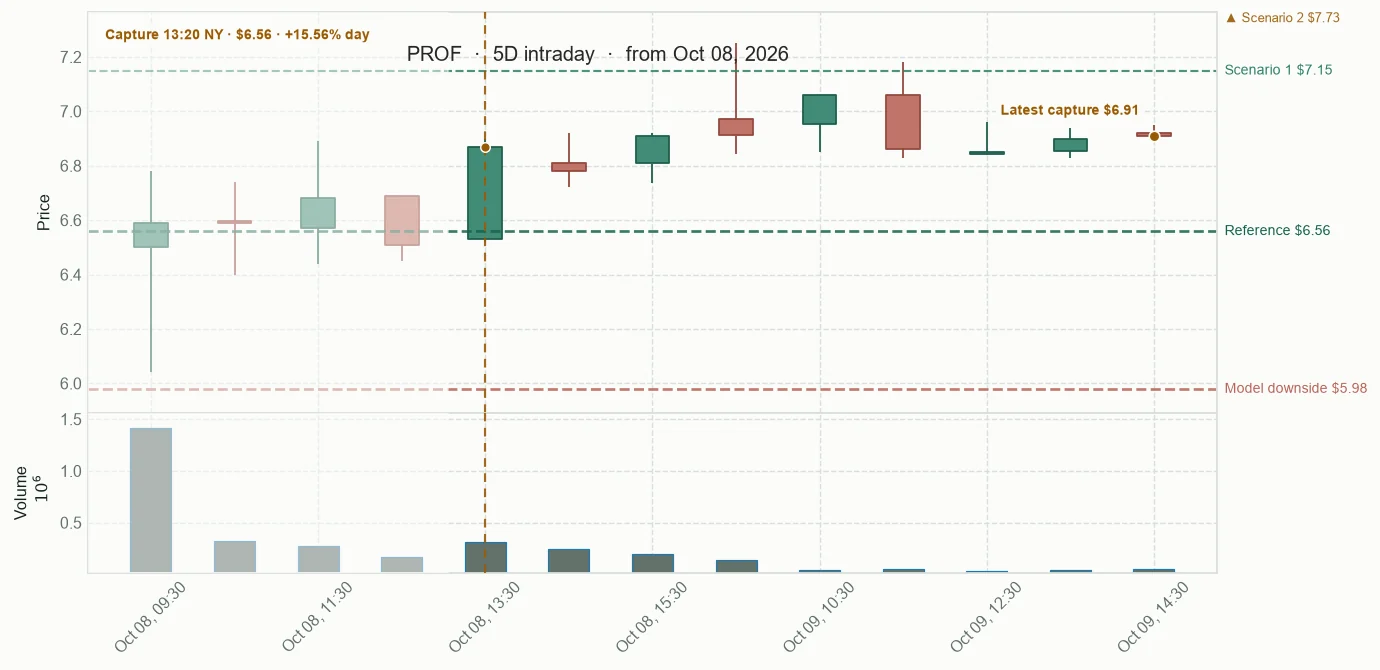
+15.56% · 17.23x volume · 6.01 > 6.06 > 6.35

Company context
Profound Medical develops MRI-guided, incision-free therapies. Its TULSA-PRO system treats prostate tissue; its Sonalleve platform provides focused-ultrasound treatments for several other indications.
Committee read
This is the committee's read of the evidence, not a probability or score. Editorial confidence in retaining Profound Medical as a Raw Try is moderate: the primary revenue update provides a concrete research check, while the active downside evidence and MDT countercase prevent confidence in Try of the Day. These percentages describe the committee’s decision confidence, not market probabilities.
Observed price path
Price channel and relative performance
Forecast fan chart
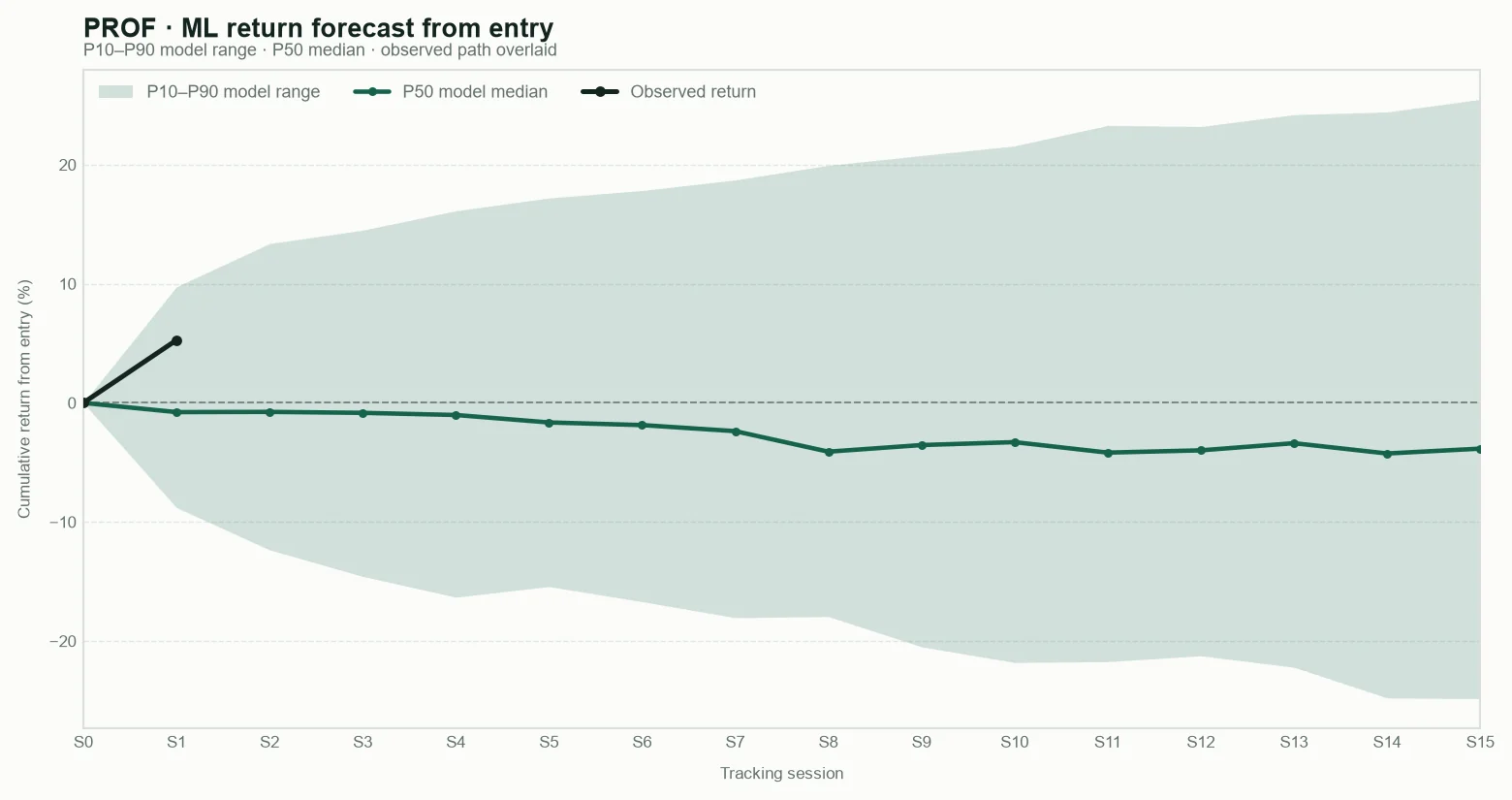
P10 — Cautious outcome: a weak result; most model estimates are above this level.
P50 — Central outcome: the middle estimate; roughly half of the model estimates are above and half below.
P90 — Favourable outcome: a strong result; only the most favourable model estimates are above this level.
These are model reference levels, not guarantees.
Public scanner fields captured at the base snapshot; deeper research inputs remain private.
Snapshot
What was captured at the base
Structure
How price is behaving
Risk and context
What may change the read
Base framework for context and outcome tracking. These are not trading instructions.
Tracking results
Observed daily-bar ranges are retrospective measurements, not targets, stops, or trading instructions.
Tryding Review
Five AI analytical agents reading the same evidence; disagreement stays visible.
“The broad tape is leaning cautious: the S&P 500, Nasdaq 100, and Russell 2000 were lower at the sealed snapshot. VIX, the market's volatility gauge, rose 1.92% to 15.37; the 10-year yield eased 1.20 basis points to 5.265%. That is pressure across benchmarks, not an explanation for any one company.”
Agreed. The evidence does not justify saying Profound’s stronger relative record outweighs its unresolved profitability, persistence, and downside risks. Its filed update still gives us a useful next check, so the candidate stays selected as Raw Try.
“The separate breadth proxy leaned negative within its covered sample, but there is no end-of-day breadth reading. We can describe that sample; we cannot call it a full-market closing count.”
I also support Raw Try. The model comparisons are bounded context, not certainty, but they expose a countercase the initial decision did not resolve. Four of us support the correction; Marcus dissents and would retain Try of the Day.
Broader Market Context
Equities were under pressure as oil and bond-market swings kept inflation risk in view. Labor signals split between low layoffs and weak hiring, while the Fed’s tone remained cautious. A later market snapshot showed yields easing after earlier volatility; small-business AI survey findings describe expectations, not realized growth.
The day’s crosscurrents resisted a one-word label. The supplied 16:54 UTC snapshot showed the major U.S. benchmarks lower, VIX higher and the dollar nearly unchanged; the 10-year yield was down 1.20 basis points at that capture. Earlier, the [Associated Press reported stocks pulling back from their record as Brent rose above $104 amid Iran-related supply uncertainty](https://apnews.com/article/6a096d714c874db13632794a32cebaa6). The [Reuters bond report](https://www.investing.com/news/economy-news/us-bonds-fall-lifting-yields-for-2nd-day-as-oil-weighs-30year-auction-looms-4939491) captured a late-morning rise in yields and investors watching a 30-year Treasury sale. By the later AP report and the supplied snapshot, the 10-year yield had eased from its early-session high. Those time stamps matter: a bond yield is the market’s borrowing rate, and its direction can change within the session. The labor picture was just as mixed. [Reuters reported initial jobless claims fell by 2,000 to 197,000](https://www.investing.com/news/economic-indicators/us-weekly-jobless-claims-fall-as-layoffs-remain-low-4939045), a measure commonly used as a proxy for layoffs. Yet September payroll growth was only 29,000, and the [Associated Press noted longer unemployment spells](https://apnews.com/article/7d52b48a5f41e60630d96c7a1711774c). Low layoffs and slow hiring can coexist; neither measure alone describes the whole labor market. Against that backdrop, the [Fed meeting minutes reported that most officials thought another rate increase might be needed this year to address persistent inflation](https://apnews.com/article/b7ed20e31e1a6fa5da6d78e5fe35b0c3). That is policy risk, not a scheduled outcome. Energy supplied an immediate link between geopolitics and inflation concerns, while the sealed context also carried a Reuters Business report on France’s planned approach to new debt issues and a report of continued central-bank gold purchases. These are separate signals about funding and reserve choices; they do not prove what drove any single market move. The [New York Fed’s small-business survey](https://libertystreeteconomics.newyorkfed.org/2026/10/ai-adoption-and-employment-expectations-evidence-from-a-survey-of-small-business-owners/) adds a different tension: firms already using AI were more likely to expect higher employment and revenue over the next year. Those are survey expectations, not realized results or proof that AI caused stronger growth. The supplied intraday breadth proxy leaned negative across its defined 300-name universe, but it was not an end-of-day, full-market breadth measure. It supports a limited reading of broad pressure, not a claim that every sector or stock moved together. Profound Medical’s technology and preliminary sales update can be discussed within that environment, but neither the small-business AI survey nor the day’s market tape establishes company-specific demand. The wider picture remains mixed: energy-driven inflation concerns and rate volatility alongside subdued hiring, low reported layoffs and uncertain follow-through.
Sources consulted: Reuters Business · Kobeissi Letter
Coffee conversation
“That was a split-screen day. The supplied snapshot had the main indexes lower and volatility higher; the AP report had oil climbing while stocks backed away from records. The tape had pressure, but not one tidy story.”
“Labor gives us the same kind of split. Initial claims—new applications for unemployment benefits, a rough proxy for layoffs—fell to 197,000. September payrolls added only 29,000 jobs. Fewer people being laid off does not mean employers are hiring briskly.”
“So those numbers can both be true? One counts people newly losing work; the other measures the net change in jobs?”
“Exactly. Low layoffs, sluggish hiring. And the AP report says people who are out of work are taking longer to find another job. The calm claims figure does not erase that strain.”
“Oil is the bridge to the policy argument. The AP tied Brent’s jump above $104 to uncertainty around Iran and shipping. That can put inflation back in the room even when the day’s equity move looks modest.”
“And the Fed minutes say most officials thought another hike might be needed this year. “Might” matters. The minutes describe their concern; they do not promise the next move.”
“The bond story moved too. A Treasury yield is the rate investors demand to lend to the government; higher yields can raise borrowing costs and weigh on asset values. Reuters caught the 10-year yield higher late morning as the oil shock fed inflation concerns.”
“But the shared snapshot later says the 10-year was lower on the day. Is that a conflict, or are we mixing captures?”
“Different times. Reuters reported 5.305% late morning, up 2.8 basis points then. AP later said the yield had eased to 5.26%, and the supplied 16:54 UTC snapshot recorded 5.265%, down 1.20 basis points on the day. A level is where it stood; the change is how far it moved from its comparison point.”
“Investors were also waiting for a 30-year Treasury auction, a sale of long-dated government debt that gives a fresh read on demand. The Reuters report treated it as a test of appetite, not a verdict on public finances. France’s debt minister was also talking about being strategic on new issuance.”
“And central banks added 39 tonnes of gold in August, according to the supplied context. That was a fifth consecutive month of net buying. A reserve trend can be interesting without explaining today’s gold quote.”
“The New York Fed survey adds a useful counterpoint to the layoff story: small businesses already using AI were more likely to expect both employment and revenue growth over the next year. Expectations are not outcomes, and the survey does not show AI caused them.”
“Right, and that survey is about small businesses generally. It cannot tell us whether a particular medical-device company is selling more systems. Good wider context; wrong shortcut to issuer demand.”
“For Profound, the company filing says commercialization depends in part on compatible MRI scanners and adequate payer reimbursement—whether insurers or public programs cover the treatment. Those are adoption conditions; the rate moves do not tell us whether they improved.”
“That’s the limit I want to leave visible: oil and bond yields raised the policy question, but the labor data were not uniformly weak and the later yield reading eased. The session carried competing pressures, not a clean macro verdict.”
Timeline
PROF's tracked gain remains +5.27% after a 0.29% rise today, but price sat 0.29% below VWAP in the lower quarter of the range despite volume at 2.1 times average. It still leads Healthcare by 12.74 points over twenty sessions; the preliminary Q3 revenue range has no final result in this packet, and the current model's near-flat median sits inside a broad -12.7% to +18.4% range, leaving follow-through and downside open.
Panel thesis: If final Q3 revenue confirms the preliminary $9.8–10.0 million range and subsequent observations preserve relative strength, the update may support further research into Profound Medical’s operating path. The preliminary revenue result does not establish durable profitability or future price performance. Invalidation boundary: Final Q3 revenue materially below the preliminary $9.8 million floor, or continued loss of healthcare-relative strength without evidence of improved cash generation, would materially weaken the thesis.
Panel comparison
Selected candidate versus the alternatives retained from the panel comparison.
Latest display-only snapshot · Oct 9, 2026 · 15:42 NASDAQCM
Since base -3.01% · Today +9.52% · Since prior 0.00% · Relative volume 2.0 · RSI 47.6 · EMA 14.27 > 14.6 > 15.1 · VWAP below · 52-week high 60.97% · As of Oct 8, 2026 · 17:12 NASDAQCM
Since base -0.80% · Today +0.65% · Since prior 0.00% · Relative volume 1.45 · RSI 56.21 · EMA 4.26 > 4.25 > 4.26 · VWAP above · 52-week high 70.17% · As of Oct 8, 2026 · 17:14 NASDAQCM
Since base -1.04% · Today -1.41% · Since prior 0.00% · Relative volume 3.7 · RSI 32.37 · EMA 19.85 > 20.35 > 20.02 · VWAP above · 52-week high 80.74% · As of Oct 8, 2026 · 16:46 NASDAQCM
Since base +0.20% · Today +0.17% · Since prior 0.00% · Relative volume 1.4 · RSI 56.68 · EMA 38.66 > 36.76 > 33.7 · VWAP above · 52-week high 96.52% · As of Oct 8, 2026 · 16:40 NASDAQCM
Since base -2.33% · Today +0.87% · Since prior +0.20% · Relative volume 1.68 · RSI 68.49 · EMA 2.1 > 2.04 > 2.02 · VWAP above · 52-week high 39.02% · As of Oct 8, 2026 · 17:13 NASDAQCM
Since base -0.63% · Today -0.02% · Since prior 0.00% · Relative volume 4.25 · RSI 40.43 · EMA 87.5 > 88.5 > 88.43 · VWAP above · 52-week high 83.12% · As of Oct 8, 2026 · 16:49 NASDAQCM
Since base +1.71% · Today +0.98% · Since prior 0.00% · Relative volume 1.34 · RSI 52.72 · EMA 18.85 > 18.53 > 17.75 · VWAP above · 52-week high 96.43% · As of Oct 8, 2026 · 16:34 NASDAQCM
Since base +5.58% · Today +0.29% · Since prior +1.46% · Relative volume 2.1 · RSI 63.61 · EMA 6.25 > 6.17 > 6.39 · VWAP below -0.26% · 52-week high 77.40% · As of Oct 9, 2026 · 15:21 NASDAQCM
Since base -0.77% · Today +3.38% · Since prior +0.63% · Relative volume 1.41 · RSI 61.09 · EMA 3.28 > 2.83 > 2.23 · VWAP below · 52-week high 43.07% · As of Oct 8, 2026 · 15:50 NASDAQCM
Since base +0.24% · Today -0.24% · Since prior 0.00% · Relative volume 0.95 · RSI 36.02 · EMA 8.22 > 9.05 > 10.38 · VWAP above · 52-week high 49.02% · As of Oct 8, 2026 · 16:49 NASDAQCM
Company dossier
History, curiosities & sources

Selected facts and links behind the public profile.
Company description
Profound Medical Corp. is a Canadian commercial-stage medical-device company developing MRI-guided, incision-free therapies for tissue ablation. Its TULSA-PRO system combines real-time MRI, robotic transurethral ultrasound and closed-loop temperature feedback to ablate prostate tissue. Its Sonalleve platform uses MRI-guided focused ultrasound for indications including uterine fibroids, pain palliation for bone metastases, osteoid osteoma and desmoid tumors.
History
- Profound Medical Inc. was incorporated in Ontario on June 13, 2008. In June 2015, it amalgamated with Mira Subco, with Profound Medical Corp. as the surviving public holding company.
- After completing a 30-patient TULSA safety and precision study in March 2014, the company received European CE certification for TULSA-PRO in April 2016 and began a pilot commercial launch in key European markets in Q4 2016.
- The FDA cleared TULSA-PRO in August 2019. Profound began its U.S. launch in Q4 2019, and the first U.S. patient was treated in a clinical service setting in January 2020.
Curiosities
- TULSA-PRO is designed to work with selected MRI scanners from Philips, Siemens and GE HealthCare; the 2025 annual report describes Sonalleve compatibility with Philips MRI scanners.
- Profound’s 2025 annual report describes three Category 1 CPT codes for the TULSA procedure, effective January 1, 2025, covering different physician configurations.
- The TULSA-PRO system uses a customer’s existing MRI scanner alongside durable equipment and single-use devices.