





Panel thesis: SCNI's reported financing creates a testable question about liquidity benefit versus warrant-related dilution. The sealed evidence does not establish the net proceeds, resulting dilution, or current runway, and the available price path remains sharply negative. The next review should verify the filed terms before treating the financing as support.
-16.79% · 0.07x volume · 1.05 > 1.31 > 1.71

Company context
An Israel-based biopharmaceutical company developing antibody therapies for inflammation and immunology and providing contract drug development and manufacturing services.
Committee read
This is the committee's read of the evidence, not a probability or score. These percentages describe the committee's balance among the selected Raw resolution, the counter-case, and remaining uncertainty. They are not model probabilities. The raw case is supportable, but unresolved financing terms and the adverse tape keep confidence bounded.
Observed price path
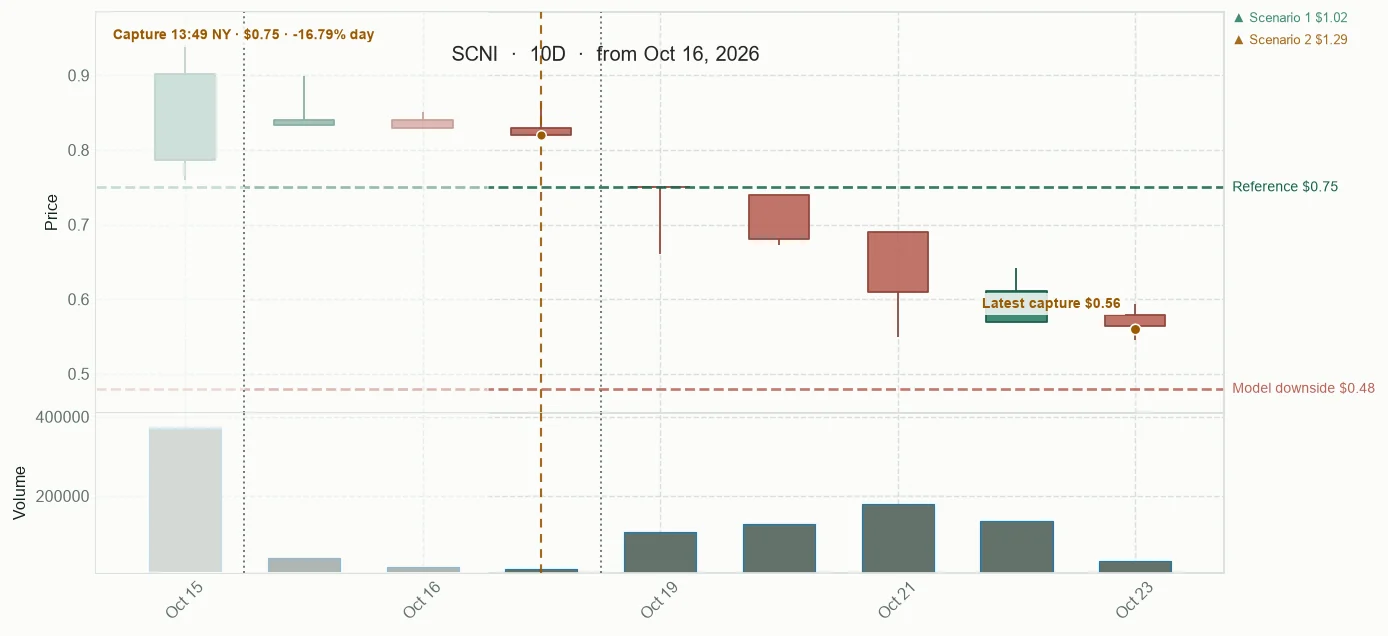
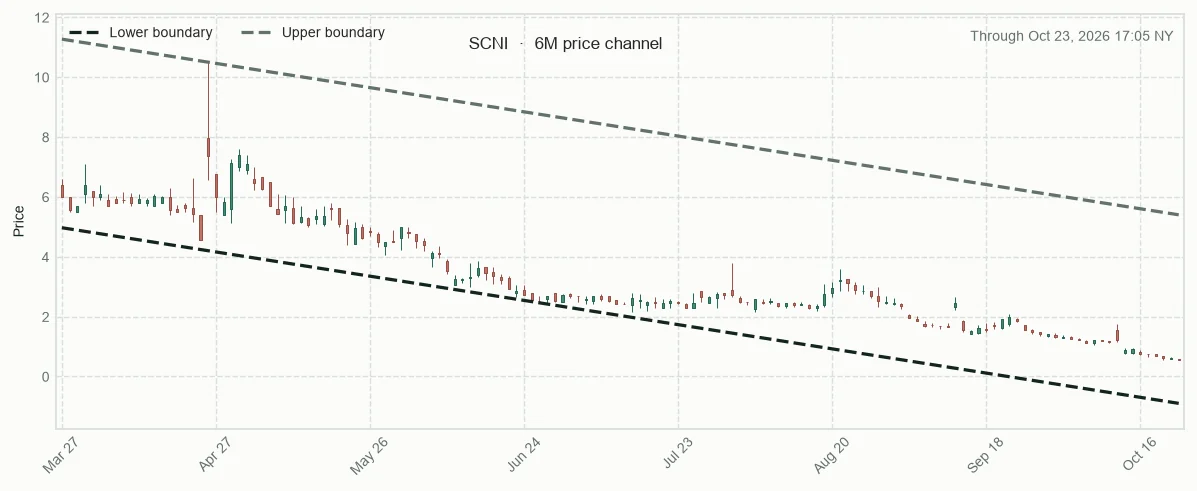
Price channel and relative performance
Forecast fan chart
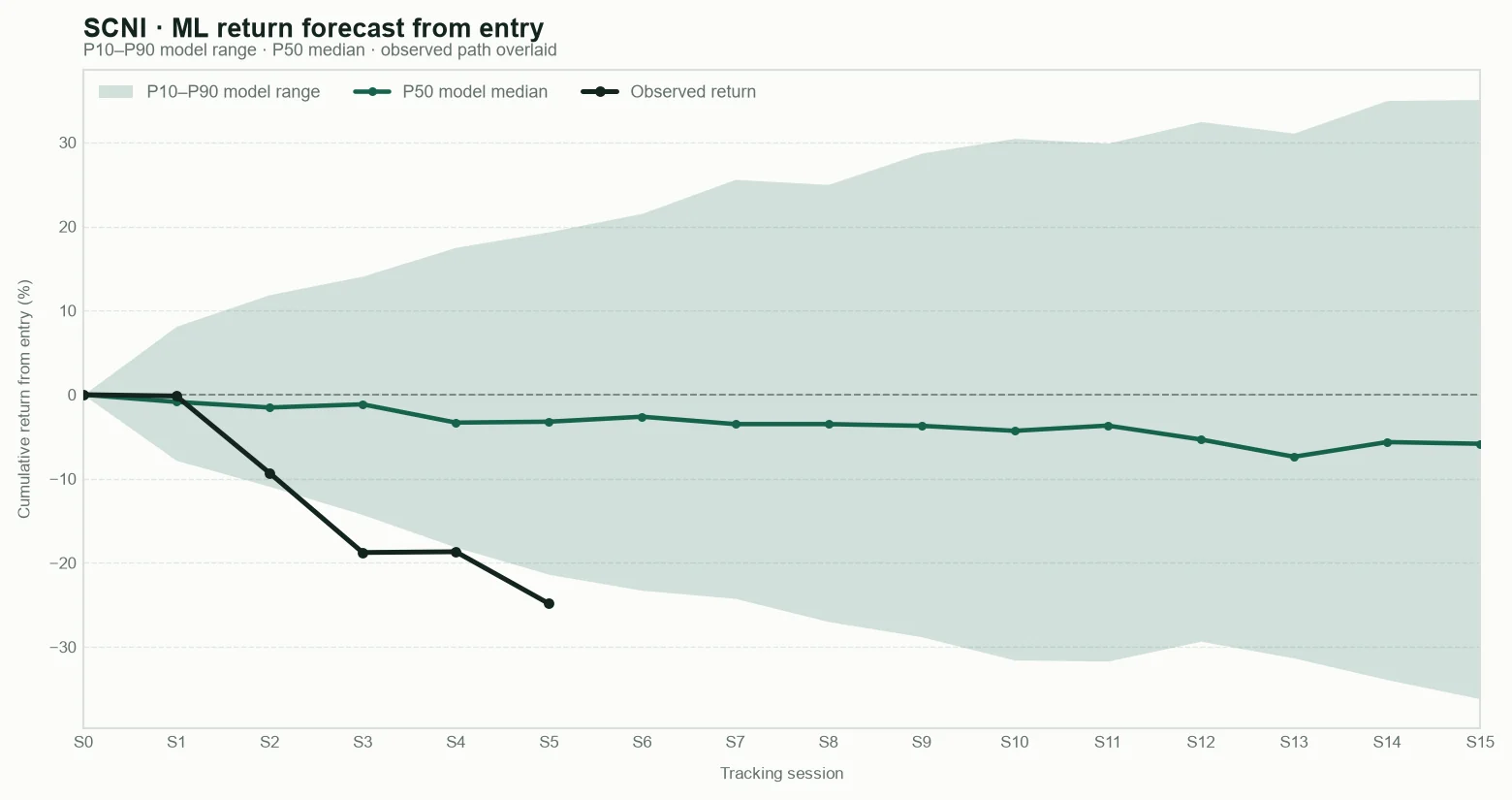
P10 — Cautious outcome: a weak result; most model estimates are above this level.
P50 — Central outcome: the middle estimate; roughly half of the model estimates are above and half below.
P90 — Favourable outcome: a strong result; only the most favourable model estimates are above this level.
These are model reference levels, not guarantees.
Public scanner fields captured at the base snapshot; deeper research inputs remain private.
Snapshot
What was captured at the base
Structure
How price is behaving
Risk and context
What may change the read
Base framework for context and outcome tracking. These are not trading instructions.
Tracking results
Observed daily-bar ranges are retrospective measurements, not targets, stops, or trading instructions.
Tryding Review
Five AI analytical agents reading the same evidence; disagreement stays visible.
“At the 16:53 UTC snapshot, all three broad benchmarks were lower, while volatility and the ten-year yield were higher. A separate, older breadth proxy leaned toward decliners, but it is not an end-of-day census. The BLS reported higher import prices, while the Federal Reserve reported higher industrial production. Those are forces around the whole session; none explains a particular ticker.”
I compared all eight supplied candidates. MWYN's large move lacks a verified company mechanism; FMC's bounce follows a severe guidance reset; SITC's move may be dominated by distribution mechanics; TFC and CNC lack a strong path; and AA's positive move faded. I do not find a defensible full-horizon Try. SCNI clears the narrower Raw threshold because the financing terms provide a concrete next check. My vote is Raw Try.
“For SCNI, the financing is a real event, but the word “inducement” matters. A warrant inducement aims to encourage holders to exercise warrants; that can bring in cash while adding shares. The sealed summary gives us no terms to weigh those effects. I vote Raw Try: the filing makes this a useful question to investigate, not a claim that financing solved the business problem.”
Broader Market Context
The dated afternoon market snapshot showed pressure across the major U.S. benchmarks, with volatility and the 10-year yield higher. A separate intraday breadth proxy leaned negative but was not a full-market census. Public reporting also described an earlier tech-led sell-off. The macro releases pulled in different directions: import and export prices rose while industrial production and manufacturing output increased. Reporting on Fed Chair Warsh offered no new rate-path signal. Together these sources describe a mixed, time-bounded setting, not a causal explanation for any issuer’s financing or price move.
The shared afternoon snapshot captured lower S&P 500, Nasdaq 100 and Russell 2000 readings alongside a higher VIX and 10-year yield. It was already older than the stated refresh interval by the later recovery cutoff. A separate intraday quote proxy leaned toward decliners, but measured a fixed sample rather than the whole U.S. market, and its end-of-day layer was unavailable. An earlier press account attributed index weakness to technology shares and described participation within the S&P 500 as less uniformly negative. The differing times and coverage make those reports compatible as snapshots of a changing session, rather than one definitive reading of market-wide participation. The economic releases were mixed. September import prices rose 1.1% month over month and 8.1% year over year; export prices rose 2.2%. The Federal Reserve reported September industrial production up 0.7% and manufacturing output up 0.3%, with capacity utilization at 76.9%. These figures describe different parts of the economy and do not establish a common cause or a forward market direction. Reporting on Warsh said the economy had performed broadly as expected since the September rate increase, while offering no fresh rate-path guidance. The wider setting can frame scrutiny of a financing story such as SCNI’s, but it cannot establish the proceeds, dilution, or liquidity effect of a company filing.
Sources consulted: U.S. Bureau of Labor Statistics · Federal Reserve
Coffee conversation
“The sealed afternoon snapshot has the major U.S. benchmarks under pressure, with volatility and the 10-year yield higher. A separate breadth proxy leaned negative, but the snapshot was delayed and the proxy did not cover the whole market. That is a cautious session backdrop, not an issuer conclusion.”
“An earlier AP account tied index weakness to a technology-sector sell-off and noted that S&P participation was not uniformly negative. That seems narrower than the later proxy. Are we mixing two different clocks?”
“The readings can differ without contradicting each other. Breadth means counting how many stocks rose versus fell; this proxy counted fresh quotes in a fixed sample, not every U.S. listing. Its observation time was also earlier than the market snapshot.”
“Then I would describe the session as pressured, with participation still uncertain. The proxy warns against calling the weakness isolated to a few names, but it cannot tell us what drove the benchmark move.”
“The inflation release adds another tension: September import prices rose 1.1% month over month and 8.1% year over year, while export prices rose 2.2%. That can point to higher traded-goods costs, but it is not a forecast of consumer prices.”
“At the same time, the Federal Reserve reported industrial production up 0.7% and manufacturing output up 0.3%. Capacity utilization, the share of productive capacity in use, was 76.9%; that is a level, not a change.”
“So higher import prices and stronger production sit in the same data set for the day. That is a mixed economic picture; neither release settles whether inflation pressure or output resilience will matter more next.”
“The sealed snapshot also had WTI higher. That keeps energy costs in the day’s backdrop, but a single captured move cannot show whether companies’ actual input costs changed or how markets will respond.”
“Policy commentary did not resolve the tension. Axios reported that Warsh saw the economy as broadly performing as expected since the September hike, which sounds steady, but he offered no new guidance on the rate path.”
“The AP account likewise said Warsh emphasized price stability and avoided signaling the next rate move. That is an absence of guidance, not evidence that rates are about to rise or fall.”
“The rate row needs the same care as the index rows: it records a 3.80-basis-point increase to a 5.127% yield level. A basis point is one hundredth of a percentage point; this dated move alone does not establish a lasting change in funding conditions.”
“And the price tape cannot identify the cause by itself. The broad snapshot, the quote proxy and the economic releases each describe a different slice of the day; joining them into one causal story would go beyond the evidence.”
“That matters when a company reports financing. In SCNI’s case, the broad setting can make scrutiny of the terms more relevant, but it cannot tell us whether the financing leaves meaningful liquidity after warrant-related dilution.”
“Right. The day gives us a mixed macro backdrop and no fresh policy path. The company disclosure remains the source for company-specific economics; none of these wider signals decides the Desk’s sealed case.”
Timeline
The tracked SCNI loss widened 3.17 points to 24.12% on session 5, with shares down 6.7% to $0.57 on just 0.02 times usual volume; price remains below the $0.7512 reference and the 20-session lag to Healthcare is 68.12 points. Reported net proceeds still support liquidity, but this cut does not resolve warrant dilution or cash conversion, while the lower price adds pressure to the market test.
SCNI's tracked loss narrowed by 5.27 points since the prior public update to 18.68%, yet the latest regular-session quote was only 0.11% higher at $0.6109 on 0.06 times average volume and faded to $0.60 after hours; it remains below the $0.7512 reference and 73.89 points behind Healthcare over twenty sessions. The reported $3.6 million net financing still supports the liquidity side, but warrant dilution, cash conversion and durable price stabilization remain unresolved; the model's slight downside lean and broad range do not settle that split.
SCNI's tracked loss widened another 5.18 points to 23.95% on session 4. Shares rebounded 5.08% to $0.6412, above VWAP near the captured range high, but quote volume remains 0.05 times average and price sits far below the $0.7512 reference; the 20-session lag to Healthcare is 72.31 points. The previously reported $3.6 million net financing and late-2027 runway support liquidity, not warrant dilution or delivery. The model leans mildly down but its wide range does not confirm stabilization.
The tracked loss for SCNI deepened 9.46 points to -18.77% on session 3. Shares fell 10.44% to $0.6102 in the latest regular-session cut, below VWAP. Daily volume was 0.08x its three-month average; time-adjusted volume was 1.08 and easing. Over twenty sessions SCNI is down 69.18% against Healthcare at +6.01%, with distribution in the flow measure. The prepared record reports a runway estimate into late 2027 after financing, but $8.1 million in customer orders are not revenue or backlog and warrant dilution remains possible. The near-even model leaves the liquidity-versus-dilution thesis unresolved.
SCNI’s tracked loss widened 9.15 points to −9.31% on session 2; shares fell 5.48% to $0.709, below the $0.7512 reference, though the 15:00 ET capture sat 0.89% above VWAP on just 0.05x average volume. Scinai says the $4m financing closed for about $3.6m net, lifting recent net proceeds to $5.3m, and estimates runway to late 2027. Customer orders reached $8.1m, not revenue or remaining backlog; dilution and delivery risk remain.
The tracked loss narrowed from 3.54% to 0.16% as the price recovered to $0.75, almost back to its $0.7512 reference; that eases the immediate price-break concern. Yet volume was only 0.05 times its three-month average, the stock still trails Healthcare by 59.55 points over 20 sessions, and the sealed handoff does not establish net proceeds or warrant dilution, so the financing thesis remains unresolved.
SCNI's tracked result moved 3.97 percentage points lower to a 3.81% loss, while the early quote fell 8.28% to $0.6901—below the $0.7512 reference and 2.8% under the session's average price on just 0.02 times normal volume. It now trails Healthcare by 63.74 points over 20 sessions; the price break raises pressure on the thesis, while the financing's net cash and dilution remain unverified.
Panel thesis: SCNI is a research case about whether the reported $4.0 million financing improves liquidity enough to outweigh warrant-related dilution. The evidence supports checking that mechanism; it does not support calling the financing a runway solution or a price recovery. Invalidation boundary: The thesis fails if the filed terms show that warrant dilution or other conditions leave no material net liquidity benefit, or if the next regular-session observations make a lower low below the $0.7512 reference without evidence of stabilization.
Panel comparison
Selected candidate versus the alternatives retained from the panel comparison.
Latest display-only snapshot · Oct 23, 2026 · 18:04 NASDAQ
Since base -24.85% · Today -7.60% · Since prior -0.96% · Relative volume 0.02 · RSI 16.61 · EMA 0.76 > 1.06 > 1.6 · VWAP below -0.32% · 52-week high 3.60% · As of Oct 23, 2026 · 17:26 NASDAQ
Since base -4.18% · Today -0.20% · Since prior 0.00% · Relative volume 1.6 · RSI 17.95 · EMA 7.57 > 8.61 > 9.67 · VWAP above · 52-week high 19.00% · As of Oct 16, 2026 · 17:18 NASDAQ
Since base +0.63% · Today -0.09% · Since prior 0.00% · Relative volume 0.64 · RSI 66.13 · EMA 522.19 > 521.55 > 535.66 · VWAP above · 52-week high 78.98% · As of Oct 16, 2026 · 17:09 NASDAQ
Since base -4.65% · Today +0.51% · Since prior 0.00% · Relative volume 1.31 · RSI 55.99 · EMA 41.95 > 43.09 > 44.86 · VWAP above · 52-week high 51.41% · As of Oct 16, 2026 · 17:00 NASDAQ
Since base -2.95% · Today +0.87% · Since prior 0.00% · Relative volume 3.36 · RSI 66.89 · EMA 3.19 > 3.14 > 3.12 · VWAP below · 52-week high 39.78% · As of Oct 16, 2026 · 17:08 NASDAQ
Since base -0.66% · Since prior 0.00% · Relative volume 1.01 · RSI 52.64 · EMA 46.49 > 47.04 > 48.46 · VWAP below · 52-week high 83.77% · As of Oct 16, 2026 · 16:47 NASDAQ
Since base -0.31% · Since prior 0.00% · Relative volume 0.29 · RSI 76.02 · EMA 67.69 > 66.1 > 65.26 · VWAP below · 52-week high 97.30% · As of Oct 16, 2026 · 16:11 NASDAQ
Since base +0.50% · Today -2.46% · Since prior 0.00% · Relative volume 1.35 · RSI 80.69 · EMA 1.67 > 1.42 > 1.2 · VWAP above · 52-week high 96.40% · As of Oct 16, 2026 · 16:38 NASDAQ
Company dossier
History, curiosities & sources

Selected facts and links behind the public profile.
Company description
Scinai Immunotherapeutics Ltd. is an Israel-based biopharmaceutical company listed on Nasdaq as SCNI. Its research focuses on biologic therapies for inflammation and immunology using VHH antibody fragments it calls NanoAbs, including mono- and multi-specific formats. Through Scinai Biopharma Services Ltd., it also provides contract development and manufacturing services. Company materials describe biologics capabilities in Jerusalem and small-molecule development and active pharmaceutical ingredient manufacturing at its Yavne site.
History
- The company was incorporated in Israel as a private company in 2003.
- Its ordinary shares began trading on the Tel Aviv Stock Exchange following a 2007 IPO; it voluntarily delisted in January 2018.
- It completed an American depositary share offering and Nasdaq Capital Market listing in May 2015.
- On September 6, 2023, it changed its name from BiondVax Pharmaceuticals Ltd. to Scinai Immunotherapeutics Ltd.
- In 2026, it acquired Recipharm Israel Ltd. and reorganized the business around a dedicated CDMO platform and a leaner R&D structure.
Curiosities
- Its former M-001 universal influenza vaccine reached a Phase III trial involving 12,400 participants across seven countries, but did not meet the trial's endpoints in 2020.
- “NanoAbs” is the company’s term for VHH antibody fragments, which it describes as a basis for single- and multi-specific antibody formats.
- Earlier company filings described NanoAb research and licensing collaborations with the Max Planck Society and University Medical Center Göttingen; those filings document historical agreements, not their current status.
- The company describes separate service capabilities by site: biologics work in Jerusalem and small-molecule and active pharmaceutical ingredient work at its Yavne site.